Complete Production Process of FRP Water Tanks: 12 Core Steps from Raw Materials to Finished Products
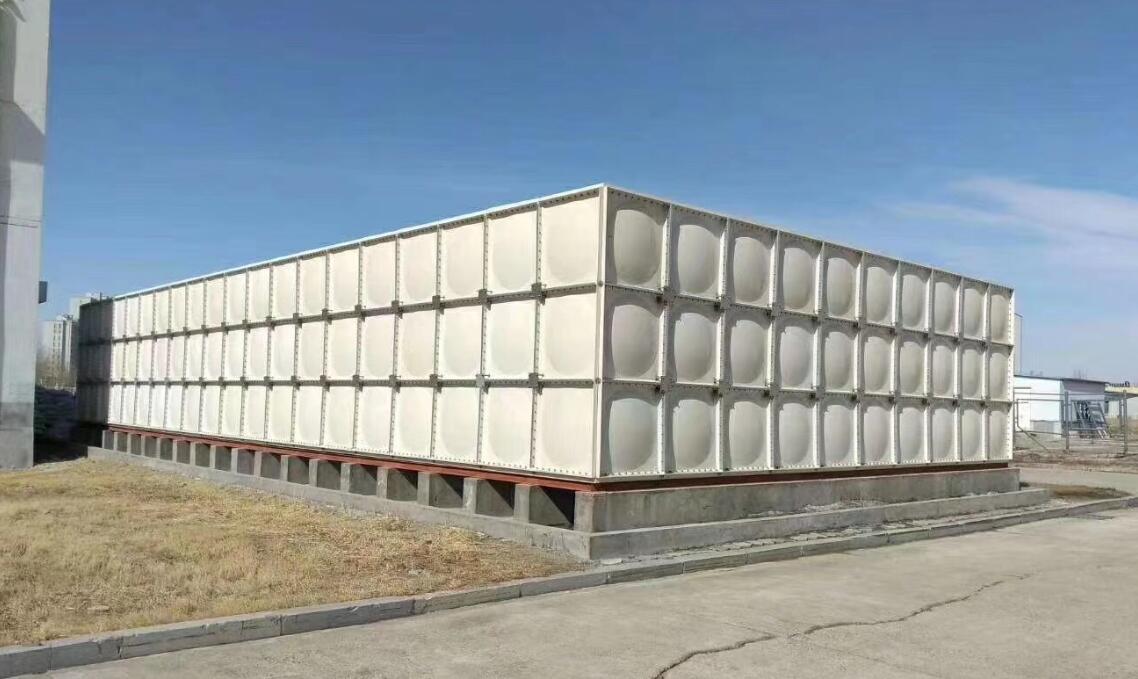
1. Raw Material Selection and Ratio Control
The performance of FRP water tanks is 70% determined by raw material quality and precision of ratios. Beijing Yuanhui FRP Co., Ltd. uses 196# unsaturated polyester resin as the matrix, reinforced with medium-alkali or E-glass chopped strand mat (450g/m²) and surface mat (30g/m²). The resin-to-catalyst (MEKP) ratio is strictly maintained at 100:1.5–2.0, with cobalt naphthenate accelerator at 0.5%–1.0% of resin weight. When ambient temperature drops below 15°C, accelerator ratio is raised to 1.2%.
Production data shows that when resin viscosity is controlled at 0.35–0.45 Pa·s at 25°C, fiber wet-out is optimal, achieving Barcol hardness of 35–40. Deviation beyond ±0.3% in ratio can cause incomplete curing or exothermic cracking—a finding verified by our 2023 batch quality traceability system.
2. Mold Preparation and Hand Lay-Up Process
Mold surface quality directly determines tank exterior finish and demolding success. We use steel or FRP master molds, polished with 400#–600# sandpaper, then coated with three layers of PVA or 8# wax mold release, each layer spaced 15 minutes apart. Standard: surface roughness Ra≤0.8μm, no shrinkage in water film test.
The hand lay-up process follows three steps: first, gel coat (0.3–0.5mm thick) with 2%–3% pigment paste (typically RAL5015 blue), left until tack-free; second, surface mat applied and rolled flat to remove air; third, alternating layers of chopped strand mat and woven roving, each saturated with resin and rolled with a bristle roller at least 120 times per square meter. For a standard 1m³ tank panel, total layers are 6 (2 mats + 4 woven roving), with thickness controlled at 4.5–5.0mm (±0.2mm tolerance).
Common pitfall: reducing rolling passes to save time reduces interlaminar peel strength by over 30%. Our internal standard mandates ≥120 rolls/m², ensuring bubble content below 0.5%.
3. Curing, Demolding, and Post-Processing
Curing can be ambient or heated. Ambient curing requires 20–30°C and RH below 75%, for 8–12 hours. For winter production in Beijing, we use infrared heating to raise the temperature to 35–40°C, shortening the cycle to 4–6 hours and reducing residual stress by ~15%. Curing completion is verified by Barcol hardness ≥35 before demolding.
Demolding uses a wedge-shaped brass chisel along the mold edge—no hammering. Panels are left 24 hours for natural aging, then trimmed with diamond blades to edge straightness ≤1mm/m. For sectional tanks, joint surfaces are beveled at 45° (width 8–10mm), later sealed with EPDM gaskets and stainless steel bolts torqued to 45N·m.
Since introducing automated cutting lines in 2024, trimming efficiency increased by 40%, and panel yield rose from 92% to 97.5%.
4. Quality Testing and Final Assembly
Three mandatory tests before shipment: 1) Hydrostatic test—panels sealed and pressurized to 1.5× working pressure (typically 0.15MPa for 0.1MPa tanks), hold 30 minutes without leakage; 2) Barcol hardness spot check—10% of each batch, minimum 35; 3) Resin content by ignition loss (600°C/2h in muffle furnace), target 55%–65%—below 55% compromises corrosion resistance, above 65% reduces strength.
Field assembly follows GB/T 17219-1998 drinking water standards, with food-grade resin lining. SMC molded tanks have thickness tolerance ±0.3mm, bolt torque uniformly 45N·m, and EPDM gaskets rated for 15+ years service life.
From material batching to finished product, a standard FRP water tank takes 5–7 days (including natural aging). Understanding these 12 core steps enables buyers to better evaluate supplier capabilities and avoid leakage or deformation risks caused by process defects.