Analysis of Seismic Performance and Design Standards for FRP Water Tanks
Introduction
Earthquakes pose serious threats to building water supply systems. FRP (Glass Fiber Reinforced Plastic) water tanks are widely used in high-rise buildings and lifeline engineering due to their lightweight, high strength, and corrosion resistance. However, their seismic reliability is not automatic—improper anchoring and rigid piping connections can lead to failure, as seen in the 2010 Yushu earthquake. This article, based on the expertise of Beijing Yuanhui FRP Co., Ltd., examines the seismic performance of FRP tanks through material mechanics, structural design, and code compliance.
1. Material Properties as Seismic Foundation
1.1 Strength-to-Weight Ratio
FRP has a density of 1.8–2.0 g/cm³ (1/4 to 1/5 of steel) and tensile strength of 200–400 MPa. Lower self-weight reduces inertial forces during seismic events. For a 10 m³ tank, a steel tank weighs ~800 kg, while an FRP tank weighs only ~250 kg, resulting in a 3× reduction in seismic force.
1.2 Elastic Modulus and Fatigue Resistance
FRP's elastic modulus (10–30 GPa) is 1/10 to 1/20 of steel, allowing energy absorption through deformation under cyclic loading. Its fatigue strength retains 50%–70% of static strength, far better than concrete (~30%). Beijing Yuanhui's SMC molded panels maintained >85% residual strength after 1 million cycles at 1 Hz (National Building Materials Testing Center).
2. Seismic Design Code Requirements
2.1 Chinese Standards (GB 50011-2010)
Key requirements for FRP tanks:
- Anchor bolts: M16 minimum chemical or expansion bolts, embedment depth ≥2/3 of structural layer and ≥100 mm.
- Slip prevention: Rubber pads ≥10 mm thick, static friction coefficient ≥0.4.
- Stiffness control: Lateral displacement ≤1/250 of tank height to avoid pipe joint failure.
2.2 International Codes
ASCE 7-16 demands stricter seismic coefficient C_s calculation considering site class, tank height, and importance factor. Eurocode EN 1998-1 requires flexible connections with ≥50 mm displacement capacity. Beijing Yuanhui's Middle East projects are designed per ASCE 7-16, using SW6 software for bolt shear checks.
3. Structural Design and Installation Techniques
3.1 Tank Body Optimization
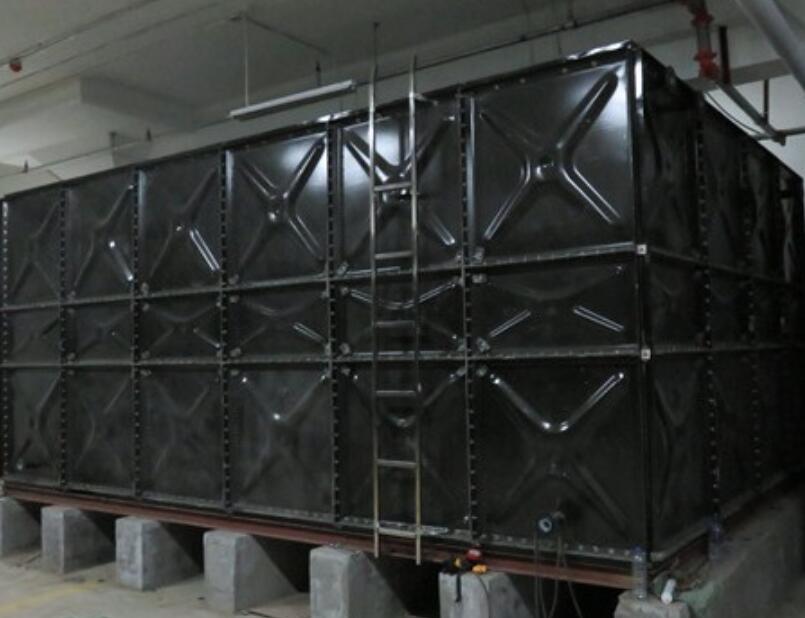
Weak points are panel joints and pipe connections. Recommended: double-sealed flanges (EPDM inner seal + 304 stainless steel clamp) improve seismic resistance by 30%. Add damping struts (3–5 units) on top to absorb horizontal energy and reduce rocking.
3.2 Foundation and Anchoring
Base elevation ≥200 mm above ground to prevent corrosion. Use diagonal symmetric anchor layout with ≥1.2× the number of supports. For zones of intensity 6 or above, install shear keys (height ≥50 mm). In a Tianjin super-tall building project (intensity 8), Beijing Yuanhui used H-beam base + chemical anchors + rubber pads; shake table tests at 0.4g acceleration showed only 12 mm top displacement with no damage.
3.3 Flexible Piping Connections
Inlet/outlet pipes must use expansion joints (bellows or rubber hoses) with compensation length ≥150 mm. Fixed supports between valves and tank prevent pipe whip transfer. After the 2013 Lushan earthquake, a hospital replaced rigid pipes with dual-sphere rubber joints; the system survived a 6.1-magnitude aftershock in 2022.
4. Case Study: Seismic Validation
Beijing Yuanhui supplied 40 modular FRP tanks (total 1,200 m³) for a large project in Dali, Yunnan (intensity 8). Design: tank height ≤3 m, aspect ratio ≤2.5, base frame of 10# channel steel welded and anchored with 16× M20 chemical bolts. Shake table test using El Centro wave (0.3g): max horizontal displacement 24 mm, peak stress 168 MPa (safety factor ≥1.8), zero leakage. After 3 years of operation with 4 perceptible earthquakes, the system remains fault-free.
Conclusion
The seismic performance of FRP water tanks relies on the synergy of material properties, structural design, and installation quality. Selecting code-compliant products and strictly controlling anchoring, damping, and flexible connections can significantly reduce earthquake risks. Beijing Yuanhui FRP Co., Ltd. continues to develop seismic-resistant tanks with full technical support from design to acceptance. Future integration of stiffness-optimized design and smart monitoring will further enhance reliability.