Complete FRP Water Tank Production Process: 12 Key Steps from Mold to Finished Product
Introduction: Why Process Precision Determines Tank Lifespan
FRP (Fiberglass Reinforced Plastic) water tanks are widely used in building water supply, fire protection, and industrial cooling due to their light weight, corrosion resistance, and leak-free performance. However, the same design can yield tanks with drastically different service lives—differences of 5 to 8 years—depending on the manufacturing process. Beijing Yuanhui FRP Co., Ltd., with 18 years of production experience, reports that tanks manufactured under a strict 12-step process have a post-installation repair rate below 0.3% over 15 years. This article walks through every phase of their production line, from mold preparation to final inspection.
1. Mold Preparation and Surface Treatment: The Foundation of Dimensional Accuracy
1.1 Mold Material and Structural Design
FRP water tank molds are typically made of steel or composite. Beijing Yuanhui uses 4–6 mm thick steel molds with chrome plating to achieve a surface roughness of Ra ≤ 0.4 μm. The parting line gap must be ≤ 0.05 mm; otherwise, flash thickness can exceed 3 mm, increasing post-processing grinding time. For irregular tank shapes (L-type, T-type), modular segmented molds are employed, with each segment weighing no more than 80 kg for manual handling.
1.2 Release Agent Application and Pre-baking
After cleaning, three layers of release agent are applied: a semi-permanent agent (e.g., XTEND 838) baked at 80°C for 30 min, a PVA film-forming agent dried for 20 min, and a carnauba wax layer hand-polished to a mirror finish. In-house records show that uneven release agent coating increases surface pinhole density by a factor of 2.3, directly compromising water hygiene.
2. Formulation and Mixing: Precise Resin Chemistry
2.1 Resin Selection and Accelerator Addition
For potable water tanks, only food-grade isophthalic unsaturated polyester resin (e.g., DSM P60-901) with styrene emission ≤ 35% is used. Beijing Yuanhui’s standard formula: resin-to-accelerator (cobalt naphthenate) ratio of 100:0.5–1.0, and resin-to-catalyst (MEKP) ratio of 100:1.2–2.0. Workshop temperature is maintained at 18–25°C with humidity below 65%—every 10% increase in humidity reduces gel time by approximately 15%.
2.2 Filler and Reinforcement Pre-mixing
To reduce shrinkage and improve flame resistance, 10–15% aluminum trihydrate (800 mesh) and 5% fumed silica are added. Reinforcement uses EMC450 chopped strand mat (450 g/m²) and 30 g/m² surface mat. Glass fiber must be pre-dried at 40°C for 2 hours to remove moisture from the sizing agent; otherwise, interfacial bond strength drops by 20%.
3. Molding Methods: Hand Lay-up vs. SMC Compression
3.1 Hand Lay-up—For Large and Customized Tanks
Process: Apply a 0.3–0.5 mm gel coat, then lay surface mat and roll with a bristle roller to remove air bubbles. Alternate layers of chopped strand mat and woven roving (0.4 mm/layer), saturating each with resin. Beijing Yuanhui’s SOP mandates scanning each layer with a bubble detector—bubbles >2 mm must be punctured and filled. For a 12 mm thick side panel, 8 layers are required, taking about 45 min/m².
Data: Hand lay-up achieves a fiber content of 30–35% by weight, Barcol hardness ≥ 35, and flexural strength ≥ 180 MPa.
3.2 SMC Compression Molding—For Standardized Tank Panels
Beijing Yuanhui operates a 3,000-ton hydraulic press with mold temperature at 145±3°C. SMC sheet (25% glass fiber, 30% resin, 40% filler, 5% additives) is cut 10% larger than the cavity. Pressing pressure: 12–15 MPa; dwell time: 60 seconds per mm of thickness. For an 8 mm base plate, dwell time is 480 seconds. SMC products achieve 40% fiber content, flexural strength ≥ 220 MPa, and superior surface finish.
Case: In 2023, a Beijing hospital fire tank project used SMC molded panels, reducing installation time by 40% compared to hand lay-up, and passing NSF 61 certification.
4. Curing, Demolding, and Post-processing
4.1 Cure Cycle and Warpage Control
Hand lay-up parts are cured at 40–60°C for 4 hours, then cooled naturally. SMC parts are demolded hot but require a post-cure at 70°C for 2 hours to relieve internal stress. Beijing Yuanhui’s data shows that without post-cure, 48-hour shrinkage reaches 0.3%; after post-cure, it drops to 0.08%.
4.2 Demolding and Flash Trimming
A pneumatic pry bar and compressed air are used to separate the part from the mold. Flash is trimmed immediately with an angle grinder, then the parting line is sanded with 80-grit paper. For SMC parts, flash width is strictly kept below 1.5 mm; non-conforming panels are scrapped. Beijing Yuanhui’s scrap rate is 0.8%, well below the industry average of 2%.
5. Assembly and Inspection: Final Quality Gates
5.1 Panel Joining and Sealing
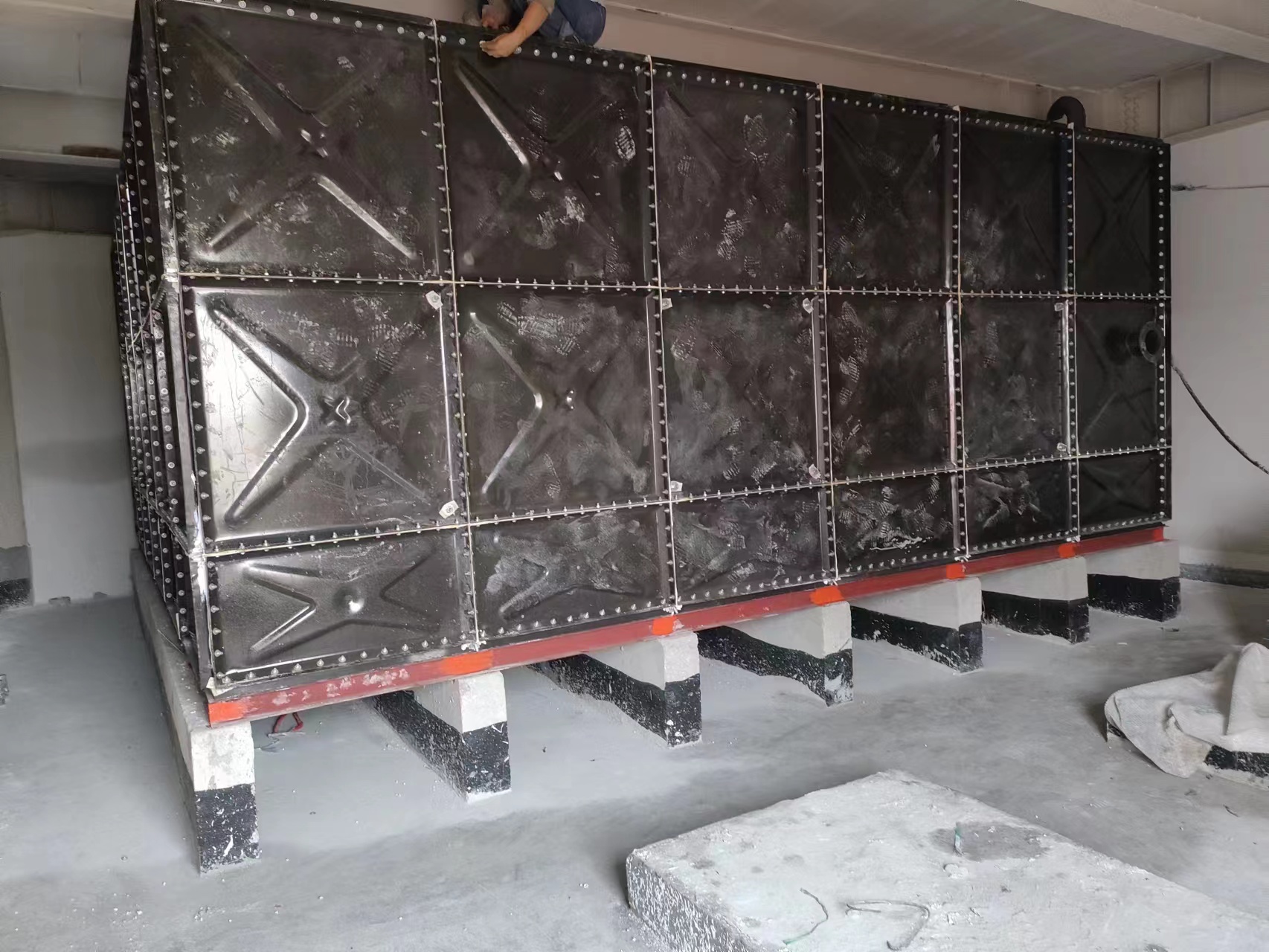
Standard tanks use bolted connections with EPDM gaskets (70 Shore A, 30% compression). Beijing Yuanhui employs a torque wrench set to 25–30 N·m to avoid gasket extrusion. Silicone sealant (Dow Corning 791) is applied around each bolt hole to a thickness of 2 mm.
5.2 Hydrostatic Test and Hygiene Testing
After assembly, a 24-hour full-water test is conducted; leakage must not exceed 0.05% of total capacity. One panel per batch is sent to a third-party lab for GB/T 8237-2015 compliance, and potable tanks must pass GB 5749 full water quality testing. In 2024, Beijing Yuanhui’s first-pass rate for the hydrostatic test reached 99.6%.
Conclusion: Standardized Process = Long-term Reliability
From mold cleaning to hydrostatic testing, FRP water tank production involves dozens of tightly controlled parameters. Hand lay-up offers flexibility for custom sizes, while SMC compression excels in high-volume standardization. Regardless of the method, temperature, humidity, formulation ratio, and cycle time must be rigorously documented. Beijing Yuanhui FRP Co., Ltd. has demonstrated that upgrading from manual supervision to digital process dashboards improves product yield from 95% to 98.7%. For buyers, auditing a supplier’s production process is far more valuable than simply comparing prices—a well-defined process is the single best predictor of a tank’s total cost of ownership over the next decade.