Complete Process Analysis of FRP Water Tank Manufacturing: From Hand Lay-Up to SMC Compression Molding
Introduction
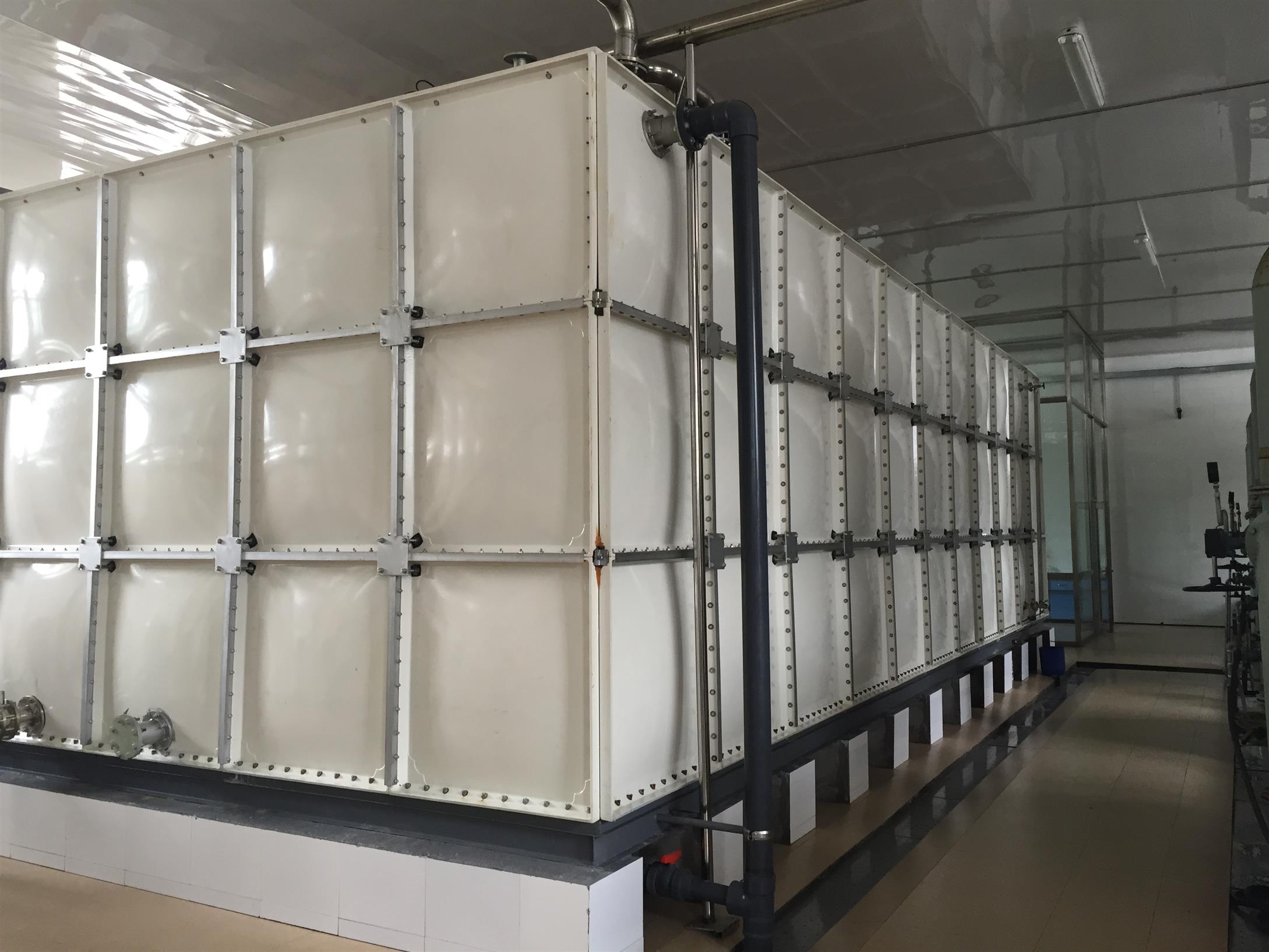
Fiberglass Reinforced Plastic (FRP) water tanks are widely used in construction, municipal water supply, and chemical industries due to their light weight, high strength, corrosion resistance, and long service life. Beijing Yuanhui FRP Co., Ltd., with over a decade of experience, has delivered more than 5,000 sets of tanks, of which 70% are SMC compression-molded. However, some manufacturers still rely on hand lay-up techniques from 30 years ago, resulting in porosity rates as high as 5–8%, compared to <1.5% for SMC parts. This article breaks down the full production process, highlighting key technical parameters and common defects.
1. Material Selection and Pretreatment
1.1 Resin System
Unsaturated polyester resin is the primary matrix. Orthophthalic (80°C), isophthalic (120°C), and vinyl ester (180°C) types are selected based on temperature requirements. Beijing Yuanhui uses isophthalic resin for municipal tanks, achieving a Barcol hardness ≥45—30% higher than orthophthalic. The curing agent MEKP is dosed at 1.5–2.5%, targeting a gel time of 15–25 minutes.
1.2 Reinforcement
E-glass fiber mat (EMC 300/450) is the standard reinforcement. Hand lay-up uses chopped strand mat (30–50 mm), while SMC sheets have fiber lengths of 25 mm and content of 28–32%. Test data shows SMC molded panels achieve tensile strength of 120 MPa and flexural modulus of 7.5 GPa—1.8 times that of hand lay-up panels.
2. Molding Processes: Three Main Approaches
2.1 Hand Lay-Up
Suitable for complex shapes or small batches. Steps: mold cleaning → release agent (3–4 coats) → gel coat → fiber mat placement → resin impregnation → roller debulking. Key parameters: each layer ≤2 mm, interlayer interval 30–45 minutes. Drawbacks: resin content varies widely (45–65%), high operator dependency, strength coefficient of variation up to 0.15.
2.2 Spray-Up
Resin and chopped fibers are sprayed simultaneously, tripling production speed compared to hand lay-up. However, fiber length is limited to 10–25 mm. Beijing Yuanhui uses spray-up only for local reinforcement of internal ribs, avoiding random fiber orientation issues.
2.3 SMC Compression Molding
The dominant method today. Process: SMC sheet cutting (5% larger than mold) → stacking (3–5 layers) → mold loading → compression (100–150 kg/cm²) → heat curing (140–150°C, 3–5 min/mm) → hold pressure to cool. Fiber content is precisely controlled at 30%±1%, thickness tolerance ±0.3 mm, and cycle time 5–8 minutes per mold. Beijing Yuanhui’s SMC line produces 120,000 m² annually with a reject rate of only 1.2%.
3. Curing, Demolding, and Post-Processing
3.1 Cure Degree Control
Hand lay-up parts cure at 25°C for 24 hours, followed by post-cure at 80°C for 2 hours. SMC parts cure directly in the heated mold. Cure degree is measured via acetone extraction (GB/T 2576), requiring residual styrene <0.5%. Under-cure leads to deformation or leakage. Beijing Yuanhui’s cure-defect rate dropped from 3.5% in 2019 to 0.8% in 2023.
3.2 Demolding and Trimming
Molded parts must cool to below 40°C before cutting. Water-jet cutting (accuracy ±0.5 mm) is recommended over abrasive saws to avoid micro-cracks. Edges are rounded to R3 to prevent stress concentration.
4. Quality Testing and Common Defects
4.1 Mechanical Tests
Three specimens per batch undergo tensile (GB/T 1447), flexural (GB/T 1449), and impact (GB/T 1451) tests. Typical SMC values from Beijing Yuanhui: tensile strength 130 MPa, flexural modulus 8.0 GPa, impact toughness 45 kJ/m².
4.2 Air Tightness
Assembled tanks undergo a 0.04 MPa air pressure hold test (30 min, pressure drop ≤0.005 MPa). Industry data from 2022 shows a first-pass air tightness rate of 82% for hand lay-up tanks vs. 97.5% for SMC tanks.
Conclusion
FRP water tank production has evolved from hand lay-up and spray-up to SMC compression molding as the mainstream. Beijing Yuanhui’s practice proves that SMC offers clear advantages in dimensional accuracy, mechanical properties, and environmental performance (60% VOCs reduction). For special features like built-in ladders or irregular connections, hand lay-up or spray-up remain useful complements. Manufacturers should select processes based on order volume, product standards, and quality cost, not merely lowest price.