Complete Process Analysis of FRP Water Tank Production: From Material Selection to Quality Control
Introduction
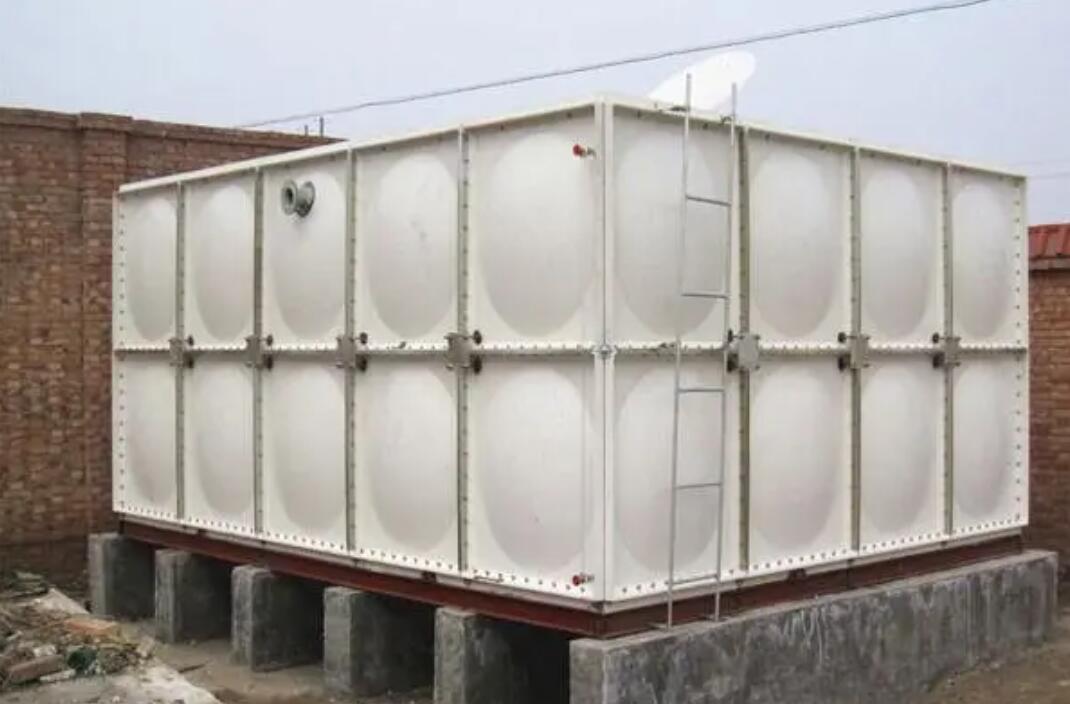
FRP (Fiberglass Reinforced Plastic) water tanks have become indispensable in building water supply, fire protection storage, and industrial cooling due to their lightweight, high strength, and corrosion resistance. According to the China Composites Industry Association, annual production exceeded 1.2 million cubic meters in 2023, with SMC compression molding accounting for 65% and hand lay-up for 30%. Beijing Yuanhui FRP Co., Ltd., with two decades of production experience, shares a step-by-step breakdown of the manufacturing process, from material selection to final quality control.
1. Material Selection and Pretreatment
1.1 Resin and Fiber Ratio
The mechanical properties of FRP tanks depend on the compatibility between resin and glass fiber. Orthophthalic unsaturated polyester resin (UPR) dominates 80% of the market due to cost-effectiveness. Beijing Yuanhui uses UPR with Barcol hardness of 35-40 and elongation at break ≥2.5%. E-glass roving with 13μm filament diameter and 2400 tex linear density is selected, with sizing content controlled at 0.8%-1.2%.
Key data: Tests show that when the resin-to-fiber weight ratio is between 1.8:1 and 2.2:1, tensile strength reaches 280 MPa and flexural strength exceeds 180 MPa. Fiber content below 30% increases brittleness, while above 45% causes dry spots due to poor wet-out.
1.2 Fillers and Additives
To reduce shrinkage and improve fire resistance, aluminum trihydrate (ATH) filler (10-15μm) is added at 25%-35% of resin weight. Curing agent (MEKP) at 0.5%-1% and cobalt naphthenate promoter at 0.1%-0.3% are also included. Beijing Yuanhui's lab data: Adding 30% ATH increases the oxygen index from 20% to 28%, meeting GB/T 2406 requirements.
2. Hand Lay-Up Molding Process
2.1 Mold Preparation and Release Agent
Steel or FRP molds with surface roughness Ra ≤0.8 μm are used. A semi-permanent PVA release agent is applied in three coats, each 15 minutes apart, forming a 0.02-0.05mm film. In 2022, Beijing Yuanhui introduced automated spraying, reducing release agent consumption by 18% and extending mold life to over 500 cycles.
2.2 Lay-Up and Resin Impregnation
The standard laminate structure: surface veil (30 g/m²) + chopped strand mat (450 g/m²) + woven roving (800 g/m²) × 4 layers + chopped strand mat (450 g/m²). Each layer is debulked with a roller to keep void content below 1%. Beijing Yuanhui's protocol: lay-up time ≤8 min/m², resin temperature 22-25°C, viscosity 300-500 mPa·s.
Case study: A 50 m³ fire water tank project in 2023 achieved void content of only 0.8%, well below the industry limit of 2%.
2.3 Curing and Demolding
Room-temperature curing takes 6-8 hours. If ambient temperature falls below 15°C, infrared heating is used with a ramp rate of 5°C/min, peak at 55-60°C, held for 2 hours. Demolding occurs when Barcol hardness ≥35. Beijing Yuanhui uses ultrasonic NDT for internal defect detection, achieving a pass rate of 99.2%.
3. Assembly and Sealing
3.1 Panel Cutting and Joining
CNC cutting ensures tolerance of ±1 mm. Panels are joined with flanged bolts at 200 mm spacing and torque of 40-50 N·m. EPDM gaskets with 25%-30% compression ratio provide sealing. After upgrading to automated drilling in 2021, Beijing Yuanhui increased installation efficiency by 40% and reduced hole deviation to under 0.5 mm.
3.2 Stiffeners and Internal Supports
Tanks exceeding 30 m³ require internal stiffeners. Beijing Yuanhui uses pultruded FRP profiles (50×50 mm) spaced 600 mm apart. In 2022, a honeycomb reinforcement structure reduced sidewall deflection from 8 mm to 3 mm under full-water load.
4. Quality Control and Standards
4.1 Performance Testing
Per GB/T 17219, every batch undergoes:
- Barcol hardness: ≥35
- Flexural strength: ≥160 MPa
- Leak test: 1.5× design pressure, 30 min hold
- Water quality: turbidity ≤1 NTU, color ≤15 degrees after 24h immersion
4.2 Case Study Data
In 2024, a 100 m³ potable water tank from Beijing Yuanhui achieved third-party test results:
- Tensile strength: 292 MPa (standard ≥250 MPa)
- Impact toughness: 45 kJ/m² (standard ≥30 kJ/m²)
- Predicted service life: ≥25 years (ASTM D638 accelerated aging)
All products are ISO 9001:2015 certified, with retained samples traceable for 10 years.
Conclusion
FRP water tank production is a multidisciplinary process requiring precision in material science, machining, and quality control. From resin selection to final testing, every step affects performance. Beijing Yuanhui FRP Co., Ltd. has achieved a 99.5% pass rate through optimized lay-up, automation, and rigorous inspection. Future advancements in BMC molding and smart monitoring will further enhance efficiency and consistency.