Seismic Performance and Design Standards of FRP Water Tanks: From Codes to Practice
Introduction
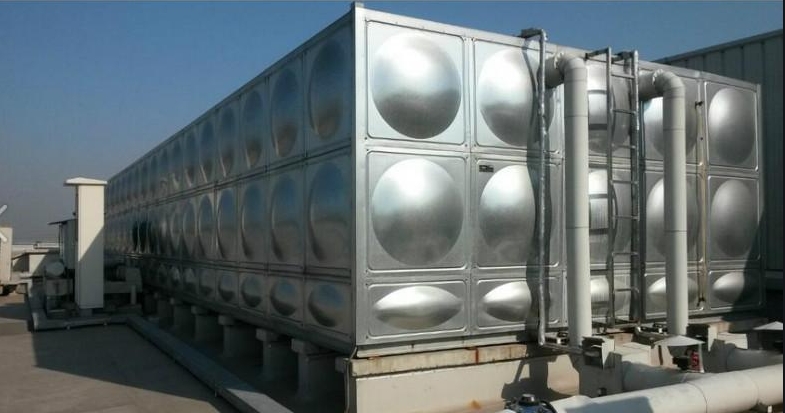
FRP (Fiberglass Reinforced Plastic) water tanks are widely used in building water supply, fire protection and industrial storage due to their light weight, high strength-to-weight ratio, corrosion resistance and ease of installation. However, in regions with seismic intensity 6 or above, their seismic performance directly affects the reliability of lifeline systems. In the 2013 Lushan 7.0 earthquake in Sichuan, the FRP tank at a hospital failed due to anchor bolt loosening, causing a 48-hour water supply interruption. This case underscores that seismic design of FRP tanks must follow mandatory codes, not merely empirical rules.
Based on the 15-year engineering practice of Beijing Yuanhui FRP Co., Ltd., this article draws on GB 50011-2010, GB 50884-2013 and CECS 190:2005 to analyze seismic performance from four aspects: material properties, structural design, joint details and installation verification.
Material Properties Affecting Seismic Behavior
Elastic Modulus and Damping Ratio
FRP has an elastic modulus of 20-30 GPa (about 1/10 of steel) but a specific strength three times that of steel. Low modulus allows larger flexible deformation under earthquakes, while high damping ratio (5%-8% vs. 2%-3% for steel) helps dissipate seismic energy. In a shaketable test by Beijing Yuanhui FRP on a 2000mm×3000mm×2000mm tank (0.3g PGA), the top displacement reached 28mm without local buckling, while a steel tank of same size displaced 9mm but showed stress concentration at welds.
Anisotropy and Laminate Design
FRP is anisotropic; its mechanical properties depend on fiber orientation and stacking sequence. According to CECS 190:2005, wall laminates should adopt [0°/90°/±45°] symmetric layups with at least 30% ±45° plies for shear stiffness. Seismic loads from GB 50011-2010 (horizontal seismic coefficient αmax) are converted into equivalent static loads for finite element stress analysis.
Design Code Requirements and Key Calculations
Shell and Support Configuration
Square tanks exhibit stress concentration at corners (factor 2.5-3.0), requiring internal stiffeners at ≤600mm spacing. Circular integral tanks have better hoop stiffness, but the support-shell connection is critical. Beijing Yuanhui FRP recommends a combined support of steel base beams + anchor bolts + lateral braces (inclination 45°-60°).
Wall Thickness and Local Buckling
Per GB 50884-2013, minimum wall thickness t≥(P×D)/(2[σ]), where P = hydrostatic + hydrodynamic pressure. For a 100m³, 4m-high tank in intensity 8 zone (αmax=0.16), Housner model gives a hydrodynamic coefficient of 0.25, requiring t≥8mm (hand lay-up) or 6mm (spray-up). Local buckling stress must exceed the maximum compressive stress under 1.2 times design load.
Joint Connections and Anchorage
Bolts should be stainless steel, ≥M16, with preload at 70%-80% of design value and lock washers. Elastic pads (e.g., 10mm neoprene) between base and tank absorb horizontal deformation. According to GB 50011-2010 Clause 13.3.3, anchor bolts must resist 1.5 times the horizontal shear from gravity load.
Installation and Inspection Measures
Foundation and Anchor Bolts
Concrete foundation ≥C25, surface flatness ≤±5mm. Anchor bolt embedment depth ≥25d (d = bolt diameter), protruding ≥50mm above foundation. Torque inspection: 10% of every 100 bolts, tolerance ±10%. Beijing Yuanhui FRP adopts a 'secondary grouting + steel shim' process to eliminate gaps.
Flexible Pipe Connections
Inlet, outlet and overflow pipes must have flexible joints ≥200mm long (stainless steel bellows or rubber couplings). Rigid connections transmit displacement directly to the tank wall. In a 2016 Yunnan project, a welded steel drain pipe caused a crack after a 5.4 earthquake — a flexible coupling costing only ~$70 could have prevented failure.
Conclusion
Seismic performance of FRP water tanks results from material selection, structural design and joint detailing. Designers must not underestimate seismic demands due to the tank's light weight. For intensity 8 and above, circular integral tanks with lateral braces are recommended. Beijing Yuanhui FRP Co., Ltd., with over 15 years of experience and 300+ projects in high-seismic zones, offers tailored solutions and technical support to the industry.