Complete FRP Water Tank Production Process: 12 Key Steps from Raw Materials to Finished Product
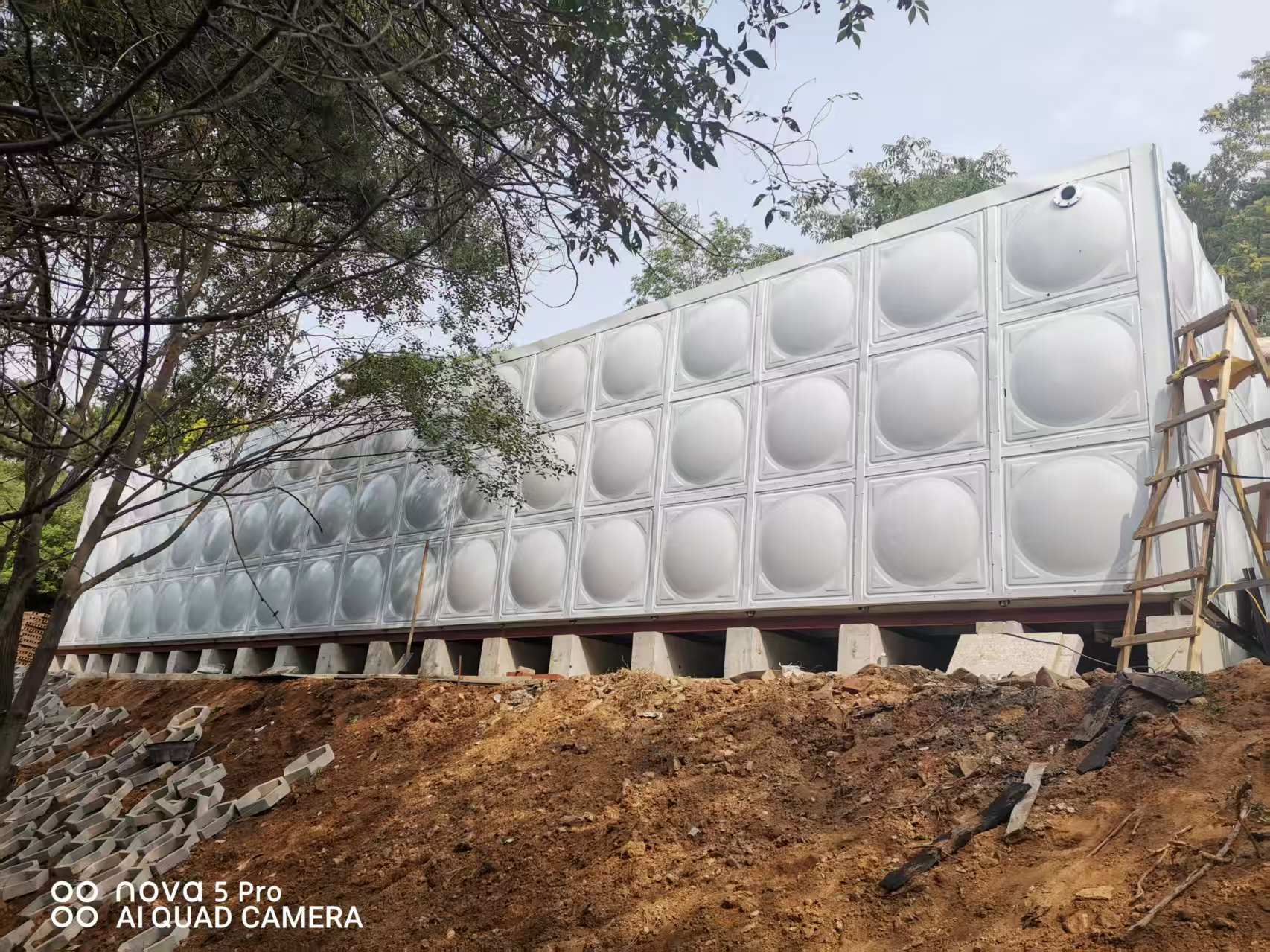
1. Overview of the FRP Water Tank Production Process
FRP (Fiberglass Reinforced Plastic) water tank manufacturing is a precision engineering process, not a simple casting operation. At Beijing Yuanhui FRP Co., Ltd., producing a standard 10-ton tank involves 12 distinct steps from material receipt to finished product, taking approximately 72 hours (including curing). Below is the complete process breakdown.
2. Raw Material Preparation and Ratio Control
2.1 Resin and Fiber Selection
Only isophthalic unsaturated polyester resin (e.g., DS-411 series) is used for water tanks, with a water absorption rate ≤0.15% after 24-hour immersion. Reinforcement consists of E-glass chopped strand mat (450 g/m²) and E-glass woven roving (0.4mm thickness, 0/90° weave), laid alternately. Layer count depends on pressure rating: atmospheric tanks require at least 5 mat + 4 cloth layers; pressure tanks (≥0.1 MPa) need 7 mat + 6 cloth layers.
2.2 Precise Catalyst and Accelerator Addition
The curing system uses MEKP (methyl ethyl ketone peroxide) at 1.5%-2.0% by weight as initiator, and cobalt naphthenate at 0.3%-0.5% as accelerator. Beijing Yuanhui’s shop-floor data: at 25°C ambient temperature, gel time is controlled at 25-30 minutes, demold time at 8-10 hours. For every 5°C temperature rise, MEKP dosage must be reduced by 0.2% to prevent exothermic cracking.
3. Mold Preparation and Molding Process
3.1 Mold Assembly and Release Agent Application
Production uses modular steel molds (≥3mm thick, surface roughness Ra≤1.6μm). Assembly gaps must be ≤0.2mm. PTFE mold release agent is sprayed in 3 coats, 15-minute intervals between coats, forming a 0.1mm release film. The film can be reused 5-8 times; beyond that, demolding force increases by 30%.
3.2 Hand Lay-Up (for custom/small batches) vs. Spray-Up (for standard panels)
Hand lay-up: For a 6mm panel, start with surface mat (30 g/m²), resin coating at 0.8 kg/m², then 450g chopped strand mat rolled with a 45° angled roller to remove bubbles (residual bubbles ≤1mm diameter, max 3 per m²). Resin usage decreases 15% per subsequent layer.
Spray-up: Using a dual-component spray gun (e.g., Vitesel VR-100), fiber content is controlled at 30%-35% by weight, spray distance 40-50cm, travel speed 0.5m/min. Beijing Yuanhui data: spray-up is 4x faster than hand lay-up, but thickness tolerance (±0.5mm) is wider than hand lay-up (±0.3mm).
4. Curing, Demolding, and Post-Processing
4.1 Curing Schedule and Temperature Monitoring
Cured panels are placed in a 25±2°C, 60%±5% relative humidity curing room for 24 hours. Surface temperature is checked with an IR thermometer every 2 hours; exothermic peak must not exceed 80°C (if exceeded, initiator is too high or lay-up too thick). Curing degree is verified by acetone wipe test: no stickiness or discoloration indicates demolding strength (Barcol hardness ≥35).
4.2 Demolding and Machining
Demolding uses pneumatic wedges applied evenly from four corners, force 200-300 N/m². Panels are then cut with CNC waterjet (accuracy ±0.5mm) into tank assembly blocks, edges chamfered to R3-R5. Flanges are filament-wound with 60% resin content and wall thickness ≥8mm.
5. Assembly, Inspection, and Final Testing
5.1 Panel Sealing and Bolt Torque
Sealing uses EPDM rubber gaskets (Shore A 60±5), 304 stainless steel M12 bolts, pre-torque 70-80 N·m. Silicone sealant (-40°C to 150°C) is applied at each joint, thickness 2mm. Beijing Yuanhui uses a digital torque wrench to check every bolt; any deviation >±5 N·m is re-torqued.
5.2 Hydrostatic Pressure and Leak Testing
After assembly, the tank is filled to 110% of design water level and held for 24 hours. Panel thickness is measured with an ultrasonic thickness gauge (±0.01mm accuracy); minimum thickness ≥90% of design. Leak detection uses fluorescent penetrant method: 0.1% fluorescein sodium added to water, UV lamp inspection. Standard: hold at 0.1 MPa for 30 minutes, pressure drop ≤0.01 MPa.
6. Conclusion
FRP water tank production is a tightly coupled system of material ratio-temperature-process parameters. Beijing Yuanhui FRP Co., Ltd. optimized its curing schedule (reducing exothermic peak from 85°C to 72°C) and spray-up parameters, achieving an 18% increase in impact strength and a yield rate improvement from 92% to 97.5%. When selecting a supplier, customers should evaluate gel time records, demolding force data, and hydrostatic test reports rather than focusing solely on price. For pressure-rated or custom-dimension projects, request process qualification (PQ) documentation.