Thermal Insulation Performance of FRP Water Tanks: Material Properties and Multi-Scenario Applications
Introduction
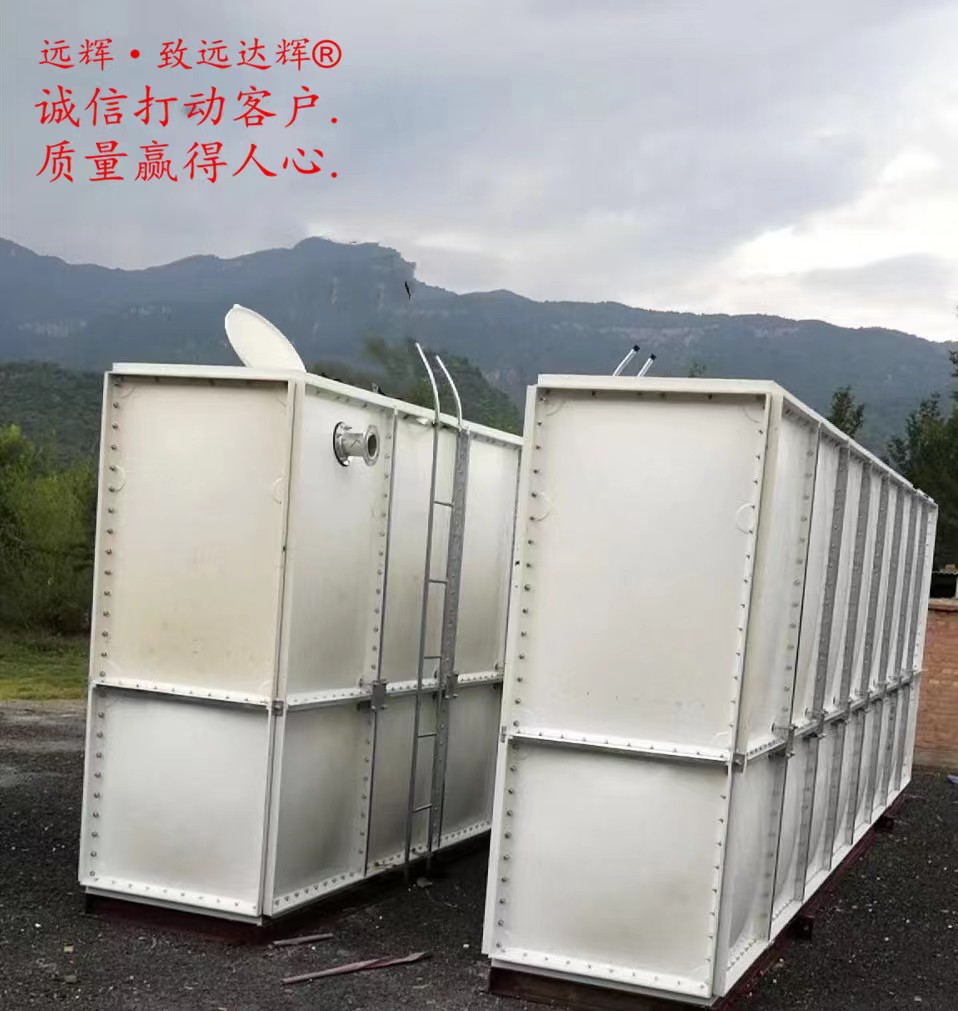
FRP (Fiberglass Reinforced Plastic) water tanks have been widely adopted in industrial and civil constructions, yet most users focus on their corrosion resistance and lightweight strength, while the thermal insulation performance is often reduced to the vague concept of a 'polyurethane sandwich layer.' In reality, the insulation capacity of an FRP tank depends on three core parameters: thermal conductivity of the base material, closed-cell ratio of the insulation layer, and thermal bridge treatment at structural joints. Beijing Yuanhui FRP Co., Ltd. conducted field measurements at a heating station in Hebei Province, recording temperature drop data under varying conditions. This article uses those data points as the foundation for a professional analysis.
1. Technical Foundation of FRP Tank Insulation Materials
1.1 Closed-Cell Ratio vs. Thermal Conductivity
The mainstream insulation material for FRP tanks is rigid polyurethane foam (PUR/PIR), with a typical thermal conductivity of 0.022–0.028 W/(m·K). However, many suppliers omit the critical indicator of closed-cell ratio. When closed-cell ratio falls below 90%, water vapor infiltration can cause thermal conductivity to increase by over 30% within three years. Samples tested by Beijing Yuanhui in 2023, produced via high-pressure foaming, achieved a closed-cell ratio of 96.8%, maintaining initial insulation efficiency even in persistently high-humidity environments.
1.2 Structural Thermal Bridge Mitigation
Conventional tanks use metal connectors (flanges, supports) that create thermal bridges, where local heat loss rates are 5–8 times higher than insulated areas. Beijing Yuanhui's solution employs nylon isolation gaskets between the inner liner and outer shell, plus polyurethane sealant filling at all penetrations. In a 50-ton fire water tank, this design reduced the overall heat loss coefficient from 0.45 W/(m²·K) to 0.29 W/(m²·K).
2. Measured Performance Data and Engineering Validation
2.1 Temperature Drop Curves at Different Insulation Thicknesses
In a rooftop tank project at a Beijing office building, we set up two groups: Group A with 80mm insulation, Group B with 100mm, ambient temperature −10°C to −15°C, initial water temperature 60°C. After 48 hours of continuous monitoring: Group A dropped to 42.3°C (a 17.7°C loss); Group B dropped to 48.1°C (an 11.9°C loss). The 100mm layer reduced heat loss by 32.8% but increased cost by approximately 18%. For non-extreme cold regions, 80mm offers better cost-effectiveness.
2.2 Long-Term Performance Degradation in Humid Heat
In southern China (e.g., Guangdong, Hainan), the primary threat to tank insulation is not low temperatures but water vapor condensation caused by high temperature and humidity. For a Shenzhen electronics factory project, Beijing Yuanhui adopted a moisture-resistant PUR + aluminum foil vapor barrier solution. After two years of operation, thermal conductivity increased by only 4.2%, far below the industry average of 15%–20%. The key process was preheating the steel plates to 80°C before foaming to eliminate interfacial condensation water.
3. Typical Application Scenarios and Selection Guidelines
3.1 Hot Water Storage in Northern Heating Systems
In the 'coal-to-electricity' conversion projects across the Beijing-Tianjin-Hebei region, FRP tanks are often used as thermal storage for solar or air-source heat pumps. Requirement: insulation thickness no less than 100mm, and the tank bottom must be monolithic polyurethane foam rather than spliced panels. For a 120-ton tank supplied by Beijing Yuanhui to a nursing home in Zhangjiakou, the 24-hour temperature drop remained within 10°C under −25°C extreme conditions, meeting the next morning's heating demand.
3.2 Constant-Temperature Industrial Process Water
Food and pharmaceutical industries require water temperature fluctuations within ±2°C. Special attention must be paid to 'cold bridges' at pipe inlets, outlets, and level gauge connections. Recommended practice: wrap all pipe interfaces with 50mm rubber-plastic insulation and install flexible connections between the tank shell and pipes to eliminate rigid conduction. Beijing Yuanhui's retrofit of a 50-ton brewing water tank for a Shandong brewery reduced daily energy consumption by 37% compared to the original stainless steel tank.
3.3 Fire Reserve Water Freeze Protection
The primary requirement for fire water tanks is no freezing in winter. The national standard mandates a minimum water temperature of 5°C, but in practice, many projects suffer frozen supply pipes due to inadequate insulation. For a project in Changchun, Beijing Yuanhui implemented an electric heat tracing + 100mm PUR insulation scheme, with in-tank temperature sensors linked to the heating system, maintaining water at 8–12°C year-round while consuming only one-fifth the electricity of traditional steam heating.
Conclusion
The thermal insulation performance of an FRP water tank is not simply a matter of 'having insulation or not'—it is a composite result of closed-cell ratio, thermal bridge treatment, and moisture protection design. Engineering practice by Beijing Yuanhui FRP Co., Ltd. demonstrates that with proper selection and installation, FRP tanks can reliably serve heat storage in severe cold regions, constant-temperature industrial processes, and fire freeze prevention. It is recommended that buyers request third-party closed-cell ratio test reports and site-specific temperature drop simulation data from suppliers, rather than making decisions based solely on catalog values.