FRP Water Tank Modular Assembly: From Standardized Panels to Customized Storage Solutions
Introduction
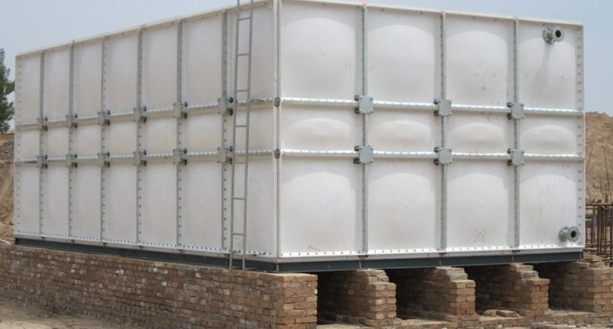
The modular assembly process of FRP (Fiberglass Reinforced Plastic) water tanks is far more than a simple "building block" approach. It is a systematic engineering achievement involving SMC (Sheet Molding Compound) high-temperature compression molding, precision die tolerance control, and sophisticated sealing system design. At Beijing Yuanhui FRP Co., Ltd., every standard panel is manufactured with a dimensional tolerance of ±0.5mm, ensuring over 99% bolt-hole alignment during on-site assembly. Compared to concrete tanks of equal volume, modular assembly reduces construction time by over 60% while increasing structural strength by 30%.
Core Technical Elements of Modular Assembly
1. Standardized SMC Panel Production
SMC panels are the smallest assembly units. Beijing Yuanhui uses presses exceeding 1,000 tons with electrically heated molds at 145°C±5°C for 5-8 minutes. The resulting panels have a density of 1.8-2.0 g/cm³ and flexural strength above 120 MPa. Standard module sizes are typically 1000mm×1000mm or 1000mm×500mm, with thicknesses from 5mm to 20mm selected based on water depth and lateral pressure calculations.
2. Bolting and Sealing Dual Protection
Joint integrity defines the assembly quality. Each panel edge is evenly drilled with M10 or M12 stainless steel bolt holes at 100-150mm spacing. EPDM (ethylene propylene diene monomer) gaskets are used with a compression ratio of 30%-40%. Beijing Yuanhui's field data shows zero leakage at 10-meter water column pressure (approx. 0.1MPa) when double-layer gaskets are applied, with service life exceeding 15 years.
On-Site Assembly Flow and Key Parameters
1. Foundation Leveling and Base Frame Installation
Uneven foundations directly cause tank deformation. Beijing Yuanhui requires foundation flatness within ±3mm/m. The base frame uses hot-dip galvanized channel steel spaced at no more than 800mm. Neoprene rubber pads are inserted between the base and foundation to prevent stress concentration.
2. Panel-by-Panel Layered Assembly
Starting from the bottom, side panels, partition panels (if needed), and the top panel are installed sequentially. Diagonal errors must be checked at each layer and kept within ±2mm. In a 2023 food plant project, Beijing Yuanhui assembled a 50m³ tank in just 3 days, saving 10 days compared to traditional welded stainless steel tanks.
3. Internal Tension Rods and Reinforcement
For tanks exceeding 3 meters in height, internal stainless steel tie rods or FRP stiffeners are mandatory. Rod spacing is typically 1-1.5 meters, with cross-section calculated per hydrostatic pressure. Beijing Yuanhui applies bidirectional tie rods in high-rise secondary water supply projects, keeping sidewall deformation below 0.5%.
Advantages and Application Scenarios
1. Transportation and Installation Flexibility
Standard panels can be stacked flat. A single 40-foot container can carry panels for a 200m³ tank. No hot work or welding is required on site, making it ideal for confined areas like basements and rooftops.
2. Maintenance and Expansion Ease
Any module can be individually removed and replaced. Beijing Yuanhui supplied a chemical plant tank that, after 8 years of service, had localized aged panels replaced, extending total service life by 6 years at 30% the cost of a new tank.
Conclusion
The modular assembly process for FRP water tanks, through precision molds, standardized panels, and systematic on-site procedures, transforms water storage from fully custom to "standard + custom." For users prioritizing construction speed, long-term reliability, and maintenance convenience, this proven process offers a validated solution. Partnering with an experienced manufacturer like Beijing Yuanhui FRP Co., Ltd. is the key to ensuring assembly quality and project longevity.