FRP Water Tank Modular Assembly Process: From SMC Molding to On-Site Installation
Introduction
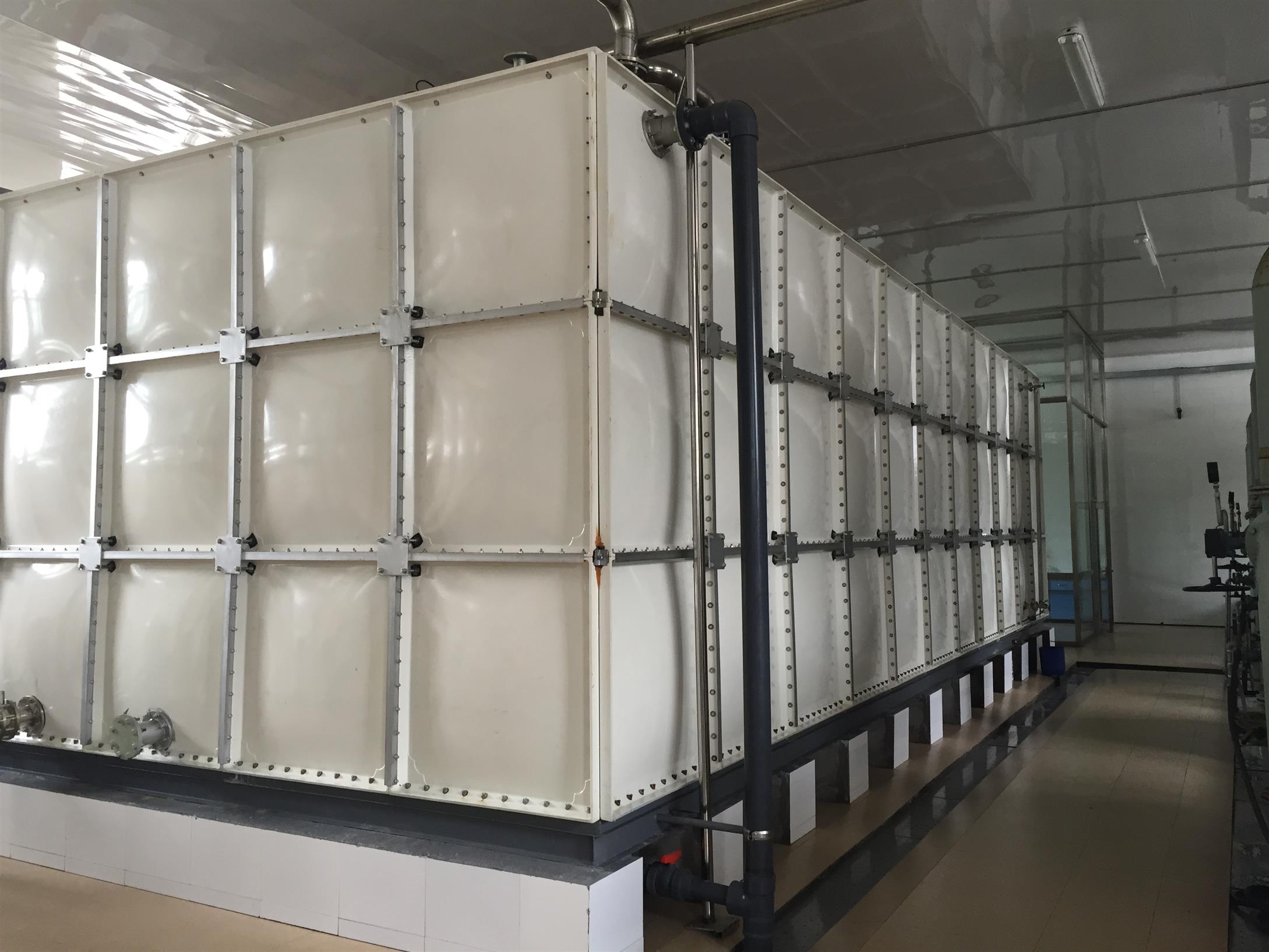
The modular assembly process of FRP (Fiberglass Reinforced Plastic) water tanks has become the dominant solution in industrial and civil water storage. Beijing Yuanhui FRP Co., Ltd., with nearly 15 years of manufacturing experience, has delivered over 2,000 modular tank systems, with the largest single unit reaching 1,500 cubic meters. The core of this process lies in breaking down the tank into standardized SMC (Sheet Molding Compound) panels, precision-molded in one shot, then assembled on-site. Compared to traditional welded tanks, modular assembly cuts construction time by more than 50% and eliminates weld corrosion entirely.
1. SMC Molded Panels: The Building Blocks
1.1 Materials and Molding Parameters
Modular assembly demands high panel precision and performance. SMC material with a glass fiber content of 25%-30% is used, combined with unsaturated polyester resin, low-shrink additives, and mineral fillers. Molds are precision-machined from 45# steel. Molding temperature is controlled at 135-145°C, pressure at 12-15 MPa, with a hold time of 40 seconds per millimeter of panel thickness. Beijing Yuanhui’s 1,000-ton press produces three standard panel sizes: 1m×1m, 1m×0.5m, and 0.5m×0.5m, in thicknesses of 4mm, 5mm, 6mm, 8mm, 10mm, and 12mm, corresponding to water pressure ratings from 0.03MPa to 0.12MPa.
1.2 Performance Data
For a 6mm panel, measured flexural strength exceeds 120 MPa, Barcol hardness is at least 50, and water absorption is ≤0.5%. These parameters determine long-term creep resistance under load. Internal tests at Beijing Yuanhui show that 6mm panels withstand 1.5 times the design pressure for 48 hours without leakage or cracking, achieving a safety factor 1.3 times the industry standard.
2. Sealing and Connection Systems: The Critical Technology
2.1 Connector Design
Modular assembly relies on specialized connectors for rigid panel-to-panel joints. Beijing Yuanhui uses 304 stainless steel hex bolts paired with nylon nuts. Bolt diameter is selected by tank height: M10 for tanks ≤3m, M12 for 3-6m, and M14 for >6m. Each panel has pre-embedded metal inserts to create a tension-resistant connection. Bolt hole spacing is held to 200mm ± 0.5mm, ensuring assembled flatness deviation ≤2mm per meter.
2.2 Sealing Materials
Sealing performance is the lifeline of tank quality. Panel joints use EPDM (ethylene propylene diene monomer) gaskets with an Ω-shaped cross-section, compression ratio set at 30%-35%. EPDM’s resistance to ozone, UV, and temperatures from -40°C to 120°C gives it a service life of over 10 years in outdoor environments. Additionally, silicone sealant is applied on overlapping surfaces as a secondary barrier, forming a flexible waterproof layer after curing. Beijing Yuanhui’s sealing test protocol: fill to 1.2 times design pressure, hold for 24 hours, zero leakage allowed.
3. On-Site Installation: From Foundation to Water Fill
3.1 Foundation and Steel Base
Installation begins with a concrete foundation, surface flatness ≤3mm per meter. Channel steel (No. 10 or No. 12) is laid in a grid pattern as the support frame. Channel spacing depends on tank width: 1m for width ≤3m, 0.8m for 3-6m, and 0.6m for >6m. Channels are anchored to the foundation with M16 expansion bolts, at least 4 bolts per linear meter.
3.2 Panel Assembly Sequence
The standard sequence is: floor panels first, then wall panels, and finally roof panels. Sealant is uniformly applied under each floor panel. Bolt tightening torque is adjusted by panel thickness: 20 N·m for 4mm, 25 N·m for 6mm, and 30 N·m for 8mm and above. Wall panels are installed from one corner, with verticality checked using a level after each panel — deviation exceeding 2mm must be corrected immediately. Roof panels are installed with a reserved manhole opening, typically 600mm or 800mm in diameter, equipped with a stainless steel clamping ring and seal.
3.3 Internal Tie Bars and External Reinforcement
For tanks over 2m in height, internal stainless steel tie bars (304 grade) are required. Tie bar diameter is selected by height: φ10mm for 2-3m, φ12mm for 3-4m, and φ14mm for >4m. Each tie bar is welded to connecting plates and bolted to the side panels. External reinforcement in the form of steel hoops is applied based on environmental conditions. Beijing Yuanhui’s standard for coastal typhoon-prone areas: one hoop every 1.5m of height for tanks ≥3m exposed to wind.
4. Quality Control and Case Data
4.1 Factory Inspection
Every batch of SMC panels undergoes three mandatory inspections: visual (no bubbles, cracks, or contaminants), dimensional (length/width tolerance ±1mm, diagonal tolerance ±2mm), and strength sampling (3 panels per batch for flexural test). In 2023, Beijing Yuanhui shipped 120,000 panels with a sampling pass rate of 99.6%. All non-conforming panels were reprocessed.
4.2 Project Case
In a 2024 large industrial park project, 12 modular FRP tanks with a total volume of 4,800 m³ were installed. A 12-person crew completed installation in 18 days — 22 days faster than the traditional welded tank alternative. After commissioning, continuous monitoring over 6 months confirmed compliance with China’s Standards for Drinking Water Quality (GB 5749-2022). Maximum panel deflection occurred during a summer heatwave (surface temperature 43°C) at just 2.7mm, well below the 5mm design limit.
Conclusion
The modular assembly process of FRP water tanks, combining standardized panels, precision connectors, and rigorous installation procedures, enables efficient construction and long-term reliable operation. Data from Beijing Yuanhui FRP Co., Ltd. confirms that this process outperforms traditional methods in construction time, sealing reliability, and structural stability. For industrial and civil projects with large water storage requirements, modular assembly is a technology path worth prioritizing.