Seismic Performance and Design Standards of FRP Water Tanks: From Material Properties to Engineering Practice
Introduction
Fiberglass Reinforced Plastic (FRP) water tanks are widely used in building water supply, fire protection, and industrial cooling due to their light weight, corrosion resistance, and long lifespan. However, in seismic zones of intensity ≥7, tank performance directly impacts lifeline reliability. The 2013 Lushan earthquake revealed anchor failures in hospital FRP tanks, highlighting design gaps. This article, drawing on experience from Beijing Yuanhui FRP Co., Ltd., examines the seismic behavior and design standards of FRP water tanks.
Seismic Performance Fundamentals of FRP Tanks
Damping and Stiffness Characteristics
FRP has an elastic modulus of 10–15 GPa (1/20 of steel) but a damping ratio of 0.03–0.05, significantly higher than steel tanks (0.01–0.02). This allows FRP to dissipate more vibrational energy. Field tests show that FRP tanks have 30%–40% longer natural periods than steel tanks, effectively avoiding the predominant seismic frequency band (0.1–1 Hz).
Structural Configuration and Response
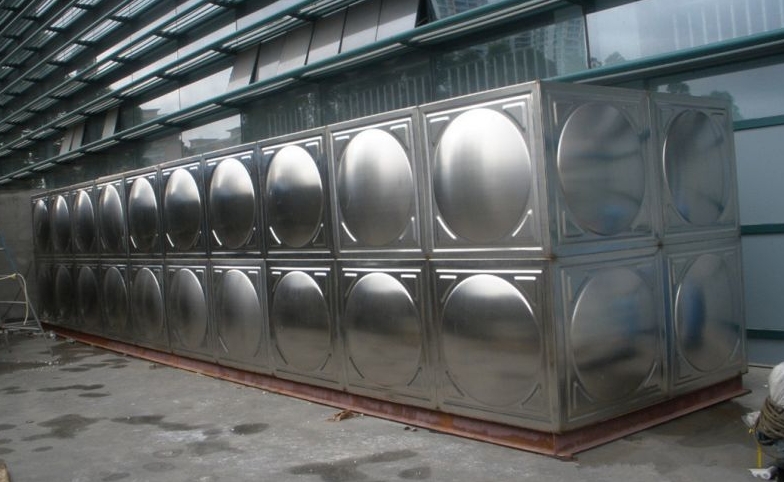
Modular FRP tanks consist of SMC panels bolted with sealant. Their multi-chamber design (partition spacing ≤1.5 m) creates natural energy dissipation units: sloshing pressure is distributed among compartments, suppressing global sway. However, when the length-to-width ratio exceeds 3, torsional effects amplify. Beijing Yuanhui FRP Co., Ltd. project data shows that tanks with a ratio of 2.0 experience 40% less top displacement than those with a ratio of 3.5 under simulated earthquakes.
Design Codes and Key Parameters
Chinese Code (GB 50011-2010)
Clause 13.3.3 specifies:
1. Horizontal seismic force uses the equivalent lateral force method with amplification factor 2.0 (2.5 for Class B buildings);
2. Height-to-width ratio (center of gravity to support) <1.5;
3. Anchor bolts must resist seismic load combined with 1.5× dead load.
Note that the code does not specify the friction coefficient between FRP and steel supports. ASTM D1894 testing suggests 0.30–0.45.
US Code (ASCE 7-16) Comparison
ASCE 7-16 Chapter 13 provides refined requirements:
- Seismic force considers liquid sloshing period (Housner model);
- Connection ductility: bolted joints must provide 0.5× yield deformation margin;
- For long-period sites (Tg>1.0s), relative displacement between tank and piping must be verified.
Beijing Yuanhui FRP Co., Ltd. uses double nuts plus spring washers in export projects, with preload loss <8% after 30 simulated M8 earthquakes.
Engineering and Construction Details
Anchorage and Foundation
Failure typically occurs at connections. Recommended design:
- Hot-dip galvanized steel brackets with 200mm×200mm×10mm base plates;
- Chemical anchors embedded ≥12× bolt diameter, edge distance ≥100mm;
- 5mm neoprene pad between bracket and tank base to increase friction to 0.5.
A data center project in Southwest China (intensity 8) using this method recorded zero displacement during the 2022 M6.8 Luding earthquake.
Flexible Piping Connections
Inlet and outlet pipes must have flexible joints to accommodate seismic displacement. Use rubber bellows (working pressure ≥1.0MPa, axial movement ±15mm) or corrugated compensators (lateral ±30mm). Pipe supports must be independent of the tank structure.
Conclusion
Seismic performance of FRP water tanks depends on material selection, rigorous design, robust connections, and proper installation. Industry peers are advised to follow Beijing Yuanhui FRP Co., Ltd. practices: high-damping panels, controlled aspect ratio, redundant anchors, and flexible piping. With the 2024 revision of GB 50011 mandating verified seismic design for FRP tanks, mastering these standards will be critical for market competitiveness.