FRP Water Tank Modular Assembly Process: A Technical Guide from SMC Molding to On-Site Installation
Introduction
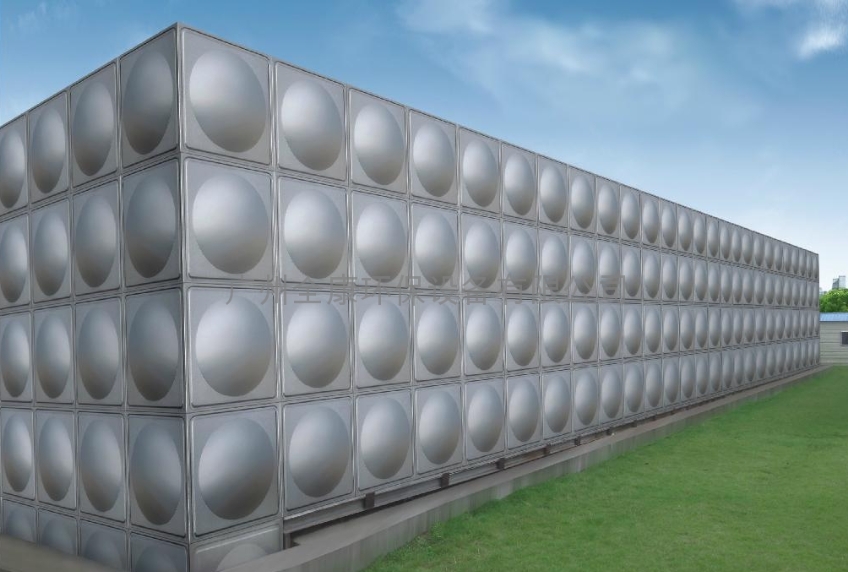
Modular assembly of FRP water tanks is not simply bolting panels together. It relies on SMC (Sheet Molding Compound) compression molding to produce standardized panels with dimensional accuracy within ±0.5mm, then connecting them on-site with specialized sealing systems and fasteners. Industry data shows that modular assembly cuts installation time by over 60% compared to traditional welded tanks. In 2023, Beijing Yuanhui FRP Co., Ltd. installed a 200-ton FRP tank for an industrial park using just 4 workers over 3 days—a clear demonstration of this process efficiency.
1. SMC Molded Panels: The Modular Foundation
1.1 Material Composition and Molding Process
SMC panels are produced from unsaturated polyester resin (25%-30%), E-glass fiber (30%-35%), calcium carbonate filler, curing agents, and mold release agents. The compound is kneaded, impregnated, thickened, then compression-molded at 140°C-160°C and 10-15 MPa. Beijing Yuanhui's SMC line achieves a 4-6 minute cycle per panel, with daily capacity of 300 standard panels (typically 1m×1m or 1m×0.5m).
Key properties: flexural strength ≥120 MPa, Barcol hardness ≥40, water absorption ≤0.5% (per GB/T 15568).
1.2 Panel Geometry and Interface Design
Each panel features tongue-and-groove edges (15-20mm depth) with a fit clearance of 0.3-0.5mm. Bolt holes at four corners are positioned by mold pins, ensuring diagonal hole deviation ≤0.5mm across batches. This self-locking design minimizes reliance on external alignment jigs during assembly.
2. Sealing and Connection Systems: The Leak-Prevention Core
2.1 EPDM Gaskets
EPDM gaskets (Shore A 60±5, compression set ≤25% at 100°C×24h) are embedded in the male groove of each panel. Their hollow or finned cross-section generates 8-10 MPa contact pressure when bolts are tightened. Beijing Yuanhui's tests confirm that even with 0.2mm flatness deviation, EPDM gaskets compensate through elastic deformation, ensuring zero leakage at 0.3 MPa water pressure.
2.2 Stainless Steel Fasteners and Flanges
304 stainless steel bolts, nuts, and washers (M8 or M10) are used with torque controlled at 15-20 N·m. Tank-to-foundation connections use hot-dip galvanized flanges with a corrosion life ≥20 years.
3. On-Site Assembly: Six-Step Workflow
3.1 Foundation Preparation and Leveling
Concrete base must meet C20 strength with surface flatness ≤3mm/m. A 10mm rubber cushion pad is laid to distribute full-load tank weight (typically 3-5 tons/m²).
3.2 Bottom Panel Assembly
Start from the center, interlock panels via tongue-and-groove, pre-tighten bolts to 10 N·m. Fix corners to foundation with expansion bolts at ≤600mm spacing.
3.3 Side Panels and Baffles
Install side panels from one corner upward, calibrating verticality (≤2mm/2m) after each row. For tanks >100 tons, install 304 stainless steel tie rods (1m×1m grid) to prevent bulging under hydrostatic pressure.
3.4 Roof Panels and Access Port
Before roof installation, verify full gasket seating. Apply dual sealing at roof-to-side joints: EPDM gasket plus silicone sealant (weather life ≥15 years). Install a 600mm access port with stainless steel cover and locking handle.
3.5 Pipe Connections and Accessories
Cut holes (diameter tolerance ≤1mm) for stainless steel flanged stub pipes (DN50-DN300) with EPDM gaskets. Install level gauge, overflow pipe, drain valve, and internal ladder (all stainless steel).
3.6 Hydrostatic Test and Acceptance
Fill to maximum design water level for 24 hours. Inspect all joints every 2 hours. Permissible surface condensation ≤0.5L/m²·24h; no dripping allowed. Beijing Yuanhui reports a first-pass acceptance rate >98% for modular tanks.
4. Quality Control and Troubleshooting
4.1 Panel Defect Repair
For cracks ≤50mm, fill with FRP repair compound (resin + chopped fiber) and sand smooth. Cracks >100mm or full penetration require panel replacement.
4.2 Bolt Loosening and Leak Remediation
Retorque all bolts to 15-20 N·m after 6 months of operation. If leaks persist, replace gaskets by disassembling adjacent panels.
4.3 Water Quality Compliance
SMC panels meet GB/T 17219 safety standards for drinking water. Factory immersion tests (24h at 25±2°C) confirm TOC ≤2mg/L and oxygen consumption ≤3mg/L.
Conclusion
Modular FRP tank assembly balances installation speed and structural integrity through standardized SMC panels, precision sealing, and disciplined on-site procedures. Field data shows completion of a 200-ton tank within 4 days, with lifecycle maintenance costs ~30% lower than welded alternatives. Beijing Yuanhui FRP Co., Ltd.'s track record of over 500 installations provides robust validation. For projects demanding tight schedules, high water quality, and easy future maintenance, modular FRP water tanks are a proven, reliable solution.