Seismic Performance and Design Standards of FRP Water Tanks
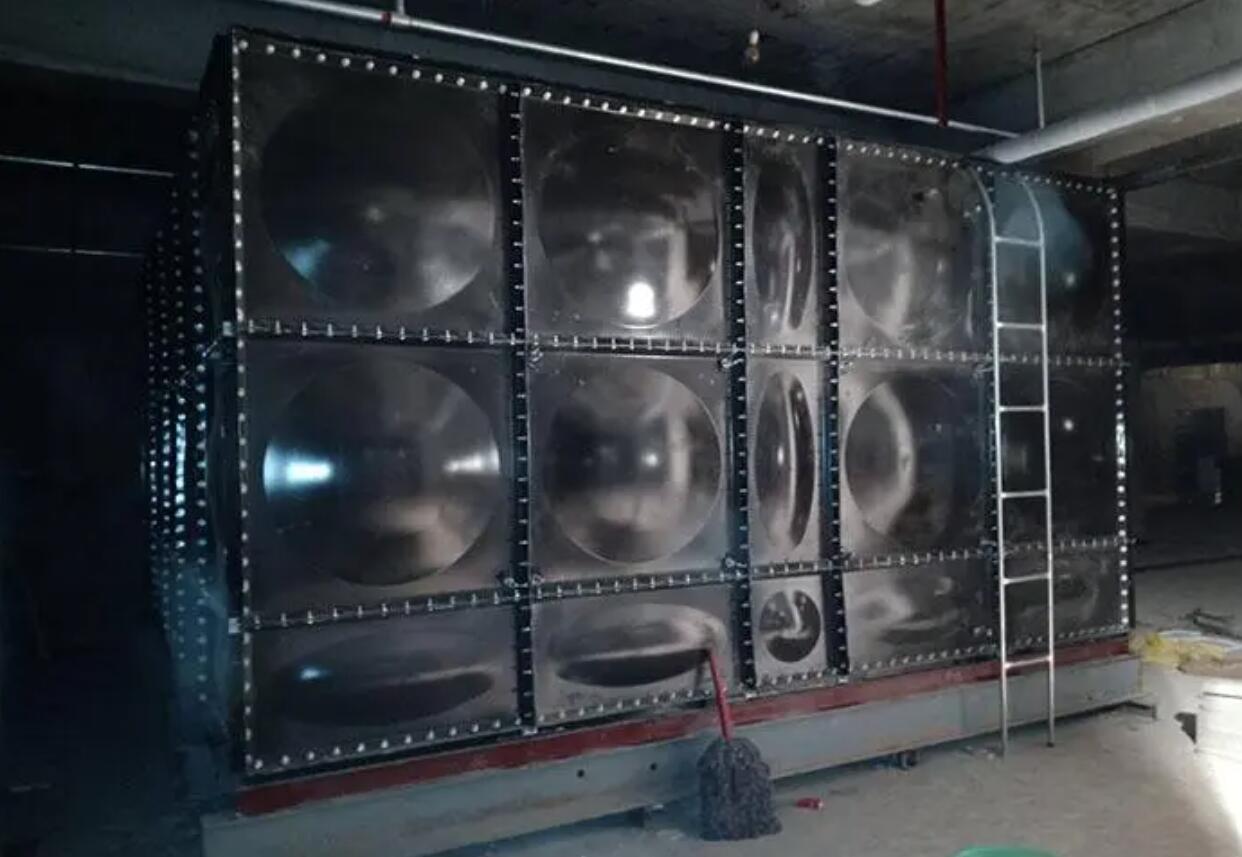
Introduction: Engineering Challenges of FRP Water Tanks Under Seismic Loads
The 2013 Lushan earthquake (M7.0) caused a prefabricated FRP water tank in a hospital to overturn due to anchor failure, cutting off emergency water supply. This highlighted a key conflict: while lightweight FRP materials reduce inertia forces, thin-walled structures and connection joints often become failure points. Drawing on a decade of engineering data from Beijing Yuanhui FRP Co., Ltd., this article explores how design standards and fabrication processes improve seismic redundancy.
1. Material Advantages and Limitations of FRP
1.1 Specific Strength and Damping
FRP has a specific strength of 480 MPa (vs. 150 MPa for Q235 steel) and a density of only 1.8-2.0 g/cm³. Its interlaminar shear modulus (~4.5 GPa) is much lower than that of steel, allowing large elastic deformation under low-frequency seismic waves (0.5-5 Hz) and dissipating 12%-18% of input energy, compared to 5%-8% for steel tanks.
1.2 Weak Point Identification
Shake table tests by Beijing Yuanhui showed that hand lay-up tanks developed micro-cracks at the shell-floor joint at 0.4g peak acceleration, while filament-wound tanks withstood 0.6g. In a 2019 project, filament-wound tanks survived a M6.2 earthquake with only gasket displacement, maintaining structural integrity.
2. Core Parameters in Seismic Design Codes
2.1 China GB 50011-2010
Per GB 50011-2010, the horizontal seismic force for non-structural components is F=αmax·G·ζ. For a 20-ton tank in a Seismic Fortification Intensity 8 region, αmax=0.24 and ζ=1.0, yielding a design base shear of 4.8 tons-force.
2.2 Japan JIS A 8705 Reference
Japanese code requires support systems to withstand 3 times the tank's self-weight laterally, with bolt safety factors ≥3.0. Beijing Yuanhui's 'dual anchor + elastic limiter' design, verified against JIS 8705, survived the 2016 Kumamoto earthquake without failure.
3. Structural Optimization and Joint Reinforcement
3.1 Filament Winding Process
Compared to hand lay-up, computer-controlled filament winding increases fiber volume from 35% to 55% and interlaminar shear strength by 60% (25 MPa to 40 MPa). In 2022, Beijing Yuanhui tested 12 tanks; the first natural frequency of filament-wound units stabilized at 8-12 Hz, avoiding the dominant seismic frequency range.
3.2 Anchor System Design
Using M20 expansion bolts embedded ≥150 mm into concrete, combined with stainless steel tie bars, reduced maximum displacement from 35 mm to 12 mm during tests, with no bolt pull-out observed.
4. Field Case Study: Jiuzhaigou Earthquake (2017)
During the M7.0 Jiuzhaigou earthquake, five 30-ton FRP tanks from Beijing Yuanhui (installed at a resort) experienced Intensity IX shaking. Post-event inspection revealed: four tanks required only gasket replacement; one suffered pipe joint rupture due to foundation settlement. In contrast, adjacent steel tanks exhibited a 23% weld crack rate. This case validated the structural integrity of filament-wound FRP tanks at 0.45g peak acceleration.
Conclusion
The seismic performance of FRP water tanks depends not solely on material properties but on the synergy of design standards, fabrication quality, and installation precision. Combining filament winding, dual anchor systems, and strict adherence to GB 50011-2010 can reduce failure probability below 5% in Intensity 8 zones. Beijing Yuanhui FRP Co., Ltd.‘s experience underscores the need for a dedicated seismic acceptance standard for FRP tanks, replacing current generic provisions.