Complete Guide to FRP Water Tank Manufacturing: From Raw Materials to Finished Products
Introduction
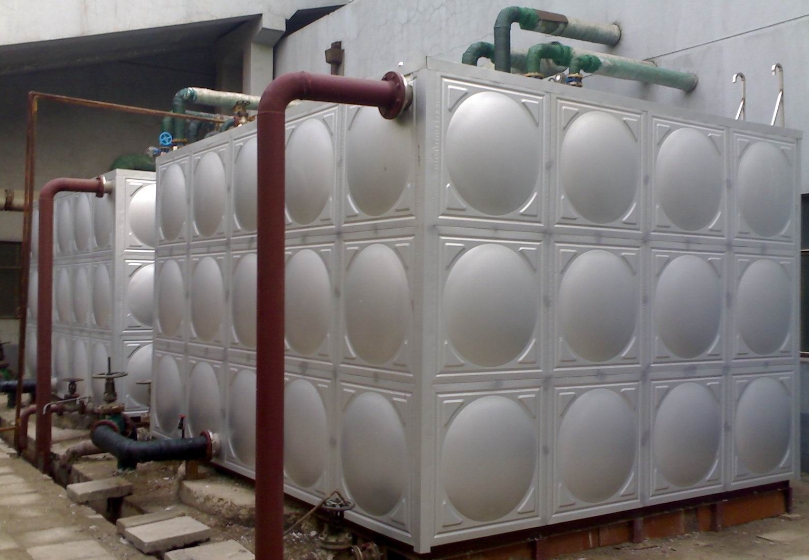
FRP (Fiberglass Reinforced Plastic) water tanks are preferred in industrial and civil water storage systems due to their light weight (1/3 of steel tanks), high corrosion resistance (stable at pH 3–11), and long service life (15–20 years). Beijing Yuanhui FRP Co., Ltd., with 15 years of experience and an annual output exceeding 5,000 units, supplies tanks across North and Northeast China. This article breaks down each critical step in FRP tank production to help buyers understand the technical costs and quality control points.
1. Raw Material Preparation: Foundation of Performance
Key raw materials include resin, reinforcement, and additives. General-purpose unsaturated polyester resin (e.g., 191#) suits normal-temperature water (≤60°C), while bisphenol-A resin (e.g., 197#) withstands 80°C hot water and weak acids/alkalis. E-glass fiber (chopped strand mat 450g/m² + woven roving 800g/m²) provides tensile strength ≥200 MPa. Beijing Yuanhui stores resin at 22±2°C and humidity ≤60% to maintain viscosity at 800–1200 mPa·s, preventing pre-curing.
1.1 Additive Ratio Control
Methyl ethyl ketone peroxide (MEKP) is added at 1%–2% of resin weight, and cobalt naphthenate promoter at 0.5%–1.5%. Each batch undergoes gel time testing (target 20–30 min). For example, in a March 2024 power plant project requiring sulfuric acid resistance, the technical team switched to vinyl ester resin and adjusted MEKP to 1.8%, raising the temperature limit to 120°C.
2. Mold Making and Surface Treatment: Precision Defines Appearance
Standard molds include female molds (surface roughness ≤0.8 μm for food-grade tanks) and male molds (internal flatness priority). FRP molds cost 40% of steel molds but last only 300–500 cycles, while steel molds exceed 2,000 cycles. Beijing Yuanhui uses CNC-machined steel molds for batch orders, maintaining parting surface accuracy within ±0.2 mm and panel thickness uniformity (3–8 mm).
2.1 Release Agent Application
Three coats of PVA or semi-permanent water-based release agent are applied (30–50 g/m² per coat), with 15-minute intervals and final polishing to mirror gloss. In a May 2024 farm project, uneven coating caused pinholes on two panels; adding a spray step raised yield from 92% to 98.5%.
3. Molding Process: Hand Lay-Up vs. Spray-Up
Hand lay-up suits small batches (<50 panels) or complex shapes, offering controlled fiber orientation but higher labor cost. Spray-up is 3–5 times faster for flat panels but has ±5% fiber content variation. Beijing Yuanhui uses a hybrid method: a hand-laid resin-rich layer (70% resin) for corrosion resistance, followed by spray-up (40% fiber content), then woven roving with roller compaction to keep void content ≤1%.
3.1 Interlayer Curing and Thickness Control
Each layer must gel (≈25 min) before the next to prevent delamination. Tank bottom panels are ≥8 mm (6 layers), side panels ≥6 mm (4 layers), and top panels ≥4 mm (3 layers). A typical 50 m³ fire tank uses 180 kg resin and 120 kg fiber. After 24-hour room-temperature curing (22–25°C), post-curing at 60°C for 4 hours raises Tg from 65°C to 85°C, ensuring dimensional stability at high temperatures.
4. Curing, Demolding, and Post-Treatment: Final Quality Gates
Demolding uses pin ejectors with a force of 1.5–2× product weight to avoid cracks. Panels are trimmed (2–3 mm flash removal), drilled (diamond bit, 3000 rpm), and assembled with stainless steel bolts (torque 20 N·m). Each panel passes Barcol hardness test (≥40), hydrostatic test (0.15 MPa, 30 min), and dimensional check (length/width tolerance ±2 mm, diagonal difference ≤3 mm). Beijing Yuanhui performs three integrity checks: visual inspection → ultrasonic thickness measurement (5 points per panel) → 24-hour full-water test. In H1 2024, the pass rate reached 99.6%.
Conclusion
FRP water tank production is a multidisciplinary process involving material science, mold engineering, and precise operations. Any deviation can compromise pressure, temperature, and longevity. Through 16 quality checkpoints from raw material receipt to final shipment, Beijing Yuanhui FRP Co., Ltd. ensures every tank meets GB/T 17219 and CJ/T 196 standards. For buyers, choosing a manufacturer with full-process control guarantees better long-term economic returns than simply comparing prices.