Color Selection and UV Protection for FRP Water Tanks: A Technical Guide by Beijing Yuanhui
Introduction: Color as a Functional Parameter
When FRP (Fiberglass Reinforced Plastic) water tanks are installed outdoors, ultraviolet (UV) radiation becomes the primary driver of resin degradation, fiber exposure, and structural strength loss. Color selection directly influences surface temperature absorption and UV reflectivity. Beijing Yuanhui FRP Co., Ltd. has observed through decades of production that improper color choice can shorten tank lifespan by over 30%. This article examines the UV protection mechanisms and provides data-driven color selection guidelines.
Physics of Color and UV Absorption
Light Colors: Reflectivity-Driven Thermal Management
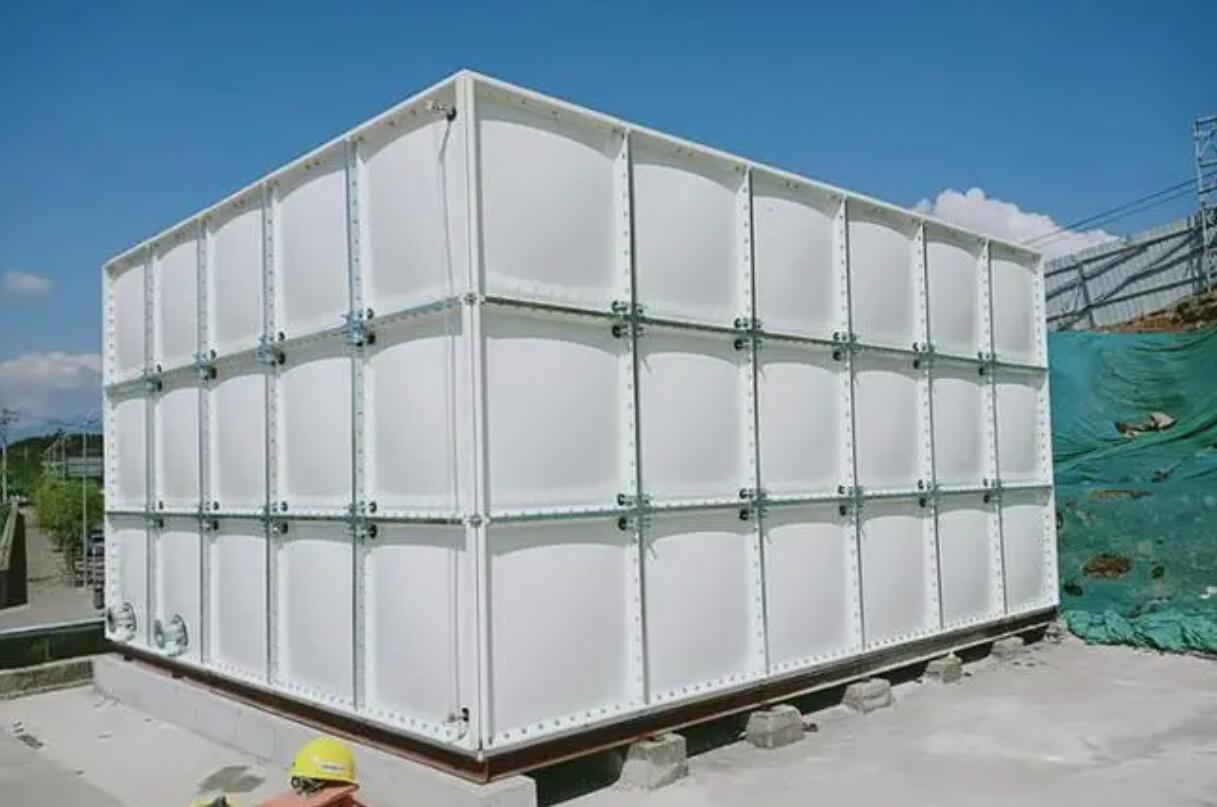
White and light gray surfaces reflect over 80% of visible and near-infrared radiation, maintaining surface temperatures 15–20°C lower than dark colors. For example, a white SMC tank supplied by Beijing Yuanhui for a Hebei project recorded surface temperatures never exceeding 45°C over five years, reducing resin aging rate by 40%. However, uneven dispersion of white pigments (e.g., titanium dioxide) can create UV-transparent 'windows,' leading to localized degradation.
Dark Colors: Heat Absorption and UV Attenuation
Dark blue and dark green surfaces absorb up to 90% of incident radiation, often reaching surface temperatures above 60°C. Accelerated free-radical reactions break ester bonds in polyester or epoxy resins. Beijing Yuanhui's lab tests showed that dark-colored tanks lost 25% of flexural strength after three years of continuous exposure, versus 8% for light-colored tanks. However, dark colors can be viable when using UV-shielding pigments like carbon black or iron black plus UV absorbers (e.g., benzotriazoles), which cut degradation rates by 50%.
Mid-Tone Colors: The Balanced Choice
Beige, light blue, and similar mid-tone colors reflect 50–65% of radiation, balancing aesthetics and protection. A light blue tank supplied by Beijing Yuanhui for a commercial complex, formulated with 0.3% hindered amine light stabilizer (HALS), showed no chalking or cracking after six years outdoors, meeting architectural standards.
Technical Implementation of UV Protection
Resin System Selection
Isophthalic unsaturated polyester resins (e.g., DSM 430 series) outperform orthophthalic types in UV resistance. The former retains ≥80% gloss after 1,000 hours of QUV testing, while the latter retains only 50%. Beijing Yuanhui uses isophthalic resin exclusively for export projects to Africa, ensuring ΔE ≤ 3 over 10 years per ISO 4892.2.
Gel Coat and Coating Synergy
Gel coat thickness should be controlled at 0.4–0.6 mm—too thin allows UV penetration, too thick risks cracking. Beijing Yuanhui recommends adding 3–5% nano-titanium dioxide to the gel coat, which blocks over 95% of UV-A (320–400 nm). For extreme environments, a fluorocarbon topcoat provides 20-year UV shielding.
Quality Control in Production
Color uniformity is critical for consistent UV protection. Beijing Yuanhui uses twin-screw continuous mixing to achieve pigment dispersion of Level 7 (Hele-Shaw scale), eliminating weak zones caused by color spots. Every batch undergoes accelerated aging per ASTM G154; if gloss retention falls below 85%, the batch is rejected.
Case Studies and Cost-Benefit Analysis
Case 1: A white tank supplied by Beijing Yuanhui for a grassland farm in Inner Mongolia, using isophthalic resin + nano-TiO₂ gel coat, maintained a Barcol hardness of 45 after eight years (a drop of only 3 units), while a dark blue tank from a local competitor dropped to 32 after five years, requiring replacement. Case 2: A Shanghai chemical plant required light gray tanks to match the factory aesthetic. Beijing Yuanhui adjusted HALS (0.5%) and UV absorber (0.2%) to ensure no yellowing over the 15-year design life under 1,800 annual sunshine hours. Cost analysis: Light-colored schemes increase pigment costs by ~8% but extend service life by 3–5 years; dark schemes have 10–15% lower upfront costs but require repairs every 3–4 years. Lifecycle cost favors light or mid-tone options.
Conclusion
Color selection for FRP water tanks should integrate UV intensity, ambient temperature, and aesthetic requirements. Light colors (white, light gray, light blue) are preferred for outdoor use due to high reflectivity and low thermal load; dark colors require enhanced UV stabilizers; mid-tones balance function and appearance. Beijing Yuanhui FRP Co., Ltd. recommends providing annual sunshine hours and UV index data for the installation site to tailor the optimal color solution. Correct color choice is not cosmetic—it is a direct investment in product longevity.