Complete Analysis of FRP Water Tank Welding & Sealing: From Principles to Practice
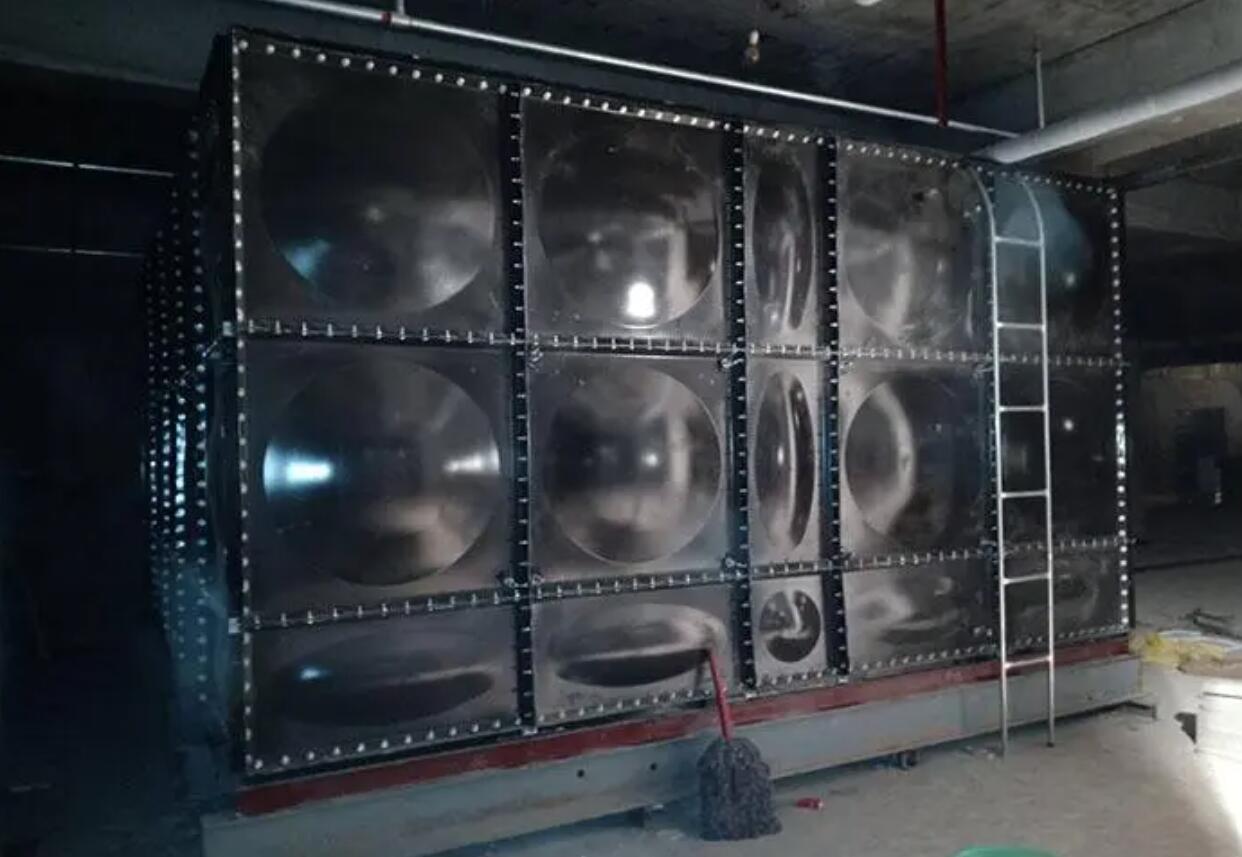
Introduction
FRP water tanks are widely used in water supply, drainage, fire protection, and HVAC systems, but leakage remains the top complaint. Welding and sealing quality directly determine tank lifespan and safety. Unlike metal tanks, FRP “welding” relies on resin curing to achieve interlayer fusion rather than melting. Beijing Yuanhui FRP Co., Ltd. has delivered over 5,000 tanks in the Beijing-Tianjin-Hebei region. This article draws on its engineering data to dissect the critical process nodes of welding and sealing.
1. Material Preparation & Interface Treatment: The Starting Point of Seal Quality
1.1 Surface Preparation Standards
Hand lay-up or compression-molded FRP panels must be sanded before jointing. Use 60-80 grit sandpaper at a 45° angle to remove wax and dust, achieving a roughness of Ra 3.2-6.3 μm. Tests show that unsanded interfaces have a peel strength of only 0.8 MPa, while sanding boosts it to over 3.5 MPa.
1.2 Resin & Hardener Ratio
For isophthalic unsaturated polyester resin, MEKP hardener is typically added at 1.5%-2.5% by weight. When temperature drops below 15°C, increase to 2.5%-3% with 0.3%-0.5% cobalt naphthenate accelerator. Yuanhui’s field records show that improper winter ratios caused 37% of incomplete curing-related leakage failures.
2. Core Welding & Sealing Process: Hand Lay-Up Butt Joints & Interlayer Bonding
2.1 Overlap Width & Fiber Orientation
For panel butt joints, recommended overlap width is 8-10 times the panel thickness (e.g., 64-80mm for 8mm panels). Use alternating layers of 0.4mm chopped strand mat and 0.2mm surface mat with fibers oriented at 0°/90° to avoid stress concentration. Roll after each layer to degas; bubble residue must be below 2%.
2.2 Stepped Joint Method
For panels thicker than 10mm, use a stepped bevel: each step 15-20mm wide and 1-2mm deep, 3-4 steps total. This increases shear area by 60% and achieves over 85% of parent material tensile strength. Yuanhui applied this method in a 500m³ fire water tank project, with no micro-cracks after three years of service.
3. Sealant Application & Curing Control
3.1 Sealant Selection
Sealant must be compatible with the resin system. Polyurethane offers good elasticity but lower water resistance than epoxy; epoxy has high bond strength but brittleness. Recommended: epoxy-polysulfide composite for inner walls, polyurethane for outer walls. Curing time: 24 hours at 25°C, extend to 36-48 hours when humidity exceeds 80%.
3.2 Injection Parameters
Use a two-component pneumatic dispensing gun with mixing ratio tolerance within ±2%. Injection pressure: 0.4-0.6 MPa; nozzle distance: 10-15mm; travel speed: 8-12mm/s. Over-injection leads to excessive thickness (>5mm) and higher shrinkage, causing debonding.
4. Common Defects & Remediation
4.1 Bubbles & Pinholes
Cause: high resin viscosity or insufficient degassing. Remedy: puncture bubbles with a needle, inject low-viscosity resin (diluted with 5% styrene), cover with release film, cure, and sand.
4.2 Interlayer Delamination
Cause: excessive interval between layers (>1.5x gel time) or failure to sand a fully cured previous layer. Remedy: sand down to a fresh layer, reapply impregnated mat, cure, and hydrotest.
4.3 Sealant Cracking
Cause: uneven thickness or structural deformation. Prevention: add an elastic transition layer (e.g., rubber gasket) in the weld zone; control sealant thickness to 2-4mm. Yuanhui’s project data shows that using an elastic transition layer reduced cracking rates from 11.2% to 2.8%.
Conclusion
FRP water tank welding and sealing is far more than “applying a layer of glue.” It requires coordinated control of surface preparation, hand lay-up parameters, sealant selection, and curing conditions. Beijing Yuanhui FRP Co., Ltd. has established a standard SOP—sanding, stepped joints, alternating fabric layers, and elastic transition—that reduces factory tank leakage rates to below 0.3%. For practitioners, recording gel time and ambient temperature/humidity for each batch is more reliable than relying on experience alone.