Color Selection and UV Protection for FRP Water Tanks: Key Factors Affecting Longevity
Introduction
For outdoor FRP water tanks, ultraviolet (UV) radiation is the primary cause of material degradation. Beijing Yuanhui FRP Co., Ltd. has observed over 15 years of production that color selection directly determines UV resistance. Many users focus solely on storage capacity while ignoring how paint color affects lifespan. This article examines the relationship between color and UV protection from a materials science and engineering perspective.
How UV Radiation Damages FRP Tanks
Photo-oxidative Degradation
FRP consists mainly of unsaturated polyester resin and glass fiber. UV-B rays (280-315 nm) possess sufficient energy to break C-C and C-O bonds in the resin, initiating photo-oxidation. Unprotected FRP exposed outdoors for six months shows a 0.3-0.5 mm reduction in surface resin thickness and a 15%-20% decrease in flexural strength.
Color, Heat Absorption, and Reflection
Dark colors (e.g., black, dark blue) absorb more light, raising surface temperature 15-20°C above light colors (white, light gray). Higher temperatures accelerate thermal-oxidative aging—every 10°C increase roughly doubles the reaction rate. Accelerated aging tests by Beijing Yuanhui FRP Co., Ltd. show that white samples (85% reflectivity) retain 32% more tensile strength than black samples (5% reflectivity) under identical conditions.
Performance Data for Different Colors
White: The Preferred Choice
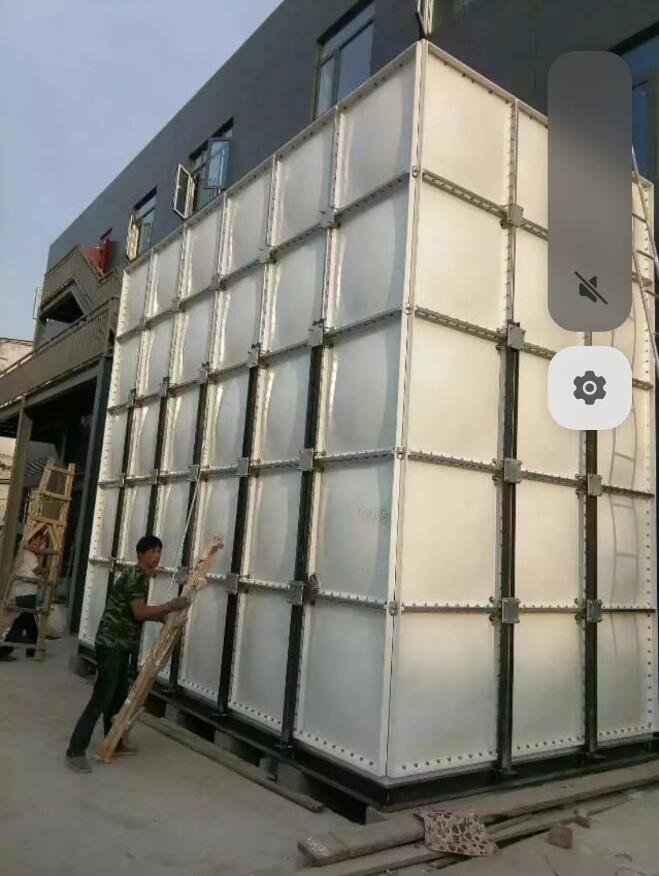
After five years of outdoor use, white or light gray tanks exhibit only slight chalking, with strength retention above 80%. Case study: A white FRP tank installed in a Beijing villa community in 2018 shows no cracks or leaks to date. White surfaces reflect most UV rays, slowing resin degradation.
Blue: Balancing Aesthetics and Performance
Light blue is a popular choice, absorbing 40%-50% of UV radiation. However, dark blue is risky—a deep blue tank installed at a coastal factory in 2019 developed visible cracks after three years, with resin degradation reaching a depth of 1.2 mm.
Green and Gray: Specialized Applications
Green tanks blend into garden environments but require 2%-3% UV absorbers (e.g., benzotriazoles). Light gray performs similarly to white, while dark gray behaves like dark blue. Beijing Yuanhui FRP Co., Ltd. recommends light colors unless specific aesthetic requirements dictate otherwise.
Technical Recommendations for Color Selection
UV Absorbers and Pigment Ratios
Regardless of color, UV absorbers must be added to the gel coat. Hindered amine light stabilizers (HALS) at 0.5%-1.0% are recommended. Use high-durability inorganic pigments (e.g., titanium dioxide, iron oxide red) instead of organic pigments (e.g., azo compounds) to prevent rapid fading.
Coating Thickness and Application
Gel coat thickness should be 0.3-0.5 mm—too thin offers insufficient protection, too thick risks cracking. Beijing Yuanhui FRP Co., Ltd. uses a combined spray-and-brush process to ensure uniform coverage. Each batch undergoes accelerated UV aging testing per ASTM G154, requiring ΔE ≤ 3.0 after 2,000 hours of exposure.
Maintenance Schedule and Repair
Inspect outdoor tanks every 2-3 years. If chalking or discoloration appears, lightly sand with 400-grit paper and reapply matching gel coat. After repair, verify UV blocking rate remains at least 90% of the original value.
Conclusion
Color selection for FRP water tanks is a technical decision, not merely an aesthetic one. Light colors (white, light gray, light blue) combined with quality UV absorbers allow safe outdoor service for 10-15 years. Beijing Yuanhui FRP Co., Ltd. suggests adding a sunshade or using metallic silver-gray paint (reflectivity >70%) if the budget allows. Remember: the lighter the color, the longer the tank lasts.