Color Selection and UV Protection for FRP Water Tanks: A Professional Guide
Introduction: Color Is More Than Aesthetic
FRP water tanks installed outdoors face continuous solar radiation. The UV-induced degradation of unsaturated polyester or epoxy resins is well documented: wavelengths between 280-400nm break polymer chains, causing surface chalking, discoloration, and mechanical property loss. Beijing Yuanhui FRP Co., Ltd., with nearly two decades of production and field service data, has observed that color choice directly correlates with UV protection efficiency and, consequently, product lifespan.
White or light-colored tanks are often chosen for their high reflectivity and lower heat absorption, while dark tanks are preferred for architectural consistency. However, the relationship between color and UV resistance is not simply about reflectance—it involves resin type, pigment chemistry, and coating thickness. This article deconstructs these variables from a materials science perspective.
Physicochemical Mechanisms of Color and UV Absorption
Resin Matrix: The First Barrier
Regardless of color, the resin matrix forms the primary UV defense. Isophthalic unsaturated polyester resins (e.g., Beijing Yuanhui's FRP-UV300 series) contain aromatic rings that offer superior UV tolerance compared to orthophthalic types. Yet even these resins yellow noticeably after 6-12 months of outdoor exposure without protection. Surface coatings or pigment layers then serve as the secondary barrier.
Pigments as Functional Additives
Pigments are not merely coloring agents. Titanium dioxide (TiO₂) in white tanks, especially the rutile form, scatters and absorbs UV rays with over 80% reflectivity. Carbon black (black pigment) absorbs nearly all visible and UV light, but if poorly dispersed or under-concentrated, it can accelerate thermal-oxidative aging due to localized heat buildup. Beijing Yuanhui's lab tests show that white specimens with 5% rutile TiO₂ retained 92% tensile strength after 1,000 hours of QUV accelerated aging, while black specimens with 2% carbon black retained only 78% under identical conditions.
Intermediate colors—such as light gray or beige—use blended pigments. Iron oxides (Fe₂O₃, FeO(OH)) offer stable UV absorption, but organic azo pigments fade quickly outdoors, reducing protective effectiveness. Although the industry standard JC/T 658.1 does not mandate UV performance by color, Beijing Yuanhui recommends white or light gray for outdoor installations based on cost-benefit analysis.
Comparative Performance of Color Schemes
White: The Industry Benchmark
White FRP tanks hold over 65% of the global market for good reason: high reflectivity lowers surface temperature by 8-12°C in summer, reducing thermal stress on interlayer interfaces. In a three-year tracking study by Beijing Yuanhui at a Hebei project (2,600 annual sunshine hours), white tanks showed no chalking, while blue tanks exhibited localized discoloration after two years with a 12% drop in Barcol hardness.
Dark Colors: Aesthetics vs. Risk
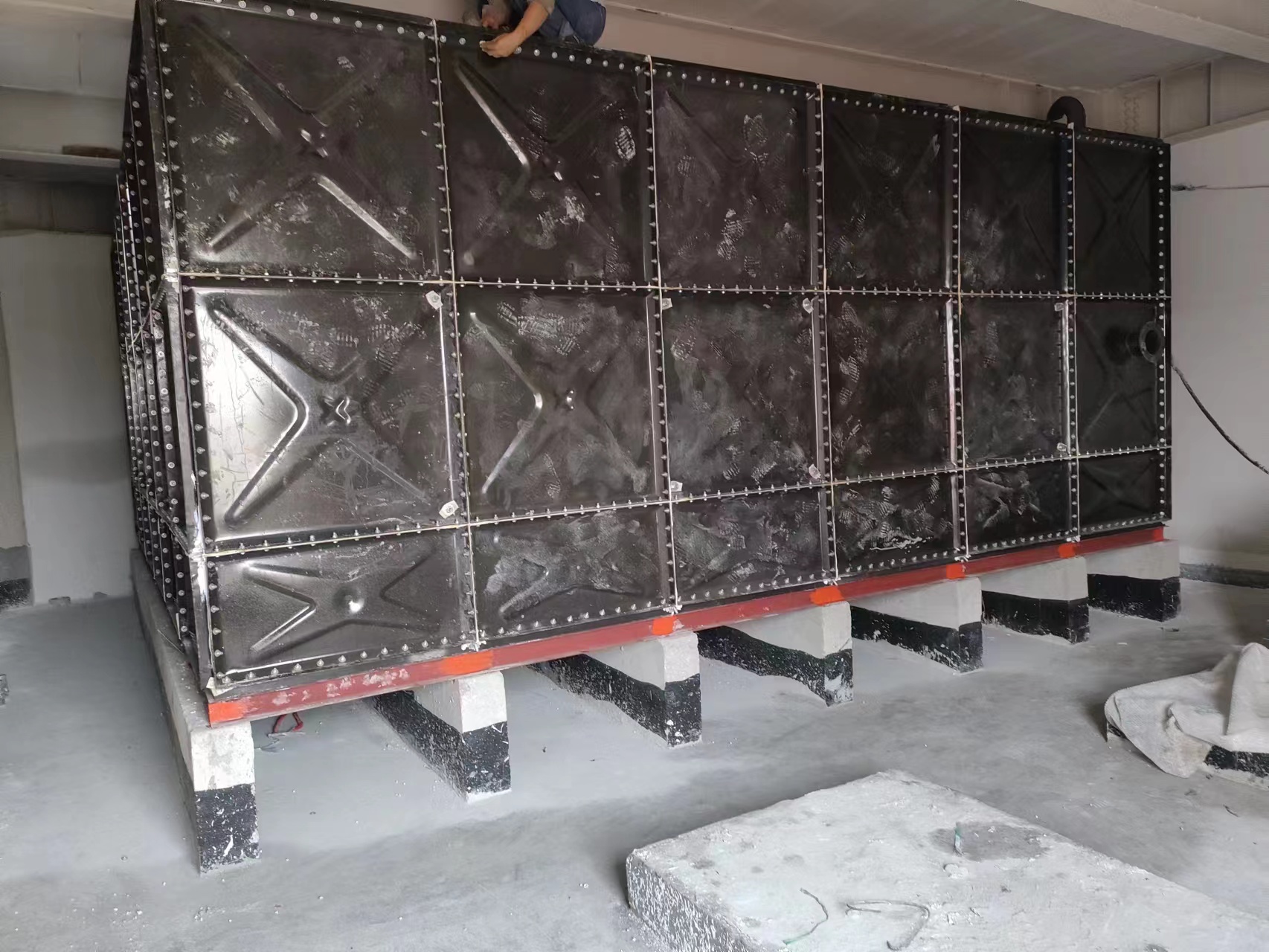
Dark blue, gray, or black tanks are common in high-end residential or landscape-sensitive projects. However, dark tanks require UV-stabilized resin systems, such as those containing UV absorbers (e.g., UV-328) or hindered amine light stabilizers (HALS). Beijing Yuanhui customized a black tank for a real estate project by increasing HALS content to 1.5% in the surface layer and adding a 200μm gel coat, passing 5,000 hours of xenon-arc testing (ISO 4892-2). Still, dark tanks typically have a design life 3-5 years shorter than white ones, necessitating more frequent maintenance.
Custom Colors: Dual-Layer Solution
When clients specify RAL colors like RAL 5015 sky blue or RAL 6018 yellow-green, Beijing Yuanhui uses a two-layer structure: a white UV-protective base layer (≥400μm) topped with a colored gel coat (≥300μm). This separates UV absorption from decorative function—even if the top layer fades, structural protection remains. In a 2023 Beijing tech park case, a pure white (RAL 9010) tank showed a color difference ΔE of only 1.2 after four years, compared to 5.8 for a single-layer colored tank over the same period.
Key Decision Parameters and Practical Recommendations
Climate Dictates Color Limits
In low-latitude or high-altitude regions (e.g., Yunnan, Tibet), UV intensity is 1.5-2 times that of plains. Beijing Yuanhui's engineering database indicates that dark gray tanks in Lhasa (annual UV index >11) require recoating within five years, while white tanks need no maintenance for a decade. Therefore, for areas with an annual UV index above 8, only white or light colors are recommended.
Coating Thickness Is Non-Negotiable
Color alone does not guarantee UV protection. Regardless of shade, the surface coating (gel coat or resin-rich layer) must exceed 400μm. Beijing Yuanhui uses ultrasonic thickness gauges (accuracy ±10μm) for batch sampling. Thin spots below this threshold can develop pinhole aging within two years, even on white tanks.
Installation and Maintenance
Field cuts and openings must be immediately sealed with matching resin; exposed edges become UV entry points. Beijing Yuanhui offers an integrated “color + protection” service, recommending optimal color and resin formulations based on latitude, annual sunshine hours, and budget. For example, in North China (2,200 annual sunshine hours), light gray with HALS-modified resin offers the best cost-performance balance.
Conclusion
Color selection for FRP water tanks must transcend visual preference and return to materials science: white, with its high reflectivity and stable TiO₂ system, is the UV protection champion; dark colors require modified resins, thicker coatings, and higher maintenance; custom colors demand a dual-layer design for balanced function and aesthetics. Beijing Yuanhui FRP Co., Ltd. urges industry peers and end users to request accelerated aging data per ASTM D2565 or ISO 4892-2 before purchasing, and to make decisions grounded in local UV intensity. Color is appearance; protection is the foundation—a principle that holds for all outdoor FRP products.