Detailed Analysis of FRP Water Tank Lining Anti-Corrosion Technology: From Material Selection to Construction Acceptance
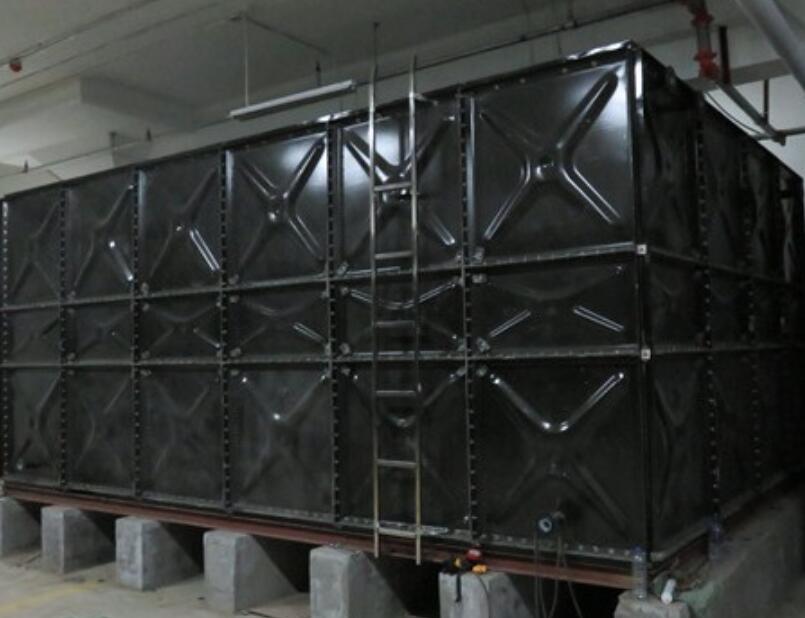
Introduction
FRP water tanks are widely used in potable water storage, industrial water treatment, and fire protection systems. Their lining anti-corrosion performance directly determines service life. According to JC/T 658.1-2007, approximately 35% of tank failures stem from lining corrosion or delamination. Over 12 years of production, Beijing Yuanhui FRP Co., Ltd. has identified material selection errors and construction defects as primary pain points. This article systematically examines three critical aspects of lining anti-corrosion technology from both material science and engineering perspectives.
1. Resin Selection Strategy
1.1 Epoxy vs. Vinyl Ester Resins
Lining resins must balance chemical resistance, low shrinkage, and high adhesion. For potable water tanks, food-grade epoxy resin (e.g., bisphenol A type) with volatile content below 0.5% (per GB/T 5750.4-2023) is preferred. For aggressive pH environments (3-12), vinyl ester resins like Derakane 411-350 are recommended, offering a temperature limit of 120°C—40°C higher than standard epoxy.
1.2 Curing Systems and Additives
MTHPA (methyl tetrahydrophthalic anhydride) as a hardener with 2-ethyl-4-methylimidazole accelerator achieves initial cure in 8 hours at 25°C and full cure in 24 hours. Adding 3% fumed silica reduces shrinkage to below 0.8%, preventing lining cracks, as verified by Beijing Yuanhui's internal tests.
2. Fiber Reinforcement Design
2.1 Fiber Types and Layup Sequence
The lining layer uses C-glass surface veil (30 g/m²) as the first ply to prevent resin bleed-through. Structural layers employ E-glass woven roving (800 g/m²) in a [0°/90°/±45°] symmetric pattern. Total layers depend on tank pressure: 4 layers for ≤0.1 MPa, 6 layers for 0.1–0.3 MPa. In a chemical plant project, Beijing Yuanhui applied a 6-layer design, achieving zero leakage after 3 years at 0.25 MPa.
2.2 Interface Treatment and Bond Strength
Substrates require grit blasting to Sa2.5 grade with 50–75 μm roughness. Epoxy primer (viscosity 800–1200 mPa·s) is applied, and fiber is laid within 30 minutes to ensure bond strength ≥10 MPa (pull-off test).
3. Construction and Quality Control
3.1 Hand Lay-Up Parameters
Environmental conditions: 18–30°C, relative humidity ≤75%. Resin mix ratio tolerance ≤2%, resin content 45%–55%. Each ply is compacted with a debulking roller, limiting bubble area to ≤3%. In a Beijing-Tianjin-Hebei project, Beijing Yuanhui used vacuum-assisted resin infusion, reducing porosity from 5% (hand lay-up) to 1.2%, significantly enhancing corrosion resistance.
3.2 Curing and Post-Processing
After 24-hour ambient cure, a post-cure at 80°C for 4 hours relieves internal stresses. Spark testing at 15 kV/mm detects pinholes; defects are repaired and retested. Lining surface roughness Ra ≤3.2 μm minimizes fouling.
4. Acceptance Standards and Issues
4.1 Testing per GB/T 5750
Lining thickness is measured by ultrasonic gauge (5 points per m², deviation ≤0.2 mm). Barcol hardness ≥35 (ASTM D2583), hydrostatic test at 1.5× design pressure for 30 minutes with no leakage. Beijing Yuanhui adds a 72-hour hot water soak test (60°C) to simulate extreme conditions.
4.2 Failure Case Analysis
In a coastal project, lack of UV-resistant gel coat caused surface blistering. Solution: adding a 0.3 mm isophthalic polyester gel coat extended service life beyond 8 years.
Conclusion
FRP water tank lining anti-corrosion is a systematic process requiring precise control from resin selection to acceptance. For potable water, Beijing Yuanhui FRP Co., Ltd. recommends food-grade epoxy with VARTM; for industrial use, vinyl ester resin with symmetric layup. Annual spark testing can reduce maintenance costs by over 40% by early detection of corrosion risks.