Complete Manufacturing Process of FRP Water Tanks: 12 Core Steps from Raw Materials to Finished Products
Introduction
FRP (Fiber Reinforced Plastic) water tanks are widely used in construction, fire protection, and industrial water storage due to their lightweight, high strength, corrosion resistance, and design life exceeding 30 years. Beijing Yuanhui FRP Co., Ltd., with 15 years of manufacturing experience and an annual capacity of over 5,000 units, presents a technical breakdown of the 12 core processes from raw material intake to finished product dispatch.
1. Raw Material Inspection and Pretreatment
1.1 Resin and Fiber Standards
We use 196# unsaturated polyester resin (viscosity 0.45-0.65 Pa·s, acid value ≤25 mgKOH/g) and E-glass chopped strand mat (450g/m²±5%) with surface veil (30g/m²). Each batch undergoes gel time testing (8-15 min at 25°C), tensile strength (≥120 MPa), and Barcol hardness (≥40).
1.2 Mold Cleaning and Release Agent
Steel molds must have surface roughness ≤Ra3.2μm. PVA release agent is applied in two coats with a 30-minute interval, dried to a thickness of 0.02-0.05mm. In a 2023 case, uneven coating caused a 3.2% scrap rate, resolved by adding visual inspection.
2. Lay-up and Forming Processes
2.1 Hand Lay-up Parameters
Standard SMC tank panels use a structure of "surface veil + 3 layers of CSM + 2 layers of woven roving," total thickness 8-12mm. Resin-to-fiber weight ratio is 2.5:1 to 3.0:1. Each layer is compacted with a serrated roller to keep bubble content ≤0.5%.
2.2 Filament Winding (Alternative)
For tanks with diameter ≥2m, helical winding at 55°-60°, with 25mm tow width and 8-15N tension, achieves fiber content of 65%-70% (8-12% higher than hand lay-up) and 30% higher hoop strength.
3. Curing, Demolding, and Post-Processing
3.1 Curing Profile
Room-temperature curing: 20-30°C, ≤70% RH for 24 hours. Heat curing (60°C×4h) increases interlaminar shear strength by 15%, but ramp rate must be ≤2°C/min to avoid thermal stress cracks.
3.2 Demolding and Trimming
Flashes are trimmed to ≤3mm, edges rounded to R≥5mm. Defect limits: pinholes ≤5/m², no delamination or white spots.
4. Assembly, Testing, and Packaging
4.1 Modular Assembly
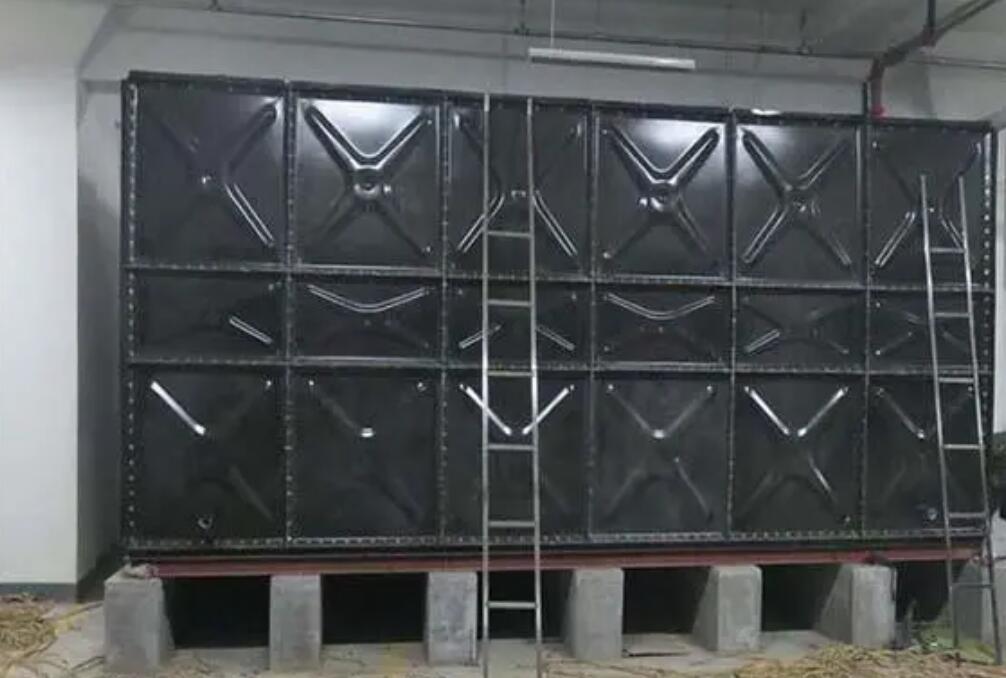
Standard tanks use SMC compression-molded panels (1m×1m or 1m×2m), joined by 304 stainless steel bolts with EPDM gaskets (Shore A 60±5, compression set ≤25%). Beijing Yuanhui FRP Co., Ltd. uses laser-guided drilling with hole position deviation ≤0.5mm.
4.2 Full-Water Test
Per GB/T 17219, tanks are filled to design level and held for 48 hours; leakage must be ≤0.1% per hour. Our 5,000-unit data shows a 98.7% first-pass rate. Leakage points (90% at bolted joints) were reduced by using torque wrenches (25-30 N·m), improving the pass rate to 99.5%.
Conclusion
Manufacturing FRP water tanks requires precise control of material science, process parameters, and assembly accuracy. From resin viscosity to bolt torque, every detail affects product lifespan. Beijing Yuanhui FRP Co., Ltd. continues to optimize its production line, achieving an average cycle time of 48 hours with a 99%+ yield rate in 2024. Buyers are advised to review curing records and full-water test reports when selecting a supplier.