Color Selection and UV Protection for FRP Water Tanks: A Professional Guide
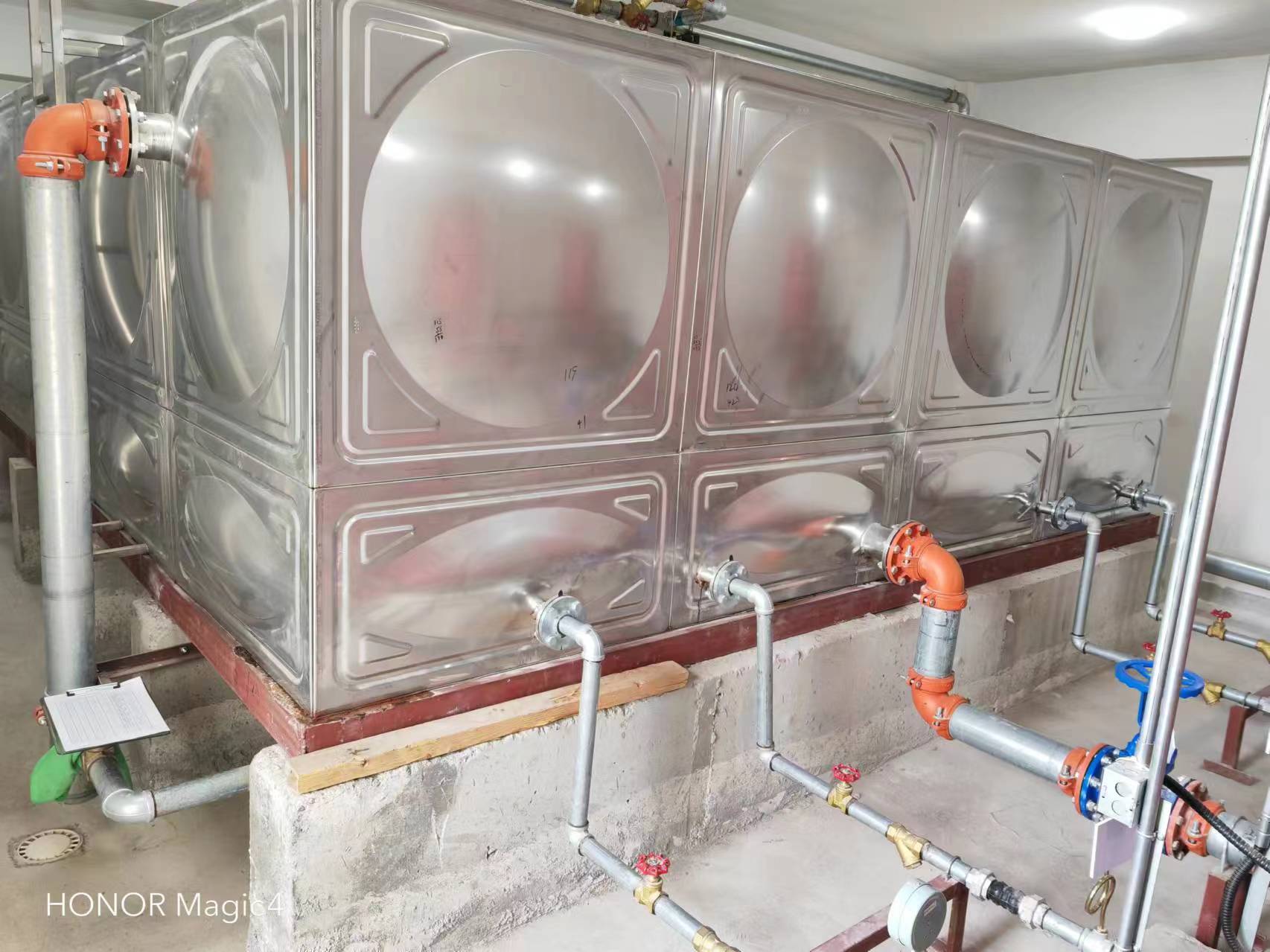
Introduction
For outdoor FRP water tanks, ultraviolet (UV) radiation is a primary cause of performance degradation. The resin matrix undergoes photodegradation under prolonged sunlight, leading to surface chalking, discoloration, and loss of mechanical strength. Color choice directly impacts the tank's weather resistance lifespan. Beijing Yuanhui FRP Co., Ltd., based on years of production and field test data, presents the following professional recommendations.
UV Damage Mechanism in FRP Tanks
Photodegradation Process
UV photons in the 290-400nm wavelength range possess sufficient energy (up to 400 kJ/mol) to break C-C bonds (347 kJ/mol) in the resin molecular chain. Experimental data show that unprotected FRP experiences a 35%-45% reduction in flexural strength after 12 months of outdoor exposure (ASTM D790).
Color-Temperature Coupling Effect
Dark colors (e.g., black, dark blue) absorb more visible and infrared radiation, resulting in surface temperatures 15-25°C higher than light colors (measured: black tank 65°C, white tank 42°C in summer). For every 10°C rise, resin degradation rate increases by approximately 1.5-2 times (Arrhenius law). Thus, dark tanks age significantly faster.
Color Selection Principles and Data
Light Colors Preferred
Colors with reflectance >70% (white RAL 9010, light gray RAL 7035, beige) effectively reduce thermal stress and UV absorption. Beijing Yuanhui's accelerated aging test (QUV, 340nm lamp, 1000h) shows: white samples retained 82% gloss retention, black only 31%.
Dark Colors in Special Conditions
In high-latitude cold regions, black or dark green tanks can absorb solar radiation to assist ice melting. In such cases, UV-stabilized resin (e.g., benzotriazole type, 0.3%-0.5% addition) must be used. Beijing Yuanhui supplied black tanks for a project in Northeast China; after 5 years outdoor service, flexural strength retention reached 78% (control without stabilizer: only 52%).
Role of UV Additives
Adding nano-TiO₂ (particle size 20-50nm, 2%-4% by weight) to the gel coat can increase UV shielding efficiency above 90%. Beijing Yuanhui internal test: white gel coat with 3% nano-TiO₂ showed color difference ΔE<1.5 after 2000h QUV, compared to ΔE>6.0 for the unmodified version.
Case Study and Maintenance Guidelines
Case: Outdoor Tank in Southern China Electronics Plant
The original dark blue tank developed extensive chalking and leakage after 3 years. Replaced with a Beijing Yuanhui white tank (gel coat with UV absorber). After 6 years, surface hardness (Barcol 934-1) dropped only 5%, with no repair needed.
Maintenance Intervals
- Light tanks: inspect gel coat every 3-5 years; apply UV-protective clear coat if needed.
- Dark tanks: inspect every 1-2 years; if chalking or discoloration exceeds 0.1mm depth, grind and recoat.
Conclusion
Light colors should be prioritized for FRP water tanks to maximize UV protection. In special environments requiring dark colors, UV-stabilized resin systems are mandatory. Beijing Yuanhui FRP Co., Ltd. recommends providing site climate parameters (annual sunshine hours, UV index) during tank specification to tailor the optimal color solution. Proper color selection combined with regular maintenance can extend tank design life from 10 to over 20 years.