Pressure Performance of FRP Water Tanks: Design Parameters, Testing Standards and Engineering Validation
Pressure Performance of FRP Water Tanks: Design Parameters, Testing Standards and Engineering Validation
Fiberglass reinforced plastic (FRP) water tanks are widely used in fire protection, domestic water supply, and industrial liquid storage. Unlike atmospheric tanks, pressure-rated FRP tanks must withstand static hydraulic pressure, thermal stress, and cyclic loading. Based on over a decade of manufacturing and testing at Beijing Yuanhui FRP Co., Ltd., this article examines the core design principles, applicable testing standards, and common failure modes.
Key Factors Determining Pressure Capacity
Wall Thickness and Laminate Structure
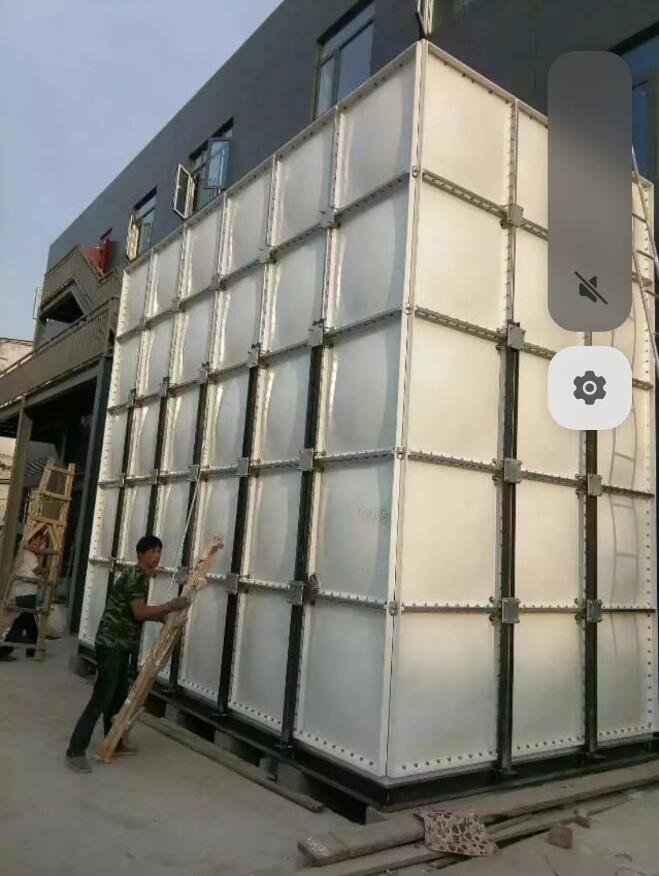
The pressure rating of an FRP tank is primarily governed by wall thickness and fiber reinforcement layers. Beijing Yuanhui's SMC molded tanks rated for 0.6MPa use a sandwich structure: a 2mm corrosion-resistant inner liner, a 6mm structural layer of E-glass fiber and isophthalic polyester resin, and a 1mm UV-resistant gel coat. At a total thickness of 9mm, measured burst pressure reaches 3.8MPa, yielding a safety factor above 6. Laminate orientation is equally critical. Alternating ±45° and 0°/90° plies distribute hoop and axial stresses, preventing premature cracking. Beijing Yuanhui performs interlaminar shear tests per ISO 9001, ensuring values ≥15MPa for every batch.
Joint and Seal Design
Tank failure most often occurs at panel joints and flanges. Beijing Yuanhui employs a double-seal method: a butyl rubber gasket as the primary seal and polysulfide sealant as the secondary. Stainless steel bolts are spaced at 150mm intervals, torqued to 30N·m. Factory pressure tests show zero leakage at 0.8MPa under this configuration.
Temperature and Environmental Effects
Sustained temperatures above 60°C accelerate resin softening and creep. Design must reference ASTM D2992 for long-term hydrostatic regression testing. Beijing Yuanhui's accelerated aging trials indicate a 12% pressure capacity reduction after 1,000 hours at 70°C, yet still exceeding 0.5MPa. For hot water applications, epoxy vinyl ester resin is recommended.
Testing Standards and Acceptance Criteria
Chinese Standard: GB/T 21238-2016
This standard mandates a hydrostatic test at 1.5 times the design pressure for 30 minutes, with no leakage or visible deformation. For a 0.6MPa design, the test pressure is 0.9MPa. Beijing Yuanhui adds destructive sampling at 1.0MPa to ensure batch consistency.
International Standards: ISO 9001 and ASTM D1599
ISO 9001 focuses on process control, requiring traceable records for mixing, winding, and curing. ASTM D1599 defines short-term burst testing: pressurize at a constant rate at 23±2°C until failure. Beijing Yuanhui's SMC tanks achieve 3.8MPa burst pressure under this protocol, far exceeding the design value.
Cyclic Fatigue Testing
To simulate fire pump cycling, tanks undergo 10,000 cycles from 0 to 0.6MPa. Beijing Yuanhui's test rig recorded only micro-cracks (<0.1mm) after 12,000 cycles with no propagation, a result accepted by multiple fire protection authorities.
Engineering Case Studies
Case 1: A high-rise residential fire tank (30m³, design pressure 0.4MPa). Beijing Yuanhui supplied a 10mm wall, double-seal design. After installation, a 0.6MPa hydrostatic test showed only 0.02MPa pressure drop over 24 hours (allowable: 0.05MPa). Two-year follow-up confirmed zero leaks.
Case 2: A chemical intermediate tank (5m³, 5% hydrochloric acid, working pressure 0.3MPa). Vinyl ester resin with 14mm wall thickness was used. After 10,000 cycles from 0 to 0.3MPa, pressure capacity remained 0.45MPa. Compared to carbon steel, the FRP tank showed no corrosion and 60% weight reduction.
Common Failure Modes and Prevention
Delamination and Blistering
Typically caused by incomplete curing or poor fiber wet-out. Beijing Yuanhui uses step-wise heating and vacuum-assisted infusion to achieve ≥95% cure. Every product undergoes ultrasonic C-scan; panels with delamination area >1% are rejected.
Flange Root Cracking
Stress concentration at the flange root is mitigated by adding an R10 fillet and three additional glass plies. Fatigue life improved by 3× after this modification.
Conclusion
The pressure performance of FRP water tanks depends on material selection, structural design, and process control. Adherence to GB/T 21238-2016 and ISO 9001, combined with optimized wall thickness, robust sealing, and rigorous testing, ensures long-term safe operation at 0.4–0.6MPa. Beijing Yuanhui FRP Co., Ltd. recommends selecting resin systems and safety factors based on actual water temperature, medium, and cycle frequency. As automated winding and inline inspection technologies mature, pressure consistency will continue to improve.