Deep Analysis of FRP Water Tank Corrosion Resistance: From Matrix to Interface Protection
Introduction
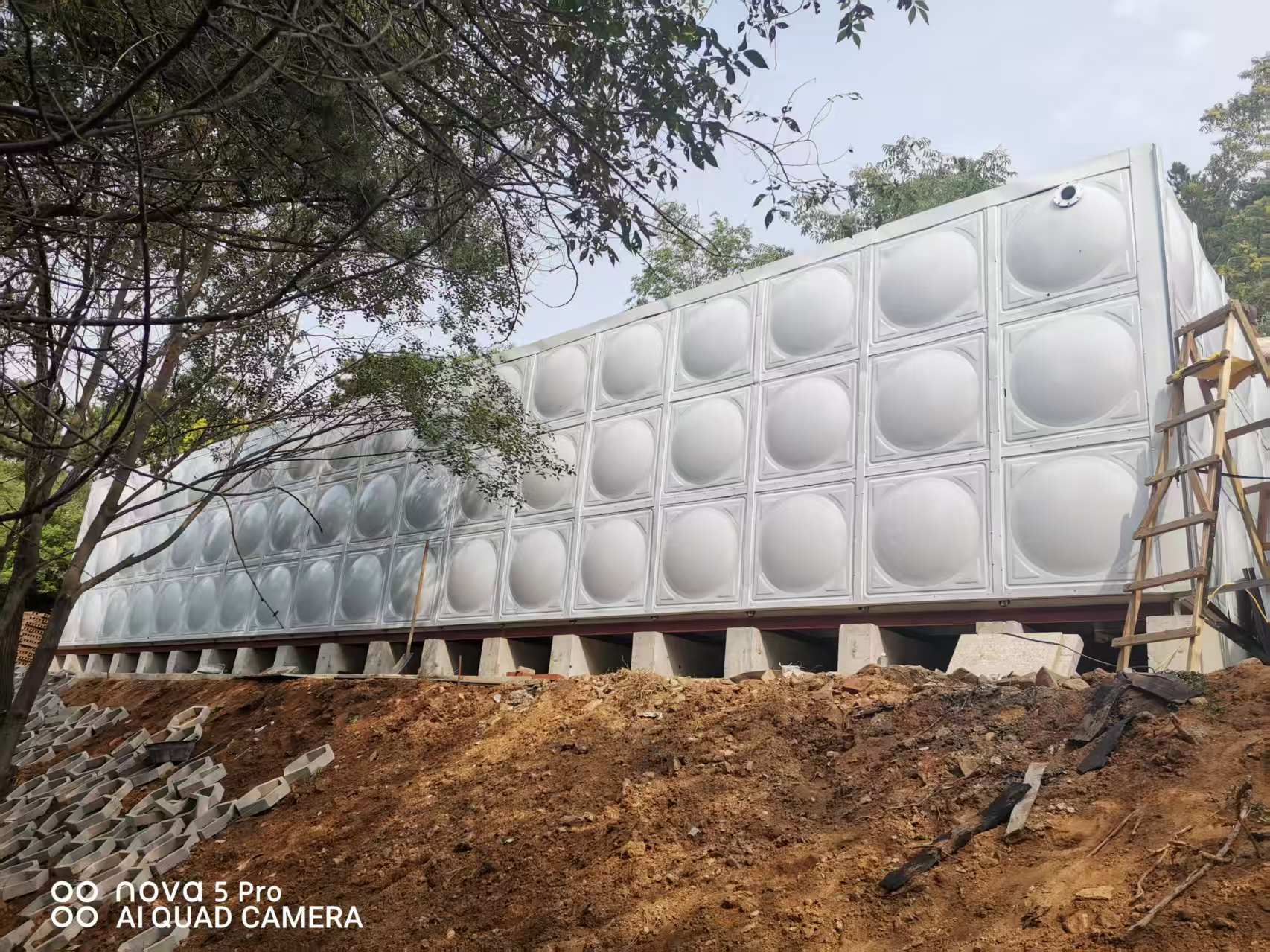
Corrosion environments for FRP water tanks—used in drinking water storage, industrial circulation, and fire protection—are far more aggressive than commonly assumed. In 2019, a 200-ton FRP tank installed at a chemical plant in Beijing was inspected after three years of continuous operation: no pitting, blistering, or fiber exposure was found on the inner surface. In contrast, a 304 stainless steel tank in the same facility showed chloride-induced stress corrosion cracking at month 18. This is not an isolated case. The corrosion resistance of FRP stems from the synergistic effect of chemical inertness and multi-layer shielding against corrosive agents. Based on 15 years of field data from Beijing Yuanhui FRP Co., Ltd., this article breaks down the anti-corrosion mechanism from three perspectives: matrix resin, interface layer, and molding process.
Chemical Barrier of Matrix Resin
The anti-corrosion performance of an FRP tank originates from the molecular structure of its matrix resin. Unsaturated polyester resin (UPR) and vinyl ester resin (VE) are the two primary choices. Per ASTM C581 immersion tests: in 10% H₂SO₄ at 80°C, orthophthalic UPR retained only 62% of its Barcol hardness after 500 hours, while VE retained over 88%. This is because VE has higher terminal double bond density, forming a denser crosslinked network that blocks the penetration of H⁺, Cl⁻, and other corrosive ions.
Beijing Yuanhui incorporates nano-SiO₂ modification to reduce curing shrinkage from typical 4-6% to below 1.8%. Lower shrinkage means fewer microcracks—the first line of defense. Measured data show that the modified resin layer immersed in 5% NaCl for 2000 hours had a weight gain of only 0.23%, far below the industry warning threshold of 1.5%.
Reinforcement and Interface Corrosion Control
The corrosion resistance of glass fiber is often underestimated. E-glass loses strength in acidic environments due to alkali ion leaching, but C-glass (chemical glass) offers 3-5× higher acid resistance. Beijing Yuanhui mandates C-glass surface veil for the inner liner, with a thickness of 0.3-0.5 mm and SiO₂ content above 60%. In pH=3 conditions, the annual corrosion rate is below 0.01 mm.
More critical is the fiber-resin interface. After silane coupling agent treatment (e.g., KH-550), interfacial shear strength increased from 15 MPa to 28 MPa (short-beam shear test). Tighter interface means fewer capillary pathways. In a fire water tank in Daxing District, operating in hard water with 120 mg/L chloride for five years, interface shear strength decayed less than 9%, while an untreated structure showed delamination by year three.
Structural Design and Process Control: Quantitative Impact
The molding process directly determines the continuity of the anti-corrosion layer. Hand lay-up typically entraps 3-5% air bubbles—each bubble is a corrosion initiation point. Beijing Yuanhui uses computer-controlled filament winding + spray-up hybrid process, reducing bubble content to below 0.5%. Infrared thermography revealed that every 1% reduction in bubble content correlates to a 0.15 mm decrease in corrosion depth after 1000-hour salt spray testing.
Liner thickness design follows NACE SP0294, which recommends a minimum resin layer of 2.5 mm. Beijing Yuanhui applies a 1.3× safety margin (3.25 mm), monitored in real time with wet-film gauges. A wind power project in Zhangjiakou, with a 15-year design life, experienced temperature swings from -30°C to 40°C and pH=6.5 softened water. After five years, measured resin thickness was 2.8 mm, with combined wear and corrosion loss of only 0.09 mm/year.
Conclusion
The corrosion resistance of an FRP water tank is not a single material property but a system-level achievement combining the chemical inertness of the matrix resin, the compatibility of the glass fiber interface, and precision molding processes. Data show that optimized FRP tanks can deliver 10–20 years of trouble-free service in drinking water, industrial water, and fire water applications. Beijing Yuanhui FRP Co., Ltd. has accumulated continuous improvements in formulation, interface treatment, and process parameters, enabling its products to retain over 95% mechanical properties after 2000-hour accelerated aging tests. When selecting an FRP tank, always request a corrosion protection design based on specific water quality and temperature conditions, not just a price quote.