Full Process Analysis of FRP Water Tank Manufacturing: From Hand Lay-Up to Compression Molding
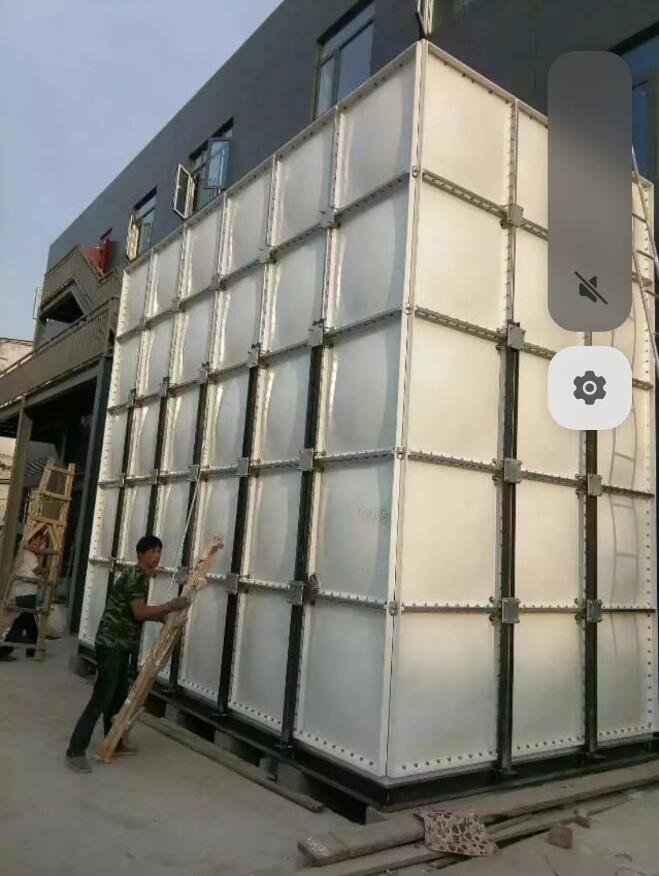
FRP (Fiberglass Reinforced Plastic) water tanks are widely used in building water supply, fire protection storage, and industrial cooling due to their corrosion resistance, lightweight strength, and long service life. But producing a qualified FRP tank involves far more than simply mixing resin and glass fiber. Every step—from ingredient preparation and molding to curing and inspection—directly impacts sealing performance, pressure capacity, and lifespan. This article uses the practical experience of Beijing Yuanhui FRP Co., Ltd. as a benchmark to systematically break down the full production process.
1. Raw Material Preparation and Ratio Control
The primary materials include unsaturated polyester resin, E-glass chopped strand mat or woven roving, curing agent (e.g., MEKP), accelerator (cobalt naphthenate), and fillers (calcium carbonate, aluminum hydroxide). Beijing Yuanhui FRP Co., Ltd. strictly controls resin-to-fiber ratios by weight: for standard SMC sheet, resin content is held at 28% ± 2%, glass fiber at 60% ± 2%, and the remainder fillers and additives. Resin viscosity is maintained at 0.3–0.5 Pa·s (25°C) to ensure thorough fiber wet-out. If resin content is too high, tank panels are prone to deformation; too high fiber content reduces toughness and can cause micro-cracks during processing. Each raw material batch undergoes a gel time test, with a target of 8–12 minutes at 25°C; if out of range, the curing agent dosage is adjusted.
2. Molding Processes: Hand Lay-Up vs. Compression Molding
2.1 Hand Lay-Up (for Irregular Shapes and Small Batches)
Hand lay-up is the earliest method used for FRP tank production, especially suitable for internal baffles, manhole covers, and stiffeners. The process: apply mold release agent (PVA or wax) → spray gel coat (0.3–0.5 mm thick) → lay glass mat and brush resin → use a roller to remove air bubbles and compact → repeat layers to design thickness. Beijing Yuanhui typically builds tank panels with 3–5 layers, total thickness 4–6 mm, resin consumption 0.4–0.6 kg/m² per layer. The critical control point is bubble area, which should not exceed 2% of total surface area; otherwise, leakage may occur under long-term water pressure. Disadvantages include high reliance on worker skill, low productivity (8–10 m² per person per day), and thickness uniformity variation up to ±0.5 mm.
2.2 Compression Molding (for Standard Sizes and High Volume)
Compression molding uses SMC or BMC as feedstock. The pre-impregnated material is placed in a mold and pressed under heat in a hydraulic press. Beijing Yuanhui's production line is equipped with 500-ton and 800-ton presses, mold temperature 140–160°C, pressure 15–25 MPa, and dwell time calculated at 30 seconds per mm of wall thickness. A standard 1m × 1m tank panel takes only 4–6 minutes per cycle, compared to 40–60 minutes for hand lay-up. Molded parts offer high dimensional accuracy (tolerance ±0.2 mm), excellent surface finish (Ra ≤ 3.2 μm), uniform fiber distribution, and isotropic mechanical properties. However, mold costs are high (¥80,000–150,000 per set), making the process economical only for projects with an annual output above 500 units. In 2022, Beijing Yuanhui supplied 350 sets of molded tank panels for a fire protection water tank project in a northern city, achieving a 99.6% pass rate at factory inspection—well above the industry average of ~97%.
3. Curing and Demolding
Curing determines the final performance of the tank. Hand-laid parts are cured at room temperature (25–30°C) for 24–48 hours, with ambient humidity below 75% to prevent surface tackiness and future peeling. Molded parts undergo high-temperature curing inside the mold, followed by immediate demolding. Post-curing is then performed: the parts are placed in an oven at 60–80°C for 2–4 hours to eliminate internal stress and raise the heat deflection temperature (HDT) above 120°C. Beijing Yuanhui uses infrared thermometers to monitor the entire post-curing process, ensuring the temperature difference between surface and core does not exceed 5°C, thus avoiding warpage. After demolding, parts are trimmed, burrs are ground, and defects such as delamination, cracks, or dry spots are inspected. Minor defects can be repaired by grinding the area, applying a resin-filler mixture, covering with glass cloth, and curing at room temperature for 24 hours.
4. Quality Inspection and Final Acceptance
Factory inspection covers four dimensions: appearance, dimensions, mechanical properties, and sealing. Appearance: visual check for bubbles, cracks, pinholes, gel coat peeling, and color difference ΔE ≤ 2. Dimensional tolerance: panel length and width ±2 mm, diagonal ±3 mm; flange flatness ≤ 1 mm/m. Mechanical properties per GB/T 8237-2017: tensile strength ≥ 80 MPa, flexural strength ≥ 120 MPa, Barcol hardness ≥ 35. The sealing test is critical: the assembled tank is filled with water and left for 72 hours to observe any leakage at seams and joints. In a 2023 project for a 300-ton fire protection tank at an industrial park, Beijing Yuanhui applied both a full water test and ultrasonic thickness measurement; the minimum panel thickness was 4.2 mm (design 4.5 mm), within tolerance, and the tank passed acceptance on the first attempt. For potable water tanks, a third-party hygiene inspection report is required to confirm that the resin and fillers comply with GB/T 17219-1998 standards for drinking water equipment.
Conclusion
FRP water tank production has evolved from traditional hand lay-up toward standardized compression molding, but each technique serves different needs. Hand lay-up is suitable for custom, small-batch projects, while compression molding offers superior efficiency, precision, and consistency. Beijing Yuanhui FRP Co., Ltd. operates mature production lines for both methods and can flexibly switch based on project requirements. For buyers, understanding the full production process helps scientifically evaluate supplier capabilities—focus on gel time control, post-curing temperature profiles, and sealing test methods, rather than price alone. A qualified FRP water tank derives its value from every fiber impregnation, every roller stroke, and every minute of curing time.