Complete Production Process of FRP Water Tanks: From SMC Molding to On-Site Assembly
1. Raw Material Selection and SMC Sheet Production
The foundation of an FRP water tank lies in its SMC (Sheet Molding Compound). Beijing Yuanhui FRP Co., Ltd. uses unsaturated polyester resin (UP resin) as the matrix, combined with E-glass chopped strands (25–50mm length), calcium carbonate filler, low-shrinkage additives, and a curing agent. The resin-to-filler weight ratio is maintained at 60:40 to 55:45 to ensure mechanical strength and water resistance. The SMC sheet is produced on a dedicated line: resin paste is evenly spread onto a carrier film, glass fibers are cut and randomly deposited on the paste, then covered with a top film and rolled into a compacted roll. Ambient temperature is kept at 20–25°C with humidity below 60% to prevent premature gelation. Each roll is typically 1.0–1.2m wide with an areal weight of 3.5–4.5 kg/m², and storage life is limited to 7 days at 25°C.
2. Compression Molding Process
SMC sheets are cut and weighed per mold design (e.g., a 1000×1000×15mm panel requires approximately 18kg of compound). Molding is performed on a hydraulic press at 140–150°C and 10–15MPa pressure, with hold time calculated as 1.5–2.0 minutes per mm of thickness. For a 3000×2000×15mm tank panel produced by Beijing Yuanhui, the actual molding cycle is 28–32 minutes. After molding, the panel cools naturally inside the mold to below 80°C before demolding to prevent warping. Edges are trimmed, and a flange (30–50mm wide) is reserved for assembly.
Key Process Parameters
Resin flow, fiber distribution uniformity, and mold temperature gradient are critical. Beijing Yuanhui uses multi-zone temperature control to keep mold surface variation ≤5°C. Density (1.8–2.0 g/cm³) and Barcol hardness (≥45) are tested on the first part of each shift before mass production.
3. Component Manufacturing and Pre-Treatment
Besides panels, an FRP tank requires flanges, manholes, pipe connections, ladders, and internal tie rods. Flanges and nozzles are made via hand lay-up or RTM, with fiber content of 35%–45%. All components undergo leak testing at 0.1MPa air pressure for 5 minutes. Internal tie rods are stainless steel 304 (diameter 10–12mm), acid-washed and passivated. Gaskets are EPDM or silicone rubber with Shore A hardness 60±5 and compression set <25%.
4. On-Site Assembly and Inspection
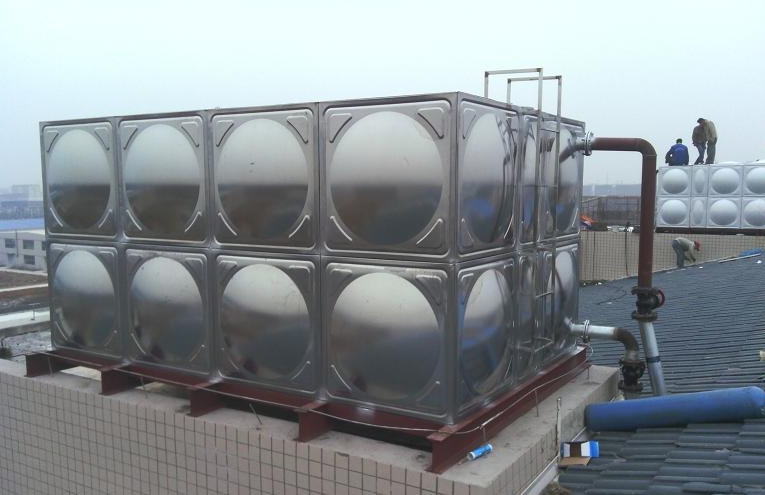
Tank assembly occurs at the customer site. First, a C20 concrete foundation is leveled to within 3mm/m. Panels are installed layer by layer from bottom to top using M10 stainless steel bolts torqued to 25–30Nm, with a bolt spacing of ≤200mm. Sealant (silicone structural adhesive, ±25% movement capacity) is applied at all joints. After assembly, a hydrostatic test is conducted: fill to design water level and hold for 24 hours. The acceptance criterion is leakage area <0.1% of total surface area. In a 300m³ tank project completed by Beijing Yuanhui in 2024, the actual leakage was 0.02%, far below the national standard.
Conclusion
Producing a reliable FRP water tank requires mastery of materials science, mold design, and field assembly. From precise SMC formulation and molding temperature control to bolt torque and sealant application, each step affects the final product's integrity. Standardized procedures and a robust quality tracking system—as practiced by Beijing Yuanhui FRP Co., Ltd.—keep the annual failure rate below 1.5%.