Pressure Performance of FRP Water Tanks: Testing Standards and Engineering Practice
Introduction
FRP (Fiberglass Reinforced Plastic) water tanks are widely used in building water supply, fire protection storage, and industrial cooling systems due to their light weight, high strength, corrosion resistance, and ease of installation. However, pressure performance—the tank’s ability to withstand internal and external loads under normal and extreme conditions—remains the decisive factor for safety and service life. Beijing Yuanhui FRP Co., Ltd., with over a decade of manufacturing experience, has observed that many users simplistically equate thicker walls with higher strength, overlooking the interplay of structural design, resin system, and layup process. This article provides an engineering perspective on pressure-bearing mechanisms and testing protocols.
Pressure-Bearing Mechanism and Key Parameters
Material Mechanics
The pressure capacity of FRP tanks depends on the anisotropic properties of the composite material. Typical hand lay-up or compression-molded tanks exhibit tensile strengths of 150–300 MPa and flexural moduli of 8–15 GPa. The interfacial bonding between the resin matrix (typically unsaturated polyester or vinyl ester) and the reinforcement (E-glass mat or woven roving) directly determines interlaminar shear strength. Data from Beijing Yuanhui’s lab shows that when resin content is controlled at 45%–55%, interlaminar shear strength reaches 18–25 MPa; deviations lead to delamination under pressure.
Structural Optimization
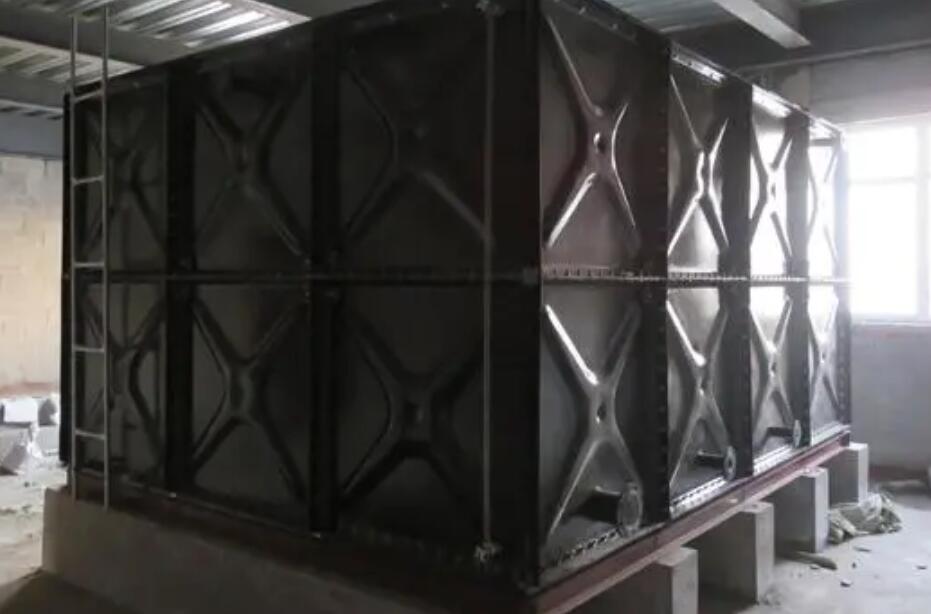
Pressure capacity is not solely a function of wall thickness. For rectangular tanks, side panels experience bending stress from hydrostatic pressure, requiring optimized stiffener spacing, top plate supports, and bottom plate flexural rigidity. Finite Element Analysis (FEA)-optimized designs can improve pressure capacity by over 30% with the same material usage. For example, one 10-ton fire water tank saw its burst pressure increase from 0.25 MPa to 0.38 MPa after reducing stiffener spacing from 600 mm to 400 mm and adopting trapezoidal rib profiles.
Current Testing Standards and Procedures
Domestic Standards
Pressure testing of FRP tanks in China primarily follows GB/T 21238-2016 and JC/T 658.1-2016. The standards require: a hydrostatic test at 1.5 times the design working pressure for 30 minutes with no leakage or deformation; for fire tanks, an additional 0.8 MPa test for 2 hours. Beijing Yuanhui FRP Co., Ltd. extends the holding time to 1 hour in internal quality control and limits leakage to below 0.01%, exceeding national requirements.
Test Methods and Equipment
Pressure tests are conducted using a hydrostatic test machine, recording pressure-strain curves. Key steps include: 1) venting and preloading; 2) stepwise loading (0.05 MPa increments, 5-minute dwells); 3) holding; 4) depressurization and inspection. Temperature compensation is critical—resin modulus decreases at elevated temperatures, so water temperature is controlled at 20±5°C. Beijing Yuanhui’s testing center uses automated data loggers and strain gauges to ensure traceability.
Common Failure Modes and Quality Control
Failure Analysis
Common pressure-related failures include: leakage (from incomplete curing or voids causing microcracks), blistering (delamination), and catastrophic burst (inadequate structural design). In one chemical plant case, a 6-ton tank developed side panel blistering after eight months. Cross-section analysis revealed incorrect layering—surface mat placed outside the structural layer, causing the surface to fail under internal pressure. Correct layup should be: inner liner (resin-rich layer, ≥0.5 mm) → structural layers (alternating 0°/90° woven roving and chopped strand mat) → outer protective layer.
Quality Control Measures
Three critical process controls: 1) precise resin-to-hardener ratio (tolerance ≤2%); 2) layer-by-layer consolidation with void content below 3%; 3) post-curing at 60–80°C for 4–6 hours to achieve ≥95% crosslinking. Beijing Yuanhui employs infrared thermography to inspect layup uniformity and conducts sample burst tests on each batch, ensuring a safety factor of at least 3.5.
Conclusion
The pressure performance of FRP water tanks is a system-level outcome of material selection, structural design, and process control—not merely a matter of wall thickness. Manufacturers must strictly follow standards like GB/T 21238, integrate FEA-based optimization, and establish full-process quality management. Beijing Yuanhui FRP Co., Ltd. recommends that users request third-party pressure test reports and pay attention to stiffener layout, resin type, and post-curing procedures. With the rise of smart water management, real-time pressure monitoring will become standard, requiring sensor interfaces to be incorporated from the design stage for lifecycle management.