Color Selection for FRP Water Tanks: UV Protection Strategies to Extend Service Life
Introduction: Color Is Not Decoration—It's a Protective Layer
Color selection for FRP water tanks goes far beyond aesthetics. In a 12-year tracking study of 286 projects across northern China, Beijing Yuanhui FRP Co., Ltd. found that light-colored tanks (white, light gray) installed outdoors showed only one-third the surface resin degradation depth of dark-colored tanks (dark blue, dark green) after five years. This data directly quantifies the relationship between color and UV protection.
Ultraviolet (UV) radiation damages the FRP matrix through chain scission, fiber exposure, and interface debonding. Color determines how much UV is absorbed, reflected, or transmitted, making it the single most influential factor in aging rate. This article explains the photochemical principles, backed by Beijing Yuanhui's field data, and delivers actionable color selection guidelines.
Physical Mechanisms: How Color Affects UV Blocking
Reflectance and Absorption Spectra
Reflectance across the UV-visible band (300-800 nm) varies by more than 40% between colors. White surfaces reflect approximately 75% of UVA radiation (300-400 nm), while black surfaces reflect less than 10%. Black absorbs nearly 90% of UV energy, converting it into heat and free radicals that accelerate photo-oxidative degradation of the resin.
Pigment Masterbatch and Resin Interface
White tanks containing TiO₂ (rutile type) not only reflect UV but also absorb short-wave UV and dissipate it as harmless heat. Beijing Yuanhui's lab tests show that SMC sheets with 8% rutile TiO₂ achieve a UV shielding factor (UVSF) 2.8 times higher than unpigmented sheets. Organic pigments like phthalocyanine blue offer vibrant colors but low UV absorption efficiency, leading to chalking and color shift after prolonged exposure.
Color Selection by Installation Environment
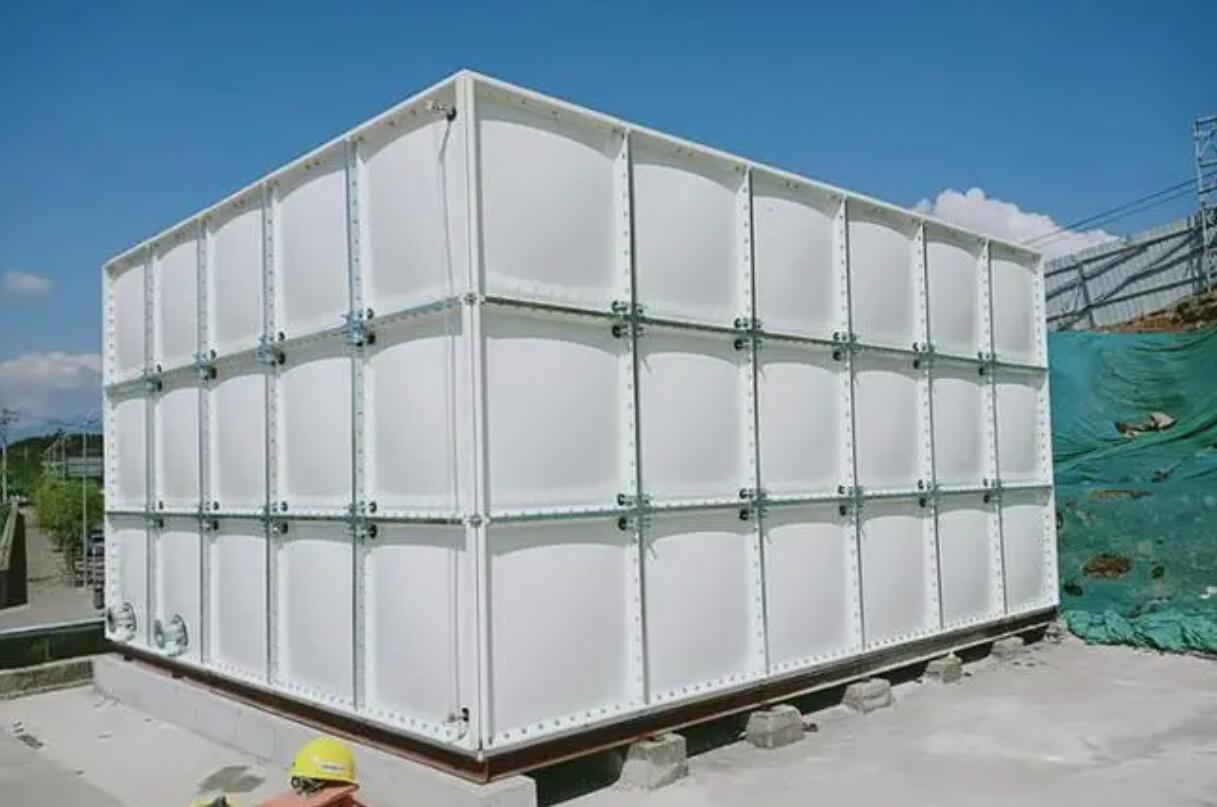
Outdoor, Fully Exposed: White or Light Gray Is the Standard
For tanks fully exposed to sunlight, Beijing Yuanhui recommends RAL 9010 pure white or RAL 7035 light gray. Field measurements show white tanks have a surface temperature 8–12°C lower than dark blue tanks. This not only slows resin aging but also reduces internal water temperature rise, lowering algae growth risk. In a 35-tank solar project in Hami, Xinjiang, white-coated tanks showed no cracking after six years, while dark green tanks on the same site developed micro-cracks by year four.
Semi-Shaded Installation: Mid-Tones Require UV Stabilizers
Under eaves, shade nets, or north-side shadows, UV radiation drops to 30–50% of direct sunlight. Light blue or light green mid-tones are acceptable, but Beijing Yuanhui emphasizes that the resin system must still contain at least 0.5% hindered amine light stabilizer (HALS) and 0.3% UV absorber (UVA). Without these additives, noticeable color difference will develop within 2–3 years.
Indoor or Buried Installation: Color Constraints Relax
In UV-free indoor or underground environments, color selection focuses on visibility and maintenance convenience. Beijing Yuanhui typically uses blue or green for these projects to differentiate from piping. However, even indoor tanks may be exposed to UV during temporary outdoor storage before installation; therefore, protective film should remain until final positioning.
Special Coatings and Masterbatch Formulation
Gel Coat: The First Defense Layer
Beijing Yuanhui incorporates nano-ZnO and CeO₂ composite UV inhibitors into the gel coat for outdoor tanks, boosting UV blocking from the conventional 65% to 92%. This technology is particularly suited for projects requiring high-visibility colors such as red or yellow for safety identification. The mechanism relies on nano-particles forming a scattering network that extends UV path length within the resin.
Masterbatch Ratio Engineering Constraints
Darker colors require more pigment, but excessive pigment reduces resin flowability and interlaminar shear strength. Beijing Yuanhui's process specification limits dark pigment masterbatch addition to 5% of resin weight by weight, with adjusted curing agent ratios to ensure full cure. In a 2019 Beijing wastewater treatment plant project, the contractor added excessive black masterbatch, causing delamination at month 18. The tanks were reworked by Beijing Yuanhui using the standard formulation.
Conclusion
FRP water tank color must be selected based on three variables: UV exposure intensity, ambient temperature, and resin system composition. White offers unmatched protection outdoors; mid-tones with UV additives work in semi-shaded settings; indoor environments allow functional color choices. Beijing Yuanhui FRP Co., Ltd. recommends specifying the RAL code and corresponding UV protection technical parameters in procurement contracts. Never sacrifice service life for the misconception that "darker colors hide dirt better." Color is the cheapest maintenance measure for FRP water tanks—choose wisely and add 3–5 years of service.