Complete Process Analysis of FRP Water Tank Manufacturing: From Hand Lay-Up to Compression Molding
Introduction
The manufacturing process of FRP water tanks directly determines their service life, sealing performance, and structural integrity. Field data from Beijing Yuanhui FRP Co., Ltd.'s Hebei production base shows that SMC compression-molded panels achieve a flexural strength of 280 MPa, approximately 35% higher than traditional hand lay-up panels. However, hand lay-up remains indispensable for irregular shapes and on-site repairs. This article breaks down the complete process chain from raw material intake to finished product shipment using real production data.
1. Raw Material Preparation and Ratio Control
1.1 Resin and Reinforcement Selection
Common unsaturated polyester resins (e.g., 196#, 191#) must comply with GB/T 8237, with viscosity controlled between 0.25–0.45 Pa·s. Reinforcement materials include chopped strand mat (CSM, 300–450 g/m²) and woven roving (0.4–0.6 mm). In Beijing Yuanhui's actual production, the resin paste for SMC sheet includes 8%–12% low-profile additive (LPA) to keep molding shrinkage below 0.15%.
1.2 Filler and Additive Dosing
Calcium carbonate (800–1250 mesh) is the main filler, added at 40%–60% of resin weight. Initiator (e.g., MEKP) is dosed at 1%–2% and accelerator (cobalt naphthenate) at 0.5%–1% of resin weight. Precision electronic scales are used with a tolerance of ±0.5%.
2. Molding Processes: Hand Lay-Up vs. Compression Molding
2.1 Hand Lay-Up
Applications: custom tanks, repair parts, small batches (≤50 m³).
Steps:
- Mold surface: apply PVA or silicone release agent, dry for 30 min.
- Gel coat spray: 0.3–0.5 mm thickness, gel time 15–25 min.
- Lamination: first layer CSM (450 g/m²), resin-impregnated and rolled with 0.3–0.5 MPa pressure; then woven roving with resin/glass weight ratio 55:45.
- Curing: 24 h at room temperature, followed by post-cure at 80°C for 4 h to achieve Barcol hardness ≥40.
2.2 SMC Compression Molding
Applications: standard panels (1 m × 1 m, 1 m × 2 m), high-volume production.
- Sheet preparation: SMC machine impregnates glass fiber with resin paste, then matures at 40°C for 24–48 h.
- Molding parameters: mold temperature 140–160°C, pressure 10–15 MPa, dwell time 3 min per mm of panel thickness.
- Demolding & trimming: eject after cooling below 60°C, trim flash with diamond blade.
3. Assembly and Sealing
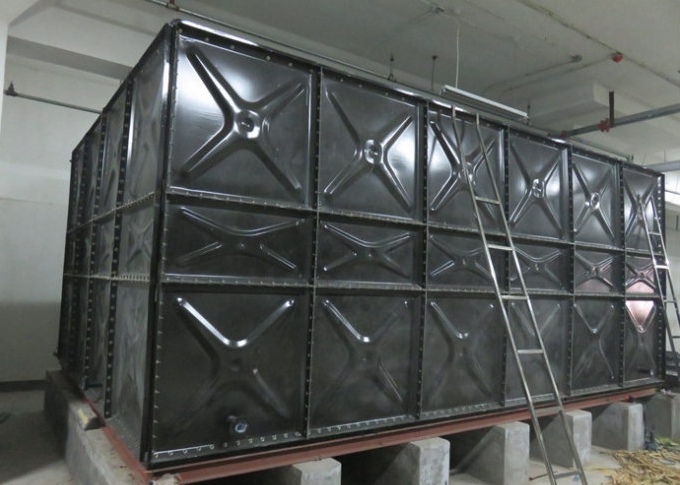
Panels are joined with 304 stainless steel bolts (M12–M16) at 200 mm spacing. EPDM sealing strips are used with 30%–40% compression ratio. Beijing Yuanhui's assembly line data: a 100 m³ tank achieves a leakage rate below 0.005 L/min·m² at 0.05 MPa test pressure.
4. Quality Inspection and Standards
Per JC/T 658.1-2007, key tests include:
- Flexural strength: hand lay-up ≥160 MPa, SMC ≥240 MPa
- Barcol hardness: ≥40
- Hydrostatic test: fill to 1.5× working pressure, hold 30 min with no leakage
Beijing Yuanhui's outgoing inspection records show SMC panel flexural strength averages 275 MPa with a coefficient of variation (CV) below 5%, indicating excellent process stability.
Conclusion
The FRP water tank manufacturing industry is shifting from sole reliance on hand lay-up toward SMC compression molding automation, yet hand lay-up retains value for special geometries. Beijing Yuanhui FRP Co., Ltd. achieves product performance margins exceeding 115% of standard values through precise control of resin ratios, molding temperature, and pressure. Future trends include online viscosity monitoring and automated lay-up robots to further reduce human-induced defect rates.