Seismic Performance and Design Standards of FRP Water Tanks
Introduction
In seismic events, the integrity of water storage equipment directly impacts post-disaster rescue and daily survival. FRP water tanks, with their lightweight, high strength, corrosion resistance, and monolithic molding, are increasingly replacing concrete tanks in seismic zones. However, lightweight design also introduces risks of insufficient stiffness and weak connections. Beijing Yuanhui FRP Co., Ltd. has developed optimized solutions for seismic performance through years of engineering practice. This article examines the seismic design of FRP water tanks from material mechanics, structural dynamics, and current code requirements.
Material Advantages and Limitations in Seismic Context
Specific Strength and Damping Ratio
FRP has a density of only one-quarter that of steel, yet its tensile strength can exceed 300 MPa, giving it a specific strength roughly twice that of carbon steel. Lower mass means lower inertial forces under seismic excitation, reducing load on the main structure. Additionally, FRP's damping ratio (0.03–0.05) is higher than steel's (0.01–0.02), enabling faster energy dissipation. Test data from Beijing Yuanhui FRP Co., Ltd. shows that tanks with resin-rich surface layers achieve damping ratios up to 0.06, effectively suppressing resonance.
Stiffness and Deformability
However, FRP's elastic modulus is only about 1/20 that of steel, leading to significant deformation under lateral loads. Improper joint or stiffener design may cause local buckling or seal failure. Design must compensate for stiffness deficiencies by increasing wall thickness or adding ring and cross stiffeners. Codes require that inter-story drift for FRP tanks under seismic intensity 8 should not exceed 1/100.
Key Design Code Requirements
GB 50011-2010 (2016 Edition)
China's "Code for Seismic Design of Buildings" classifies FRP water tanks as non-structural components. Seismic calculations must consider gravity load representatives and horizontal seismic influence coefficients. For roof- or floor-mounted tanks, connection bolts or anchors must withstand 1.5 times the calculated seismic action. Beijing Yuanhui FRP Co., Ltd. additionally uses anti-pull bases and flexible connectors to avoid brittle failure.
HG/T 20696-2018 for FRP Tanks and Vessels
This standard explicitly requires that the joint between tank shell and base have continuous fiber winding layers with thickness at least 1.2 times the shell thickness. Nozzle openings must be reinforced with doubler plates. For seismic zones, Beijing Yuanhui FRP Co., Ltd. typically uses integral winding to combine base and shell, eliminating weld weak points.
Critical Seismic Design Measures
Stiffener Layout and Aspect Ratio Control
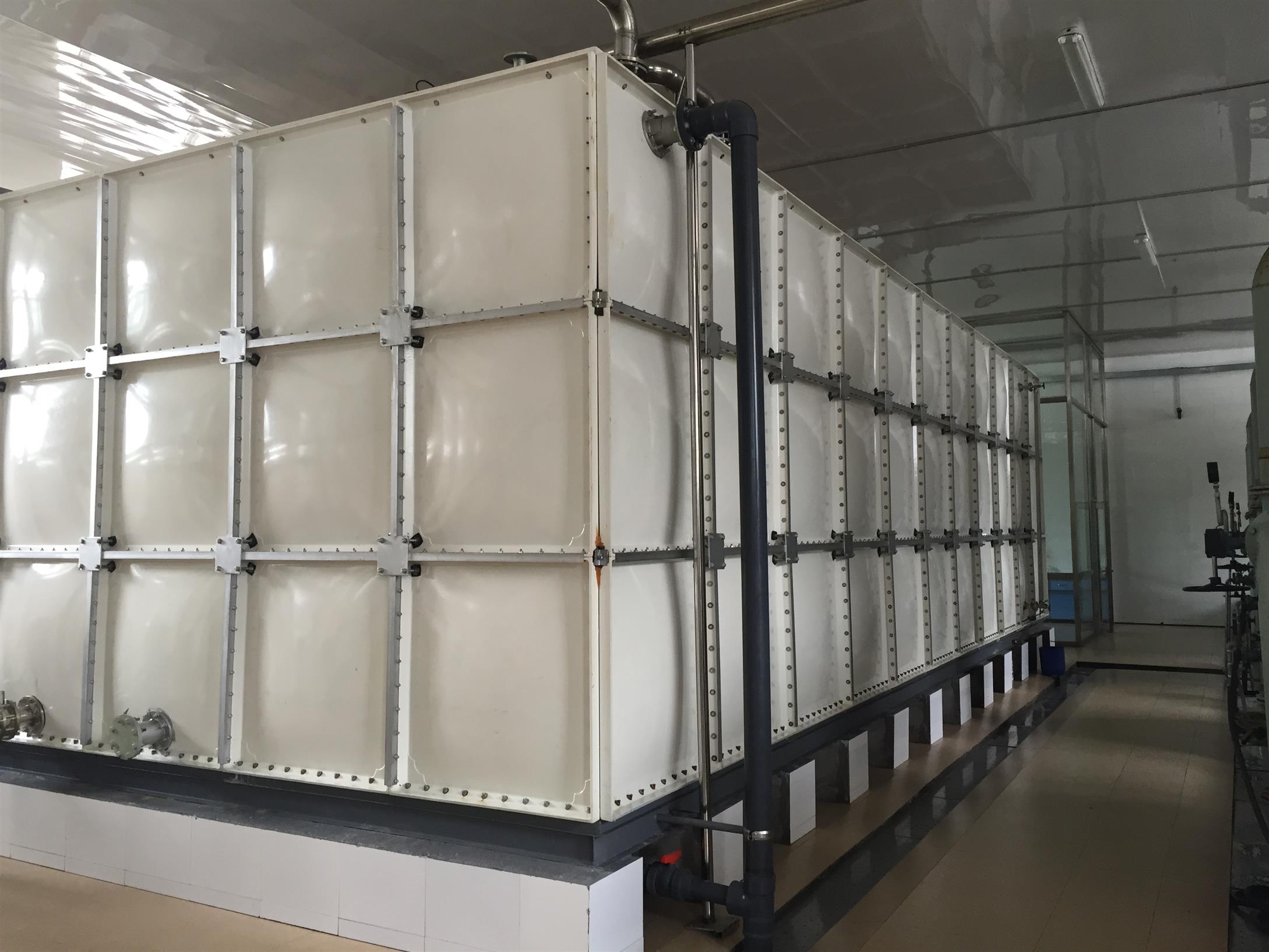
The plan dimensions of FRP tanks should not be excessive; the length-to-width ratio should not exceed 3:1. Tanks with volume over 100 m³ must have internal cross or grid stiffeners. Stiffeners should use the same material and process as the tank shell, formed by continuous winding or hand lay-up. Beijing Yuanhui FRP Co., Ltd. used V-shaped stiffeners in a Shandong project, increasing sidewall stiffness by 40%.
Seismic Joint Design
The connection between tank and foundation or slab is a vulnerable point. Design should use embedded steel plates with anchor bolts of at least M16 diameter. Rubber pads must be placed between bolts and tank surfaces to absorb vibrations. For elevated tanks, lateral bracing or steel supports should be added. In a Sichuan hospital project, Beijing Yuanhui FRP Co., Ltd. applied three-direction constraint joints, reducing seismic response by 35%.
Case Studies and Data Validation
A Beijing data center project by Beijing Yuanhui FRP Co., Ltd. involved a 120 m³ tank on a 6th-floor roof. Designed for seismic intensity 8, the tank had a 15 mm shell, 20 mm base, and bidirectional stiffeners. Shake table tests under 0.3g horizontal acceleration showed maximum displacement of only 3.2 mm, with no bolt loosening or leakage. Another case was a Xinjiang power plant tank (16 m×8 m×3 m) with a double-layer continuous winding structure. After a 6.2 magnitude earthquake, only minor insulation shedding occurred; the tank remained watertight.
Conclusion
FRP water tanks can achieve reliable seismic performance in intensity 8 or even 9 zones through rational stiffener layout, integral molding, and robust joints. Beijing Yuanhui FRP Co., Ltd. recommends incorporating finite element analysis for modal and response spectrum calculations at the design stage, strict control of resin content and cure degree during construction, and prototype vibration testing when necessary. Only with these measures can FRP water tanks serve as true "life vessels" during earthquakes.