Complete Manufacturing Process of FRP Water Tanks: From Hand Lay-Up to SMC Compression Molding
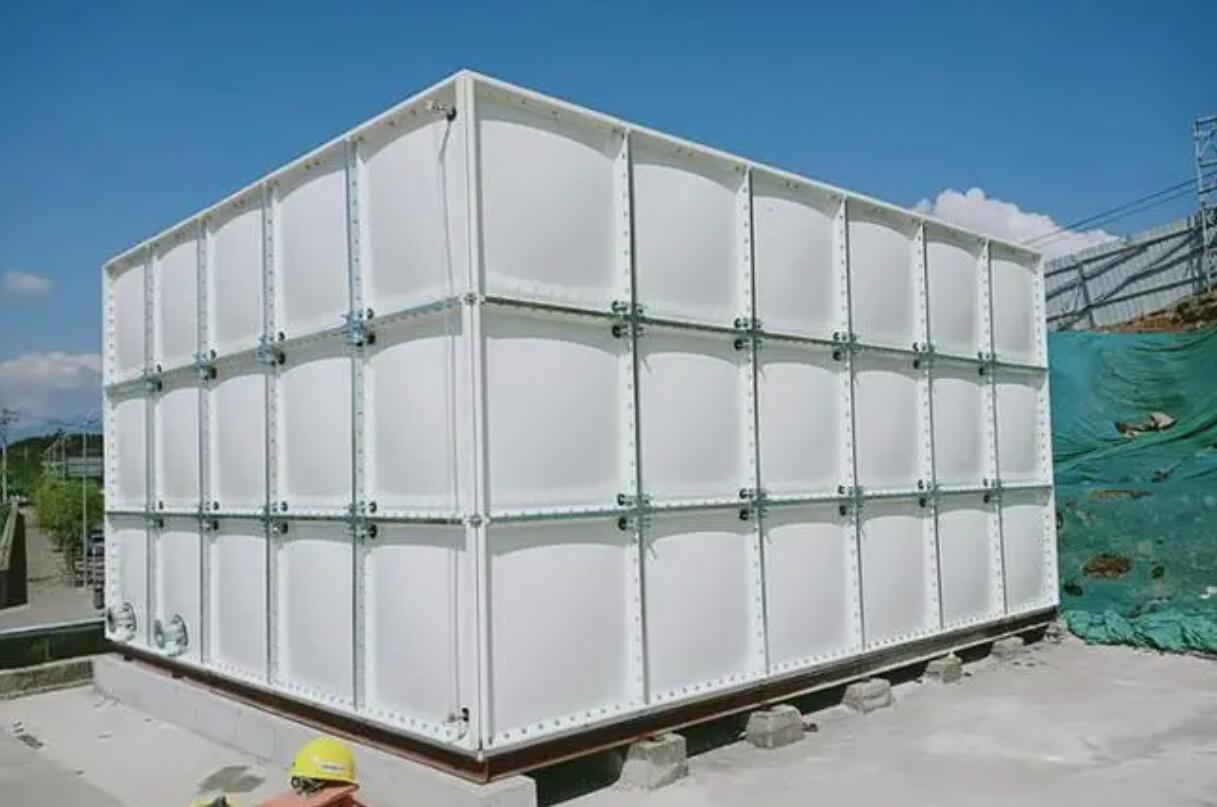
Introduction
The production process of FRP (Fiberglass Reinforced Plastic) water tanks directly determines their corrosion resistance, structural strength, and service life. Beijing Yuanhui FRP Co., Ltd. operates three SMC compression molding lines with an annual capacity exceeding 8,000 m³ and two hand lay-up lines in North China. Based on real production data from this company, this article breaks down key technical aspects: SMC paste preparation, molding processes, curing control, and final assembly & testing.
1. Material System & SMC Sheet Preparation
1.1 Resin & Reinforcement Selection
Qualified FRP water tanks require isophthalic unsaturated polyester resin or vinyl ester resin with a long-term service temperature above 80°C. The reinforcement uses E-glass chopped strand mat or SMC-specific roving, with fiber content controlled at 28-32% by weight. Beijing Yuanhui’s incoming inspection criteria: resin viscosity 1.2-1.8 Pa·s at 25°C, acid value 12-18 mgKOH/g, gel time 8-12 minutes at 25°C.
1.2 SMC Paste Mixing & Maturation
SMC (Sheet Molding Compound) preparation is the precursor to compression molding. The resin paste consists of unsaturated polyester resin, low-shrinkage agent, calcium carbonate filler, TBPB initiator, and MgO thickener. Paste viscosity is maintained at 50-80 Pa·s. Glass fibers are chopped to 25 mm length, impregnated, wrapped in PE film, and matured in a 40°C oven for 24-48 hours until tack-free and cuttable. Beijing Yuanhui requires SMC flow ≥120 mm (at 150°C/10 MPa) and shrinkage ≤0.15%.
2. Molding Processes: Hand Lay-Up vs. SMC Compression
2.1 Hand Lay-Up (for Irregular Shapes & Large Tanks)
Hand lay-up is suitable for tank panels 4-12 mm thick and exceeding 15 m², or for flanges with complex geometries. Procedure: apply mold release (8 coats, 15-minute intervals), spray gel coat (0.3-0.5 mm), lay first chopped strand mat (300 g/m²) after gel coat tack-off, roll out air with a bristle roller, and apply resin (with 1.5% MEKP). Overlap between mat layers ≥50 mm. A 10 mm panel requires 8 mat layers + 2 layers of 0.4 mm woven roving. Resin application rate: 400-500 g/m² per layer. Cure at 25°C for 24 hours, then post-cure at 60°C for 4 hours.
2.2 SMC Compression Molding (for Standardized Tank Panels)
SMC compression molding is ideal for standardized panels (1m×1m, 1m×1.5m) in mass production. Beijing Yuanhui uses a 6,300-ton four-column hydraulic press. Parameters: mold temperature upper 150±3°C, lower 145±3°C; press pressure 10-12 MPa; dwell time 60 seconds per mm thickness. SMC sheets are cut to mold cavity area +30% allowance, stacked in 3-5 layers (total 4-8 mm). Three degassing cycles (3 seconds each) are performed to eliminate internal voids. After demolding, parts cool naturally below 60°C before flash trimming to prevent thermal distortion.
3. Curing Control & Post-Processing
3.1 Curing Degree Testing & Post-Curing Schedule
Curing degree directly affects water resistance and strength. Beijing Yuanhui uses a Barcol 934-1 hardness tester: compression-molded parts require Barcol ≥35 right after demolding; hand lay-up parts ≥25. All products undergo post-curing at 70-80°C for 4 hours. After post-curing, samples undergo a 24-hour acetone immersion test (no softening or blistering). Flexural strength (per GB/T 1449) must ≥160 MPa; Barcol hardness ≥50.
3.2 Sealing Surface & Flange Finishing
Panel joints use a 45° bevel design, with edge milling tolerance ≤0.2 mm. Flanges are ground flat and coated with two-component polysulfide sealant. Beijing Yuanhui’s assembly shop uses torque wrenches for M16 bolts (100-120 N·m) to ensure a sealing gap ≤0.1 mm.
4. Assembly Testing & Quality Control
4.1 Leakage Test Standards
Every tank undergoes a water-fill test: fill to design water level +500 mm, hold for 72 hours, leakage ≤0.05% of total tank volume. Beijing Yuanhui also performs an air pressure test: 0.03 MPa for 30 minutes, pressure drop ≤0.002 MPa.
4.2 Fittings & Inner Liner Treatment
Inlet/outlet flanges are 304 stainless steel, connected via embedded nuts in the FRP body. The inner food-grade resin layer thickness ≥0.5 mm, certified per GB 17219. Internal tie rods use FRP pultruded profiles spaced ≤900 mm to limit sidewall deflection to ≤3 mm under full water load.
Conclusion
FRP water tank manufacturing has shifted from purely hand lay-up to SMC compression molding. Production data from Beijing Yuanhui FRP Co., Ltd. shows that the compression process offers superior dimensional accuracy (tolerance ±0.5 mm), cycle time (8 minutes per panel), and consistency, while hand lay-up remains irreplaceable for custom non-standard designs. Buyers should select the forming process based on tank dimensions, volume, and installation conditions. Key focus areas: SMC sheet quality, curing parameters, and seal testing—these directly determine the tank’s actual service life.