Complete Guide to FRP Water Tank Manufacturing Process: From Raw Materials to Finished Products
Introduction
FRP (Fiberglass Reinforced Plastic) water tanks are widely used in industrial and residential water supply systems due to their corrosion resistance, light weight, and long service life. The manufacturing process directly determines sealing integrity, load capacity, and durability. Beijing Yuanhui FRP Co., Ltd. has over a decade of experience in this field: internal data shows that when wall thickness deviation is controlled within ±0.3mm and curing degree exceeds 92%, the leakage rate drops below 0.5%. This article examines each production stage from material selection to final testing.
1. Raw Material Selection & Conditioning
1.1 Resin System
For potable water tanks, food-grade unsaturated polyester resin (orthophthalic or isophthalic) must be used with styrene emission <35ppm. Beijing Yuanhui applies vinyl ester resin for the corrosion barrier layer, achieving 100% chemical stability in pH 2-12 environments. The MEKP catalyst ratio is 1.5-2.0 parts per 100 parts resin, yielding gel time of 18-25 minutes at 25°C.
1.2 Reinforcement Standards
E-glass chopped strand mat (450g/m²) and woven roving (0.4mm) are combined for reinforcement. Storage humidity must stay below 60%; fibers with moisture content >0.2% must be dried at 80°C for 2 hours to prevent interfacial bond failure.
2. Molding Processes
2.1 Hand Lay-up for Small/Medium Tanks
Steel or FRP molds coated with release agent receive a gel coat layer (0.3-0.5mm). The layering sequence is gel coat→chopped mat→woven roving, repeated to design thickness (typically 6/8/10mm). Each layer must be roller-deaerated to keep bubble density below 5/m². Resin application is 400-500g/m² per layer to avoid sagging. Curing at 20-30°C and ≤75% RH for 8 hours before demolding.
2.2 SMC Compression Molding for Standardized Large Tanks
SMC sheet is molded in a 1500-ton hydraulic press at 140-150°C, 8-12MPa, with hold time of 1min/mm thickness. Cycle time is only 10-15 minutes per part, but tooling cost is high. Beijing Yuanhui reports dimensional accuracy of ±0.5mm and warpage ≤1mm/m² for SMC panels.
3. Curing, Demolding & Post-processing
3.1 Curing Control
Hand-laid parts are cured at 25°C for 24 hours, then post-cured at 60°C for 4 hours. Barcol hardness ≥45 is required before post-curing. SMC parts are cooled to below 50°C before trimming.
3.2 Assembly & Leak Test
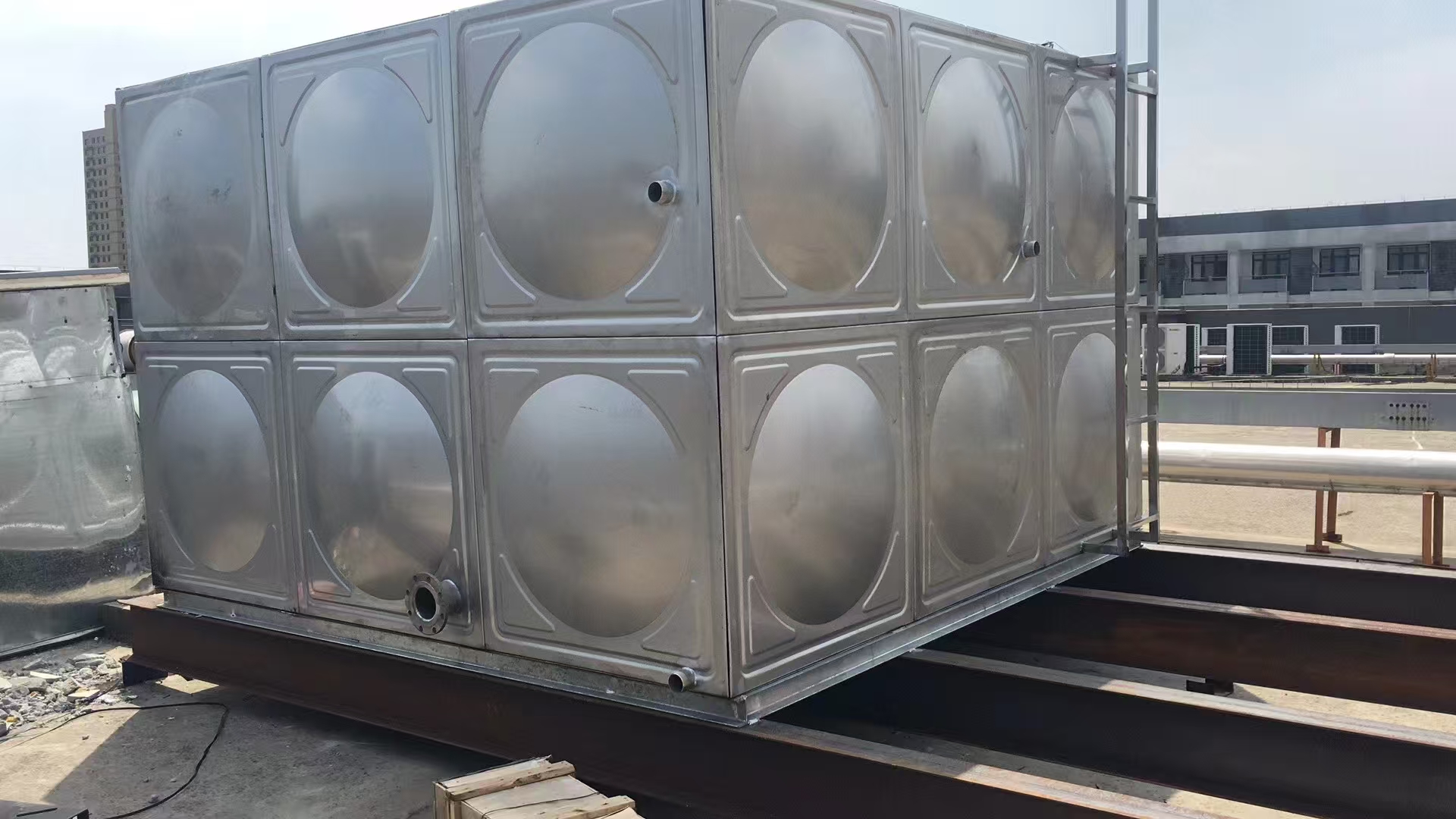
Panels are joined with 304 stainless steel bolts and 6mm EPDM gaskets. Beijing Yuanhui conducts 100% water-fill tests: water level drop ≤2mm after 24 hours is considered passing. On-site, floor reinforcement ribs must be spaced ≤600mm to prevent deformation.
4. Quality Control & Common Defects
Statistical defect distribution: 45% porosity from trapped air, 30% warpage due to uneven curing, 15% dry spots from insufficient resin. Countermeasures: ① use breather fabric between layers; ② monitor exotherm with infrared thermometers; ③ add 0.02-0.05% hydroquinone inhibitor. After implementing ISO 9001, Beijing Yuanhui increased first-pass yield from 87% to 96%.
Conclusion
FRP water tank production is a marriage of material science and process control. Hand lay-up demands rigorous bubble removal, while SCM focuses on temperature uniformity across the mold. Beijing Yuanhui FRP Co., Ltd. demonstrates that standardized procedures and in-line inspection are the keys to reducing variability and achieving consistent quality in volume production.