Color Selection and UV Protection for FRP Water Tanks: A Professional Guide
Introduction
FRP water tanks installed outdoors face constant UV radiation, which degrades the resin matrix, reduces mechanical strength, and causes surface chalking. Color selection goes beyond aesthetics—different colors reflect, absorb, and conduct heat differently, directly affecting tank longevity. Beijing Yuanhui FRP Co., Ltd. has analyzed field data from hundreds of installations to establish a systematic link between color and UV protection.
Physical Mechanism of Color in UV Protection
Reflectivity vs. Absorptivity
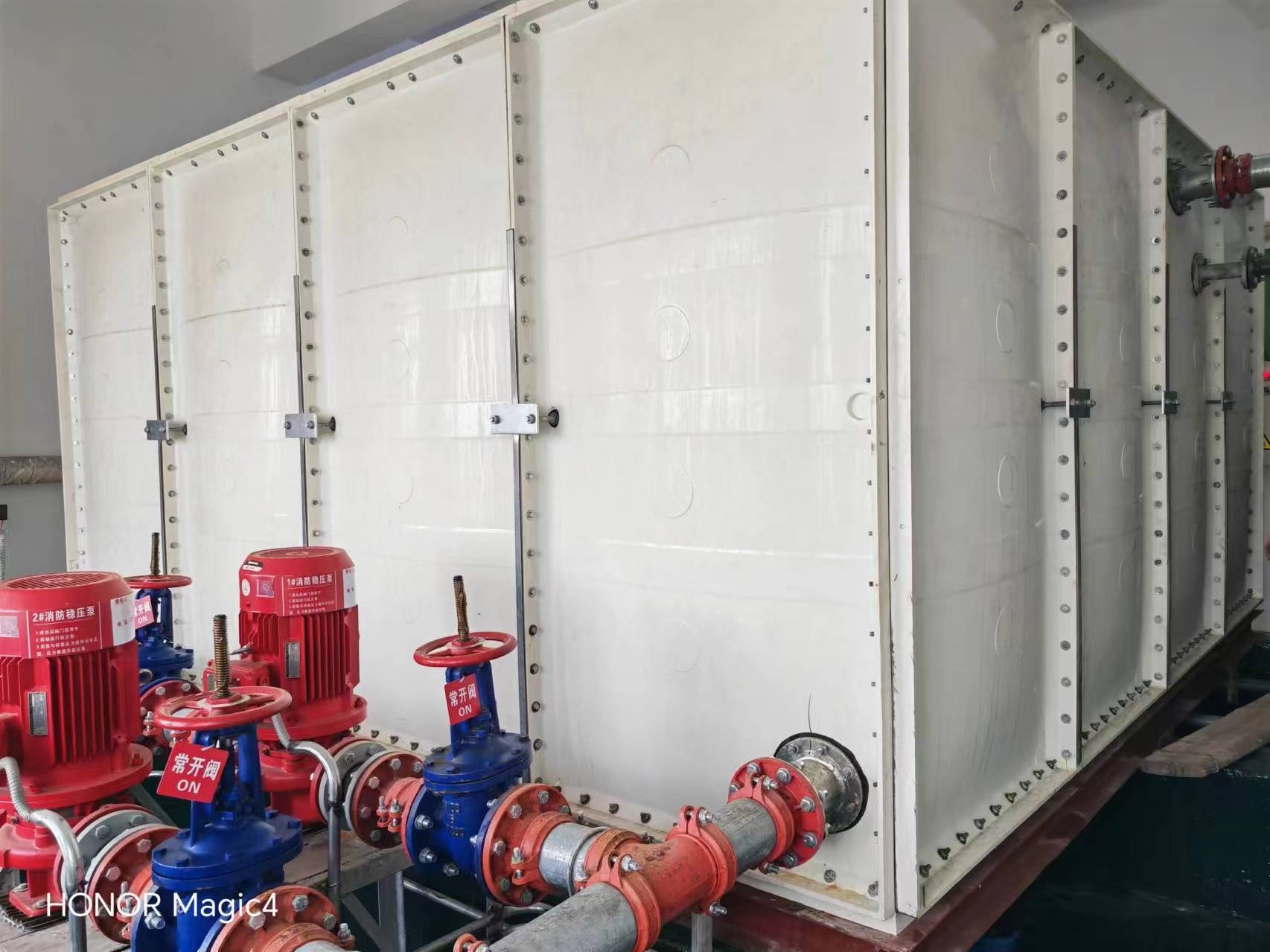
Light colors (white, light gray, beige) reflect 70%-85% of UV radiation, while dark colors (navy, dark green, black) reflect only 10%-30%. Higher reflectivity means less UV energy penetrates the resin, slowing photodegradation. Accelerated weathering tests per ASTM G154 show that white specimens retain 92% flexural strength after 2,000 hours of QUV exposure, versus 76% for dark blue specimens under identical conditions.
Thermal Accumulation Effect
Dark surfaces absorb more solar radiation, raising internal water temperature by 5-8°C (summer field measurements). Every 10°C increase roughly doubles the hydrolysis rate of the resin and accelerates thermal stress cracking at the coating-substrate interface. In a survey of 500 tanks installed by Beijing Yuanhui FRP Co., Ltd. in northern China, dark-colored tanks showed a 34% higher leakage repair rate than light-colored ones.
Color Recommendations by Scenario
High UV Regions: Light Colors Preferred
In areas above 1,500 m altitude or low latitudes (e.g., Yunnan, Tibet, Hainan), UV intensity is 30%-50% higher than in plains. White or light gray is recommended, with UV absorber (UV-329, UV-P) loading increased to 0.5%-1.0%. Case: a residential community in Kunming used white SMC tanks; after 6 years only minor chalking appeared, while blue tanks at an adjacent plant showed significant cracking after 4 years.
Cold or Shaded Environments: Dark Colors Acceptable
In northeastern China with long winters and low solar exposure, dark tanks (dark gray, dark green) can absorb solar heat to assist freeze protection and reduce ice blockage risk. However, an additional acrylic polyurethane topcoat is required as a secondary UV barrier. Beijing Yuanhui FRP Co., Ltd. supplied dark green tanks to a Heilongjiang dairy farm; combined with electric heat tracing, no UV-related performance failure occurred in 5 years at -30°C.
Special Applications: Functional Colors
Fire-fighting tanks must be red or orange per safety codes. A high-weatherability gel coat (≥0.4 mm thickness) and nano-TiO₂ (2%-3%) in the resin are mandatory to absorb UV and convert it to heat. Drinking water tanks should use food-grade white gel coat to avoid heavy metal migration from dark pigments. Industrial cooling tanks can use light blue for both UV protection and visual identification.
Composite UV Protection Strategy
Color is the first line of defense, but not the only one. Beijing Yuanhui FRP Co., Ltd. implements a three-layer protection system:
- Matrix modification: Adding hindered amine light stabilizers (HALS, e.g., Tinuvin 123) and UV absorbers to isophthalic polyester resin reduces aging rate by 60%.
- Surface coating: Fluorocarbon or polysiloxane coating reduces UV transmittance to below 2%, extending service life to 8-10 years.
- Structural design: Increasing tank roof slope (≥5°) accelerates rain rinsing, reduces dust shading, and maintains reflectivity.
Case: Beijing Yuanhui FRP Co., Ltd. supplied light gray tanks for a photovoltaic project in Inner Mongolia (annual UV radiation 6,200 MJ/m², about double that of Beijing). With a “white gel coat + UV-stabilized resin + fluorocarbon topcoat” combination, the color difference ΔE was only 3.2 after 5 years, well below the industry standard ΔE≤5.0.
Conclusion
Selecting the right color for an FRP water tank requires a balanced decision based on local UV intensity, ambient temperature, and intended use. Light colors are optimal for most outdoor scenarios; dark colors offer auxiliary freeze protection in cold zones but must be paired with additional UV coatings. Beijing Yuanhui FRP Co., Ltd. recommends that customers provide installation coordinates and purpose during procurement, so the technical team can match the best color and material formulation using UV index databases, ensuring structural integrity over a 15-20 year design life.