Thermal Insulation Performance of FRP Water Tanks: From Polyurethane to Practical Applications
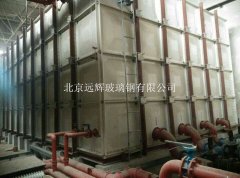
How FRP Water Tanks Achieve Thermal Insulation
FRP (Fiberglass Reinforced Plastic) itself has a thermal conductivity of 0.23–0.30 W/(m·K), similar to concrete. Therefore, insulation is provided by an external layer—typically polyurethane (PUR) rigid foam or rubber-plastic (NBR/PVC) foam. Field data from Beijing Yuanhui FRP Co., Ltd. show that a 50mm PUR layer reduces heat loss by approximately 78%, maintaining water above 40°C for over 72 hours at -20°C ambient temperature.
PUR foam has a closed-cell ratio exceeding 95% and water absorption below 3%, ensuring long-term performance even in humid environments. Rubber-plastic foam offers better flexibility for irregular surfaces but lower compressive strength, often requiring a metal jacket for mechanical protection. Each 10mm increase in insulation thickness raises thermal resistance by about 0.35–0.40 (m²·K)/W, while cost increases by roughly 15%.
Insulation Thickness Selection by Application
Severe Cold Regions (Northeast & Northwest China)
For a livestock project in Heilongjiang, Beijing Yuanhui applied 100mm PUR with 0.6mm galvanized steel cladding and bottom heating cables. At -32°C, daily temperature drop was only 3.2°C, versus 5.8°C for 80mm insulation. Recommended thickness: ≥80mm with wind-resistant cladding and sealed joints.
Hospital & Hotel Hot Water Systems
GB 50015-2019 mandates hot water supply ≥55°C. A 20m³ tank with 60mm PUR, starting at 60°C and 5°C ambient, dropped 6°C in 24 hours. With 40mm rubber-plastic, the drop exceeded 10°C. Recommendation: 60–80mm PUR for thermal stability.
Food & Pharmaceutical Plants
These require non-toxic, anti-microbial insulation. Beijing Yuanhui’s food-grade liner + closed-cell rubber-plastic solution at a beverage plant in Jiangsu showed no degradation after two years. Standard thickness: 50mm, reducible to 40mm in temperature-controlled workshops.
Measured Performance Data
A 30-day test on a 10m³ tank (5mm SMC panels, 80mm PUR, aluminum vapor barrier) yielded:
- Initial 55°C, ambient -5~0°C: 44.7°C after 24h (drop 10.3°C)
- Initial 55°C, ambient 15~20°C: 48.2°C after 24h (drop 6.8°C)
- Heating cable 15W/m maintained water above 5°C in freeze-protection mode
Thermal conductivity of PUR rises about 2–3% annually due to gas diffusion and micro-cracks. Inspection every three years and thermographic survey every five years are recommended.
Common Design & Installation Mistakes
Myth 1: Thicker is always better. Above 80mm, marginal thermal benefit shrinks while structural load increases. 80mm is the practical economic limit for most cases.
Myth 2: Omitting vapor barrier. Without aluminum foil or PE film at joints, moisture ingress freezes and damages foam cells. Beijing Yuanhui’s standard: overlap ≥50mm, sealed with specialized tape.
Myth 3: Ignoring bottom insulation. Ground heat loss can account for 20–30% of total. Extruded polystyrene (XPS) or polyurethane board of at least 50mm must be installed underneath.
Conclusion
FRP water tank insulation performance hinges on material selection, thickness, vapor sealing, and installation quality. PUR rigid foam offers the best cost-performance balance with a thermal conductivity of 0.022–0.028 W/(m·K). Rubber-plastic foam suits special applications. For reliable results, consult experienced manufacturers like Beijing Yuanhui FRP Co., Ltd. to tailor solutions to local climate, water temperature requirements, and budget. Proper insulation reduces energy consumption, extends tank life, and ensures consistent water quality.