Complete FRP Water Tank Production Process: From Hand Lay-Up to SMC Compression Molding
Introduction
FRP (Fiberglass Reinforced Plastic) water tanks are widely used in building secondary water supply, firefighting storage, and industrial cooling due to their light weight, corrosion resistance, and service life of 20-30 years. Beijing Yuanhui FRP Co., Ltd., established in 2003, has delivered over 2,000 tanks, with the largest single unit reaching 500 m³. This article breaks down the complete production process—from raw material batching, molding methods (hand lay-up vs. SMC compression), curing control, to field installation—using real production line data.
1. Raw Material Preparation and Formulation Control
1.1 Resin System Selection
The primary resin used is 196-type unsaturated polyester, with viscosity controlled at 400-600 mPa·s (25°C) and an acid value of 18-24 mgKOH/g. Beijing Yuanhui adjusts the formulation based on application: food-grade orthophthalic resin (compliant with GB/T 17219-1998) for potable water tanks, and isophthalic or vinyl ester resin for industrial tanks requiring higher chemical resistance. Gel time is tested per batch (typically 8-15 minutes at 80-120°C) to ensure a stable molding window.
1.2 Reinforcement and Fillers
E-glass continuous fiber (2400 tex, silane-treated) is used. In hand lay-up, 0.4mm chopped strand mat (450 g/m²) alternates with 0.2mm surface veil; in SMC, 50mm chopped fibers are incorporated at 25-30% by weight. Calcium carbonate filler (800 mesh) is added at 20-30% of resin weight to reduce shrinkage and improve surface finish.
2. Molding Process Comparison and Key Parameters
2.1 Hand Lay-Up (for Complex Shapes and Small Batches)
Hand lay-up remains the standard for tank lids, bottoms, and manholes. The sequence: mold cleaning → PVA release agent (drying 30 min) → gel coat (0.3-0.5mm) → lay chopped mat → resin impregnation → roller debulking → repeat to design thickness (4mm panel requires 4 mat layers + 2 veil layers). Experienced workers at Beijing Yuanhui average 45 min/m². Ambient conditions must be 18-25°C and humidity below 75% to prevent incomplete curing and defects such as whitening or delamination.
2.2 SMC Compression Molding (for Standard Panel Mass Production)
SMC (Sheet Molding Compound) is now preferred for standard tanks under 1,000 m³. Beijing Yuanhui's SMC line parameters: molding temperature 140-150°C, pressure 10-15 MPa, dwell time 60 sec per mm thickness. The sheet is pre-cured at 120°C for 3 minutes before being placed in the mold, with 2-3 degassing cycles. Standard panels (1m×1m×4mm) achieve tensile strength 120-150 MPa, flexural strength ≥180 MPa, and Barcol hardness ≥40, significantly outperforming hand-laid panels (tensile strength 80-100 MPa).
3. Curing, Demolding, and Post-Processing
Hand-laid parts cure at room temperature for 24 hours before demolding, then post-cure in a 40°C oven for 4 hours (SMC parts are demolded immediately and cooled to ambient). Defects are trimmed with diamond blades (3,000 rpm), and surface voids (≤2mm diameter, ≤0.5mm depth, max 3 per m²) are filled with resin putty. Panel flatness tolerance is ±1.5mm/m, and diagonal deviation ≤5mm.
Inspection follows QB/T 2232-2008:
- Appearance: no gel coat cracks, fiber exposure, or clustered pinholes.
- Mechanical: three-point bending test (span 64mm, 2mm/min loading).
- Hydrostatic: tank filled to 1.5× design pressure, held 30 minutes with no leaks.
Beijing Yuanhui's 2023 first-pass yield was 97.8%, with SMC panels outperforming hand-laid by about 4 percentage points in pass rate.
4. Field Assembly and Joint Technology
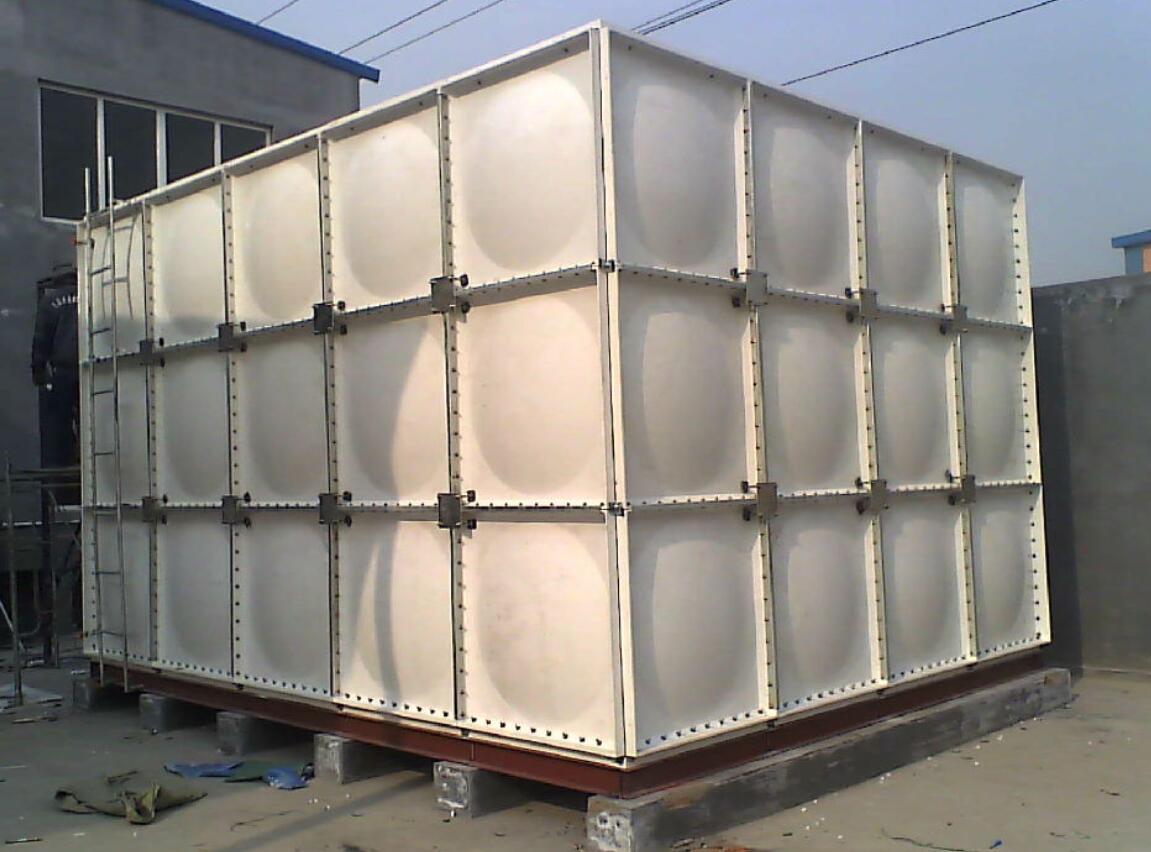
On-site, panels are bolted with M12 stainless steel (304) fasteners. Joints are filled with polysulfide sealant (2-3mm thick), and interior corners are reinforced with 50mm-wide, 3mm-thick FRP strips. The base must rest on concrete piers (200mm high, spacing ≤1.5m) for load distribution. Tanks above 300 m³ require internal tie rods (FRP tubes, 5mm wall, spaced 1.2m×1.2m) to resist hydrostatic lateral forces.
Conclusion
FRP water tank production has shifted from hand lay-up to SMC compression molding, which offers superior panel consistency, mechanical properties, and cycle time (3-5 min per panel vs. 45 min/m² for hand lay-up). Beijing Yuanhui FRP Co., Ltd.'s data emphasizes that raw material inspection, humidity control, and curing parameters are decisive for tank longevity. Buyers should prioritize manufacturers with SMC lines and complete inspection records.