FRP Water Tank Modular Assembly Process: From SMC Molding to Sealing
Introduction
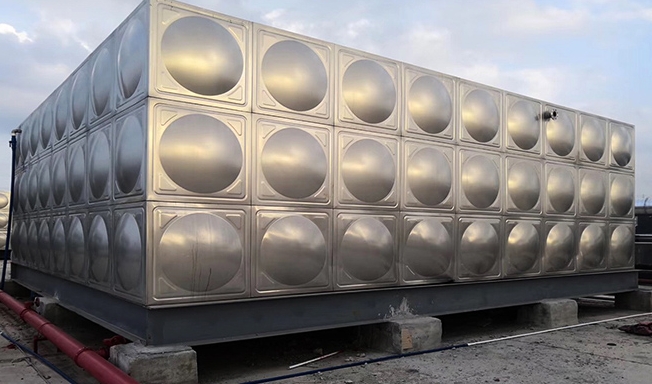
FRP water tanks dominate building, municipal, and industrial water storage due to their modular assembly process. Unlike welded steel or cast-in-place concrete tanks, FRP tanks use standardized SMC panels bolted together on site. Beijing Yuanhui FRP Co., Ltd. has completed over 300 modular tank projects, with the largest single tank reaching 500 m³. This article breaks down the key processes.
1. SMC Panel Production and Tolerances
1.1 Molding Parameters
SMC panels consist of 30-35% unsaturated polyester resin, 25-30% E-glass fiber, 30-35% calcium carbonate filler, plus curing agent. Molding temperature: 135-145°C, pressure: 12-15 MPa, dwell time 50-60 seconds per mm thickness. A standard 14mm panel requires a 12-minute cycle.
1.2 Dimensional Accuracy
Panel tolerances are kept within ±0.5 mm. Beijing Yuanhui uses CNC cutting to ensure diagonal error < 1 mm for 1000×1000 mm panels. Pre-drilled bolt holes are 16 mm diameter at 100 mm spacing.
2. Connection System: Bolts, Flanges, and Seals
2.1 304 Stainless Steel Hardware
All bolts are M14×40 mm, 304 SS, tensile strength ≥520 MPa. Embedded nuts are cast into panels during molding, eliminating post-drilling. Each standard panel contains 32 embedded nuts.
2.2 EPDM Gasket Compression
EPDM gaskets (70±5 Shore A, 12×6 mm cross-section) are compressed to 25-30% (final thickness 4.2-4.5 mm). Under 0.4 MPa water pressure, this compression rate ensures leak-free service for over 10 years.
2.3 Flange Overlap and Stiffeners
Panel joints use 40 mm lap flanges. Horizontal stiffeners (80 mm wide, same SMC material) are installed every two panels. For tanks >300 m³, 316L SS tie rods are added at 1200 mm spacing.
3. On-Site Assembly and Quality Control
3.1 Foundation Preparation
Concrete base must be C25 grade, flatness ≤±3 mm per 2 m. A 10 mm EPDM cushion layer distributes load.
3.2 Layer-by-Layer Assembly
Sequence: bottom → side → partition → top. Each layer is leveled; verticality tolerance ≤1.5 mm/m. Bolts are torqued diagonally to 140-160 N·m, verified with a digital torque wrench.
3.3 Water Test
A 24-hour hydrostatic test follows. No visible leaks; minor damp spots (<10 cm² each, max 3 spots) are acceptable. Beijing Yuanhui achieves a 95% first-pass rate. Local sealant or gasket replacement fixes any issues.
4. Case Study and Performance Data
In 2023, a Beijing hospital installed a 150 m³ modular FRP tank from Beijing Yuanhui. Assembly took 4 days (vs. 45 days for concrete). Over 18 months: average water temperature fluctuation ±2°C, water quality met GB 5749-2022 standards, no algae growth. Panel compressive strength measured 185 MPa, flexural strength 220 MPa, exceeding design values (120 MPa and 160 MPa).
Conclusion
Modular FRP tank assembly relies on standard panels, reliable sealing, and strict construction control. SMC molding with embedded nuts reduces site work; 304 SS and EPDM ensure long-term corrosion resistance. For 100-500 m³ storage, the system offers clear advantages in speed, cost, and maintenance.