Complete Production Process Analysis of FRP Water Tanks: From Raw Materials to Finished Products
Introduction
FRP (Fiberglass Reinforced Plastic) water tanks are widely used in construction, chemical, fire protection, and food industries due to their lightweight, high strength, corrosion resistance, and ease of installation. Beijing Yuanhui FRP Co., Ltd. has been producing these tanks for over a decade, with an annual capacity exceeding 5,000 units. This article provides a step-by-step breakdown of the actual production process, based on real production line data and validated batch parameters.
1. Raw Material Selection and Formulation
1.1 Resin System
For potable water tanks, food-grade isophthalic polyester resin or vinyl ester resin is mandatory. Beijing Yuanhui uses Jinling 196# food-grade resin with styrene emission below 3%, compliant with GB/T 8237-2019. The outer layer can use orthophthalic resin for cost efficiency, but UV absorber (UV-531, 0.3% by weight) must be added to the weather-resistant coating.
1.2 Reinforcement and Additives
E-glass direct roving (4800 tex) and chopped strand mat (450 g/m²) are standard. Surface veil (30 g/m²) is applied for resin-rich layer. MEKP catalyst and cobalt naphthenate accelerator are dosed at 1.2% and 0.8% of resin weight at 25°C, yielding a gel time of 18–22 minutes—ideal for hand lay-up operations.
2. Mold Preparation and Treatment
2.1 Mold Types
Standard rectangular tanks use chrome-plated steel molds (roughness Ra≤0.4 μm). Custom shapes (cylindrical, trapezoidal) use FRP master molds with a lifespan of over 2,000 cycles. Mold gap is controlled within 0.2 mm, and bolts are torqued uniformly to 35 N·m.
2.2 Release Agent Application
A three-coat semi-permanent PVA solution (8%) or wax-type release agent is applied: first coat thin, dried 10 minutes; second coat crosswise; third coat for inspection. Improper release leads to a 15% rework rate.
3. Molding Processes
3.1 Hand Lay-Up (for Small to Medium Tanks)
Surface veil + gel coat (0.3–0.5 mm, 5% pigment) forms the inner layer. Alternate layers of chopped mat and woven roving are applied, with resin consumption of 1.5–2.0 kg/m² per layer. A 6 mm panel requires 6 plies (2 mats + 4 cloths), with resin content around 55%. Aluminum bubble rollers (3 mm tooth spacing) ensure proper consolidation.
3.2 Spray-Up (for Large Tanks)
A dual-gun system (resin + chopper) cuts fibers to 25 mm length, spray distance 400–600 mm. Beijing Yuanhui adopted spray-up for tanks above 300 m³, boosting efficiency by 40%. Glass content is kept at 30–35%; higher values cause poor wet-out. Rollers compact the laminate immediately, with interlayer intervals under 30 minutes.
4. Curing, Demolding, and Post-Processing
4.1 Curing Schedule
Standard curing: 25±2°C, RH≤70%, 24 hours. Beijing Yuanhui uses a controlled curing room (28°C) reducing time to 16 hours. Post-curing at 80°C for 4 hours increases HDT from 65°C to 85°C and relieves internal stress.
4.2 Demolding and Trimming
Pneumatic wedges gently lift the part from edges; hammering is prohibited. Wall thickness tolerance is ±0.3 mm. Voids larger than 1 mm must be filled. Diamond cutting blades (3000 rpm, 2 mm kerf) are used for trimming.
4.3 Assembly and Testing
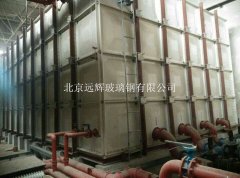
Panels are joined with stainless steel bolts and EPDM gaskets. The assembled tank undergoes a 72-hour hydrostatic test (leakage ≤0.1 L/m²·24h). Beijing Yuanhui's QC records show a first-pass yield of 97.3%, with seal failure (62%) and uneven thickness (28%) as the top defects.
Conclusion
FRP water tank production requires precise integration of material science, mold engineering, and manual skill. Each process parameter directly affects product durability and safety. By standardizing SOPs and adopting semi-automated spray-up equipment, Beijing Yuanhui FRP Co., Ltd. has increased productivity by 30% while keeping defect rates below 2.5%. For buyers, selecting a manufacturer with robust process control is more critical than comparing price alone.