Modular Assembly of FRP Water Tanks: From SMC Molding to On-Site Construction
Introduction
Modular assembly of FRP water tanks is not a new concept, but achieving efficient, reliable, and cost-effective on-site construction requires full control from raw material selection to installation standards. Beijing Yuanhui FRP Co., Ltd. has delivered over 500 SMC-molded tanks in northern China, 80% of which used modular assembly. This article breaks down the technical details based on actual project data.
1. SMC Molding: The Foundation of Modular Assembly
The modular nature of FRP tanks depends on standardized panel production. Sheet Molding Compound (SMC) offers dimensional precision and consistent mechanical properties.
1.1 Formulation and Press Parameters
Beijing Yuanhui uses SMC-1 formulation with 28%-32% glass fiber content, calcium carbonate and aluminum hydroxide fillers, molded at 135-145°C under 15-20MPa pressure. Resulting flexural strength reaches ≥120MPa, Barcol hardness ≥45. A typical press cycle is 4-6 minutes per panel, with daily output of 200 standard 1m×1m panels.
1.2 Dimensional Tolerances
Panel length/width tolerance: ≤±1.5mm; diagonal difference: ≤2mm; flatness: ≤1.5mm/m². Beijing Yuanhui uses thermal compensation mold design to keep shrinkage variation between summer and winter production within 0.05%, preventing on-site fit gaps.
2. Panel Connection and Sealing Design
The core of modular assembly lies in panel joints and sealing. Flange-bolt connections are preferred for their clear load paths and maintainability.
2.1 Flange Design and Bolt Layout
Each panel has 50mm-wide, 8mm-thick reinforced flanges with pre-embedded stainless steel threaded holes at 200mm spacing. 304 stainless steel bolts are torqued to 25-30 N·m, creating interface pressure of 0.8MPa to prevent leakage.
2.2 Gasket Selection
EPDM closed-cell foam gaskets with 30%-40% compression ratio are used. In a 2023 Hebei project, a 100-ton tank with EPDM gaskets showed 0.2L leakage after 48-hour water test, versus 1.8L with standard rubber. EPDM retained ≥85% tensile strength after 1000-hour QUV aging test.
3. On-Site Assembly Process and Quality Control
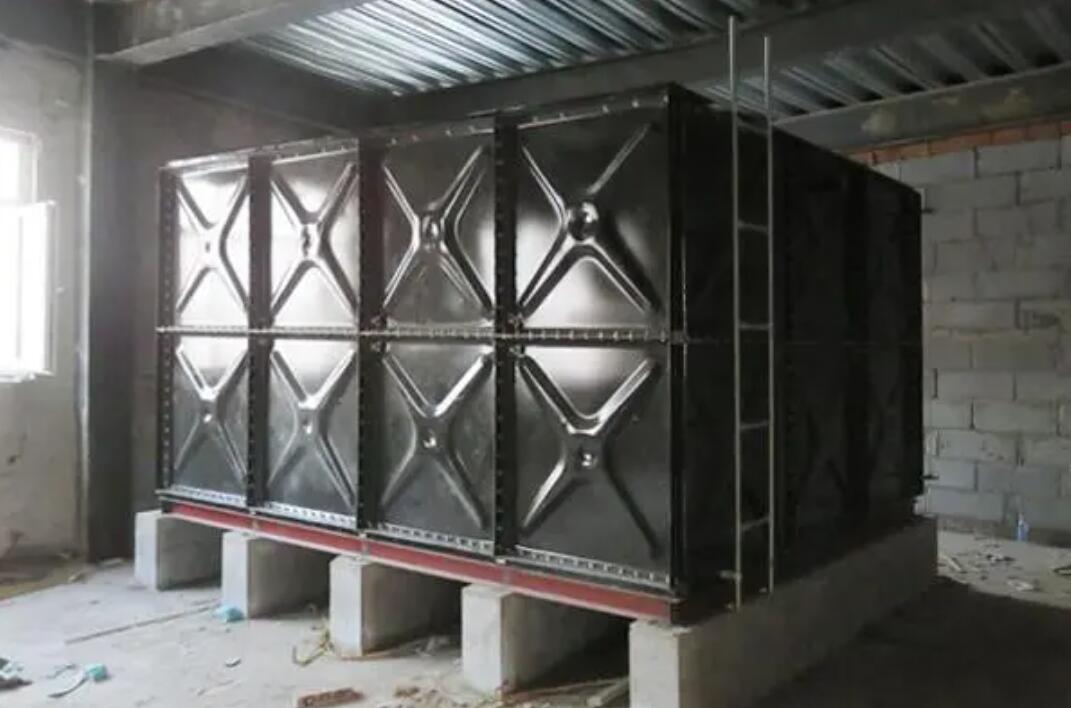
Modular assembly follows five steps: foundation inspection → floor panel installation → side panel assembly → roof installation → fittings. Each step has acceptance criteria.
3.1 Foundation and Floor Panels
Foundation is C25 concrete with flatness ≤3mm/2m and pre-embedded steel plates aligned with tank bolt holes. Floor panels sit on 10mm rubber pads. Beijing Yuanhui data shows that floor flatness deviation >5mm amplifies side panel verticality error to 8mm/m, compromising upper module sealing.
3.2 Side Panel Installation
Side panels are installed clockwise from one corner. Each panel is laser-checked for verticality (≤2mm/2m). Staggered bolt joints require ≥200mm offset between adjacent layers. For tanks above 3m height, horizontal stiffeners (40×40×4mm angle steel at 600mm spacing) are added between the second and fourth layers.
3.3 Leak Test
After assembly, a hydrostatic test is performed: water filling in three stages (6-hour intervals), maintaining final level for 48 hours. Beijing Yuanhui acceptance standard: total leakage ≤0.5L/24h (tanks <100 tons) or ≤1L/24h (tanks ≥100 tons). Leaks are repaired with epoxy resin and chopped glass mat, cured for 12 hours.
4. Common Issues and Solutions
4.1 Bolt Torque Loss
Torque loss occurs 3-6 months after commissioning. Solution: use nylon lock washers and medium-strength thread-locking compound. Beijing Yuanhui tracked 72 tanks, reducing bolt loosening from 12% to 1.5%.
4.2 Thermal Panel Deformation
In Northeast China with -30°C to 35°C temperature range, SMC linear expansion coefficient is 2.5×10⁻⁵/°C, causing 1.6mm length change per meter. Countermeasure: leave 1-2mm gap in flange connections and use elastic gaskets to compensate displacement.
Conclusion
Modular assembly of FRP water tanks integrates SMC molding, precision die design, and standardized construction. Beijing Yuanhui FRP Co., Ltd. field data shows that strict control of panel tolerances, gasket performance, and installation accuracy keeps rework rates below 3% and tank service life at 15-20 years. For project owners, selecting a supplier with a complete process chain—from molding to installation guidance—is more critical than buying panels alone.