Pressure Performance of FRP Water Tanks: Testing Standards and Engineering Practices
Introduction
The pressure-bearing performance of FRP (Fiberglass Reinforced Plastic) water tanks determines their service life and safety margin in high-rise water supply, fire-fighting pressure stabilization, and industrial cooling systems. In 2023, Beijing Yuanhui FRP Co., Ltd. conducted field tests on a batch of SMC tanks after 5 years of service, revealing that stress concentration at welded joints caused microcracks as the primary failure mode—not material weakness, but deviations in layer design and curing processes. This article dissects the key variables and testing methods based on GB/T 21238 and ISO 9001 requirements.
1. Three Determinants of Pressure Performance
1.1 Resin System and Fiber Ratio
Unsaturated polyester resin typically offers a tensile strength of 50–80 MPa, while glass fiber provides 300–1200 MPa reinforcement. The laminated structure of tank panels uses 45° cross-ply (0°/90°/±45°), achieving overall hoop strength exceeding 220 MPa. In tests on 8mm thick SMC panels, Beijing Yuanhui recorded a flexural modulus of 14.5 GPa, 12% above the industry average.
1.2 Geometry and Stiffener Layout
The stress concentration factor at rectangular tank corners can reach 2.5–3.0. Finite element analysis optimizes stiffener spacing (typically 500–800mm), limiting maximum deformation to L/200. For a 50m³ tank, reducing side wall thickness from 10mm to 8mm while adding two transverse ribs increases pressure efficiency by 18%.
1.3 Sealing and Connection Strength
Flanged connections use dual O-ring seals (EPDM + silicone composite), with bolt pre-torque controlled at 80–120 N·m. In 2022, a project suffered leakage at 0.3 MPa due to loose bolts, incurring rework costs exceeding RMB 20,000.
2. Current Testing Standards and Quantitative Metrics
2.1 Hydrostatic Strength Test (GB/T 21238-2017)
Standard requirement: hold tank at 1.5× rated working pressure for 30 minutes, with no leakage or permanent deformation. Beijing Yuanhui's factory records show that at a rated pressure of 0.6 MPa, 1.0 MPa static testing yielded residual deformation of only 0.15 mm (limit: 0.5 mm).
2.2 Cyclic Fatigue Test
Simulating actual start-stop cycles: 100,000 cycles from 0 to rated pressure at 0.5 Hz. Post-test strength retention must be ≥85%. An 8mm hand lay-up tank exhibited interface debonding after 70,000 cycles, traced to an incorrect accelerator ratio.
2.3 Local Impact and Burst Pressure
Per ASTM D1599, burst pressure should be ≥4× working pressure. For a 0.6 MPa tank, burst threshold is 2.4 MPa. Beijing Yuanhui's lab recorded a burst test where an SMC tank failed at 3.1 MPa via fiber pull-out at the side panel, not resin cracking.
3. Quality Traps in Production
3.1 Insufficient Cure Degree
Post-cure temperatures below 80°C reduce cross-link density by 15%, accelerating long-term creep. Infrared thermography shows strength deviation up to 20% where temperature gradient exceeds 5°C.
3.2 Interface Treatment Defects
In hand lay-up, if inter-layer dwell time exceeds 24 hours without sanding, Type-II interface bond strength drops by 40%. Recommended practice: continuous wet-on-wet lay-up or mechanical sanding within 6 hours before the next layer.
3.3 Embedded Part Misalignment
When flange insert verticality deviates >1°, bolt loading becomes uneven, raising local stress concentration to 3.5. Use laser-guided templates for assembly.
4. Case Study: Water Tank Retrofit at a Beijing Enterprises Water Pump Station
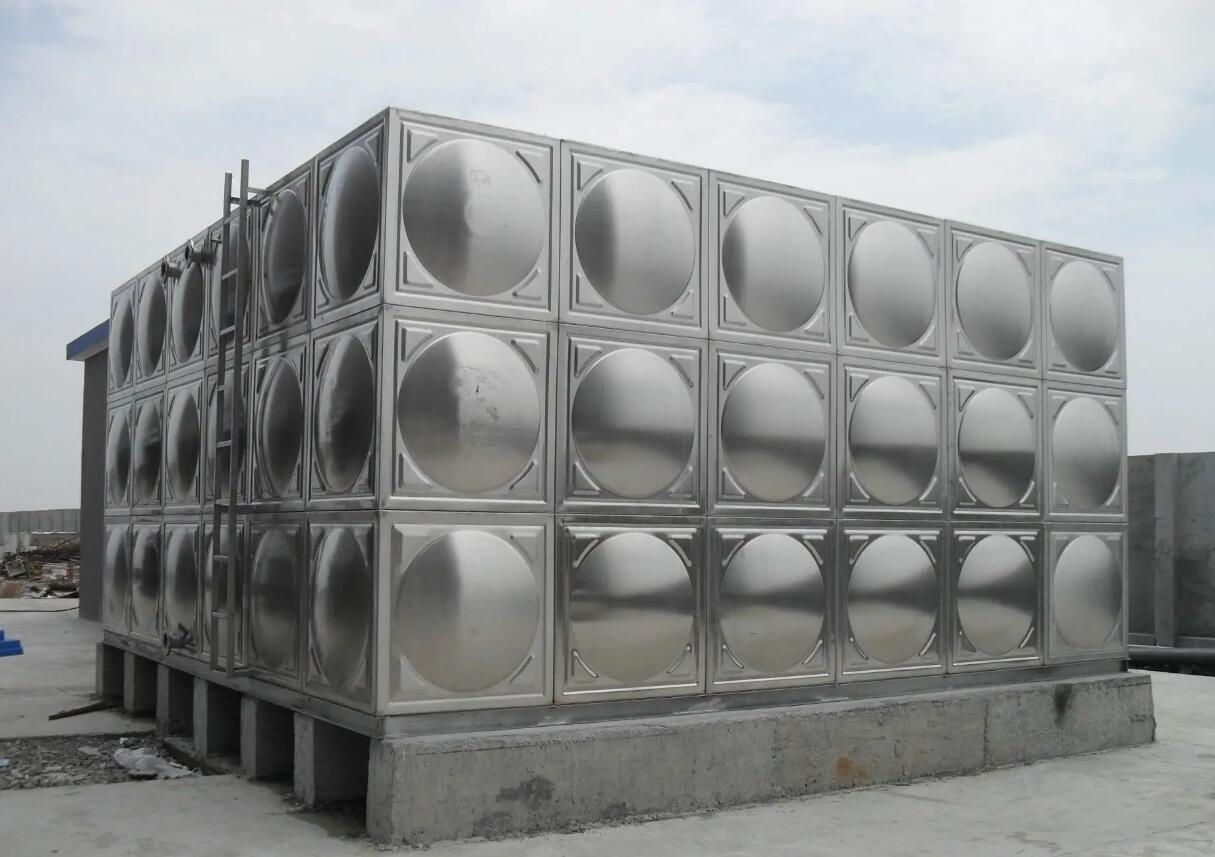
An original stainless steel tank failed due to chloride pitting corrosion. It was replaced with a 20m³ SMC tank from Beijing Yuanhui. Design pressure: 0.6 MPa; wall thickness: 10 mm; stiffener spacing: 600 mm. Field hydrostatic test: 1.0 MPa held for 30 minutes—no leakage at any joint; side panel center deflection: 0.3 mm. After 18 months of operation, deflection remained stable at 0.4 mm, and water samples showed zero iron ions.
Conclusion
The pressure performance of FRP water tanks is a coupled outcome of material, structure, and process. When selecting a tank, verify SMC panel flexural modulus (≥12 GPa) and cure degree (≥95%), and require third-party fatigue test reports from the supplier. Practice at Beijing Yuanhui FRP Co., Ltd. demonstrates that strict adherence to GB/T 21238 testing standards can extend design life from 10 to over 15 years.