FRP Water Tank Modular Assembly: From Standard Panels to Fully Sealed Structures
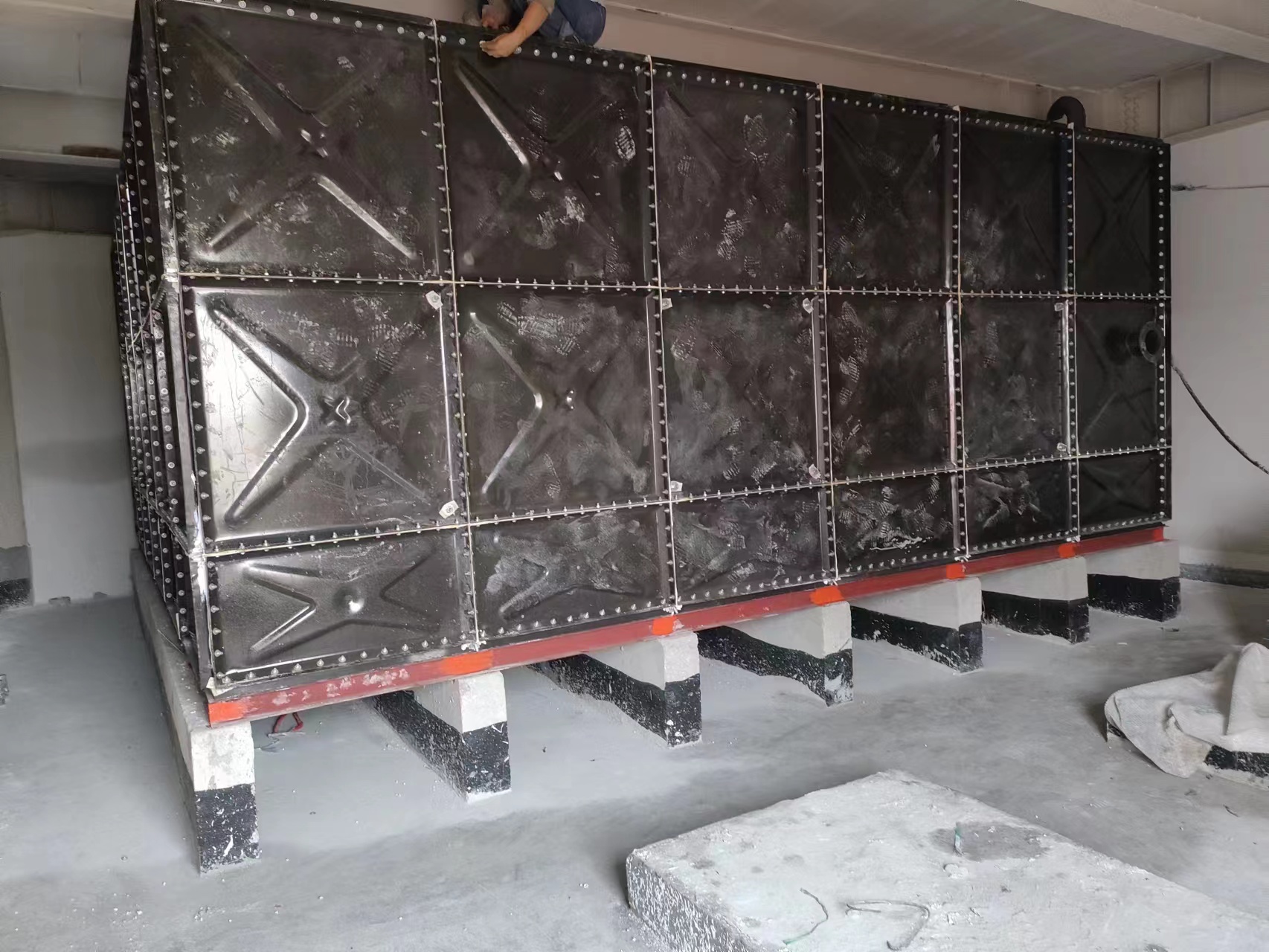
Introduction: Why Modular Assembly Dominates FRP Tank Construction
Modular assembly of FRP (Fiberglass Reinforced Plastic) water tanks breaks down a large storage vessel into standardized SMC (Sheet Molding Compound) panels, which are bolted and sealed on-site. This method eliminates the transport constraints of monolithic tanks and the long curing times of concrete structures. Beijing Yuanhui FRP Co., Ltd. has delivered over 300 modular tanks in North China, with the largest single unit reaching 800 m³. Standard panels measure 1000×1000 mm or 1000×500 mm, weighing 12-25 kg each—manageable by two workers.
This article covers panel production, sealing systems, on-site assembly, and quality control.
1. SMC Molded Panels: The Foundation of Modular Assembly
1.1 Material Composition and Mechanical Properties
Typical SMC formulation includes 28-35% unsaturated polyester resin, 25-30% glass fiber, 35-40% calcium carbonate filler, plus curing agents and mold release. After high-pressure molding at 140-150°C with 4-6 minutes hold time, panels achieve Barcol hardness ≥45, flexural strength ≥120 MPa, and water absorption ≤0.5% (24h). Beijing Yuanhui uses 2,500-ton presses to maintain thickness tolerance within ±0.3 mm.
1.2 Standard Panel Geometry and Connection
Common panel size is 1000×1000×δ (δ = 5, 8, 10, or 12 mm). Each panel has a 40-50 mm wide flange with bolt holes spaced at 200 or 250 mm. The backside features a grid of reinforcing ribs (8-15 mm high, 150-200 mm spacing). A 10 mm thick panel can withstand 8 kN/m², sufficient for tanks up to 8 m in height.
2. Sealing System: The Decisive Factor for Longevity
2.1 Dual-Seal Design
Beijing Yuanhui employs an inner food-grade silicone gasket (Shore A 40±5, Ω-shaped) fitted into a groove on the panel flange, plus an outer EPDM gasket (3 mm thick) covering the bolt holes. The system passed a 30 kPa hydrostatic test (equivalent to 3 m water head) with zero leakage.
2.2 Bolt Torque Control
M12 stainless steel bolts (304 or 316) are tightened to 40-60 N·m using digital torque wrenches. The process is done in two passes: initial tightening to 30 N·m, final to 50 N·m, following a diagonal sequence to prevent flange distortion.
3. On-Site Assembly: From Base to Roof
3.1 Foundation Preparation and Base Panel Installation
The concrete foundation must be C25 or higher, with flatness deviation ≤5 mm over 2 m. A 10-20 mm rubber cushion pad is laid before base panels. Neutral silicone sealant (2 mm thick) is applied between flanges before placing the gasket.
3.2 Wall and Roof Assembly
Wall panels are stacked layer by layer, completing one full ring before starting the next. Corner joints use prefabricated L-shaped or T-shaped connectors. A 60 m³ tank (6×4×2.5 m) typically requires 3-4 working days for on-site assembly, compared to 15-20 days for a concrete tank.
3.3 Reinforcement for Tall Tanks
Tanks exceeding 3 m in height require internal tie rods (stainless steel or FRP strips). In a 5 m tall Beijing Yuanhui project, two circumferential tie rings were installed at 2.5 m and 4 m heights. Full-load testing showed sidewall deflection of only 2.3 mm, well below the industry standard of 5 mm.
4. Quality Control and Acceptance
4.1 Visual and Dimensional Checks
After assembly, all bolts are verified for torque, flange gaps must be ≤1 mm, and sealant must be free of bubbles. Overall verticality deviation must not exceed H/1000 (H = tank height).
4.2 Hydrostatic Test
The tank is filled to the design water level and left for 24 hours. No leakage is allowed at any joint, bolt hole, or manhole edge. Beijing Yuanhui's first-pass pass rate exceeds 98%. Leaks, if any, occur mostly at corner joints or gasket overlaps and are easily repaired with field-applied sealant.
Conclusion
FRP water tank modular assembly, with standardized panels, dual-seal technology, controlled bolt torque, and rigorous site procedures, delivers efficient deployment and long-term reliability. The technology is mature for tanks ranging from a few tons to over 1,000 tons. For buyers, selecting a supplier with in-house SMC molding and a complete QC process—such as Beijing Yuanhui FRP Co., Ltd.—matters more than comparing panel prices alone. Future developments include larger panel sizes, higher pressure ratings, and smart connection systems.