FRP Water Tank Modular Assembly: From Panels to Finished Product
Introduction
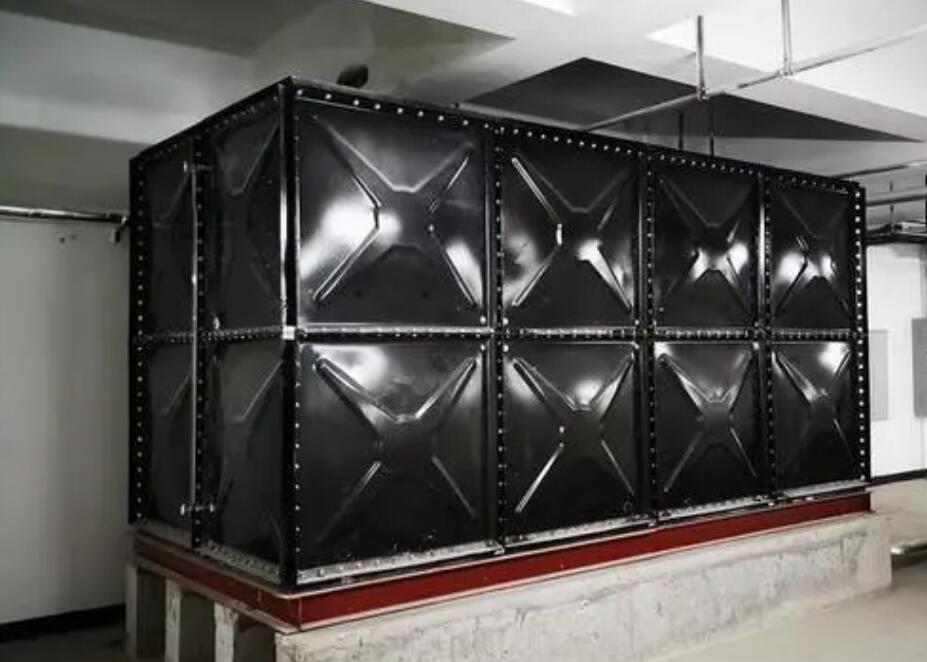
FRP (Fiberglass Reinforced Plastic) water tanks are widely used in construction, municipal water supply, fire protection, and industrial storage due to their corrosion resistance, light weight, and long service life. The modular assembly process is the core manufacturing technique, breaking down large tanks into standardized panels for on-site assembly. This solves transportation and installation challenges. Beijing Yuanhui FRP Co., Ltd. has accumulated extensive experience in this field over the past decade. This article covers raw materials, panel prefabrication, sealing, support structures, and field installation.
1. Raw Materials and Panel Prefabrication
The foundation of modular assembly lies in panel quality. Panels are made from SMC (Sheet Molding Compound) or hand lay-up using isophthalic unsaturated polyester resin, with glass fiber content controlled at 30%–35% for balanced strength and weatherability. Beijing Yuanhui produces standard panel thicknesses of 4mm, 6mm, and 8mm for tanks up to 10 tons, 10–50 tons, and above 50 tons, respectively. Flexural strength exceeds 140 MPa at room temperature, with Barcol hardness ≥40.
Panel dimensions are typically 1m × 1m or 1m × 2m. Each panel has flanged edges with pre-drilled bolt holes (12mm diameter, 150mm spacing). A gel coat layer (0.3–0.5mm) protects against UV and chemical attack. Every panel undergoes a 24-hour hydrostatic test at 0.2 MPa before leaving the factory.
2. Sealing and Connection System
The key to modular assembly is reliable sealing between panels. Beijing Yuanhui uses EPDM rubber gaskets with an Ω-shaped cross-section, achieving 25%–30% compression. The gaskets remain elastic from -40°C to 120°C. Connection bolts are 304 stainless steel, M10 size, with nylon lock washers to prevent loosening from vibration.
During assembly, flanges are aligned with the gasket in between. Bolts are tightened diagonally in sequence using a torque wrench set to 25–30 N·m. Excessive torque can deform or crack flanges; insufficient torque causes leaks. Each seam is tested with 0.05 MPa air pressure after installation—any leak requires gasket adjustment or bolt replacement.
3. Support Structure and Reinforcement
Internal bracing is required for tanks over 2 meters in height. Beijing Yuanhui specifies a horizontal reinforcing ring every 1.5 meters, made from FRP profiles (50mm × 50mm × 5mm), bonded to the inner wall with structural adhesive. The base frame uses stainless steel channel beams—8# for 10–30 ton tanks, 10# for 30–80 ton tanks, and 12# for tanks above 80 tons.
The tank top includes a 600mm manhole with double-seal cover and a DN50 vent. In cold climates, Beijing Yuanhui recommends 50mm polyurethane insulation wrapped in 0.5mm color-coated steel sheet to prevent freezing.
4. Field Installation Procedure
Typical installation steps:
Step 1 – Foundation inspection. Concrete base flatness ≤3mm/m², anchor bolt spacing deviation ≤5mm. Curing time ≥14 days, strength ≥C25.
Step 2 – Base panel assembly. Lay a 10mm EPDM sealing mat, then assemble base panels from one corner. Bolts are left loose for adjustment.
Step 3 – Side and top panels. Install side panels layer by layer (1m or 2m height per layer), with flanged connections. Add internal reinforcing rings after side panels are complete, then install the top panels.
Step 4 – Accessories. Install level gauge, overflow pipe, drain pipe, and inlet/outlet flanges. All pipe connections must be flexible to accommodate tank settlement.
Step 5 – Full water test. Fill to design level and hold for 72 hours. Water level drop ≤0.1% of total volume is acceptable.
Conclusion
FRP water tank modular assembly—through standardized panels, systematic sealing, and rational reinforcement—enables efficient factory-to-field conversion. Beijing Yuanhui FRP Co., Ltd.'s track record shows this method reduces installation time by 40%–50% while delivering a service life exceeding 15 years. For projects requiring long-distance transport or constrained installation space, modular assembly is often the only viable solution. Future advancements in SMC materials and connector standardization will further extend this technology to larger tanks and more demanding applications.