Pressure Performance of FRP Water Tanks: Testing Standards and Engineering Practice
Introduction
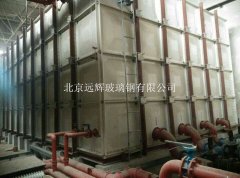
FRP water tanks are widely used in fire protection, industrial cooling, and domestic water supply. Their pressure-bearing capacity directly affects system safety and service life. Unlike steel tanks, the laminated structure of fiberglass reinforced plastic (FRP) exhibits anisotropic behavior under internal pressure, making failure modes more complex. Beijing Yuanhui FRP Co., Ltd., with over a decade of manufacturing experience, has identified that many field failures stem from misjudgment of pressure ratings or improper testing methods. This article dissects the core logic of FRP tank pressure performance from three angles: material mechanics, testing standards, and engineering cases.
1. Pressure-Bearing Principles of FRP Tanks
1.1 Laminated Structure Mechanics
A typical FRP tank wall consists of an inner liner (resin content ≥65% for corrosion resistance), a structural layer (continuous filament winding or hand lay-up for load bearing), and an outer protective layer. The fiber orientation relative to stress direction determines the pressure limit—0° winding layers handle hoop stress, while ±45° layers manage axial stress. Beijing Yuanhui's test data show that optimized ply design can increase hoop tensile strength from 120 MPa to 180 MPa.
1.2 Failure Mode Classification
Three main failure modes occur under pressure:
- Local bulging: caused by liner-structure debonding, typically at 0.6-0.8 MPa, often near corners;
- Fiber fracture: occurs when fibers reach ultimate strain (1.5%-2.0%), with an audible snapping sound;
- Leakage: from micro-crack propagation in resin, possible at 0.4-0.5 MPa, closely tied to curing quality.
2. Comparison of Current Testing Standards
2.1 Domestic Standards
In China, pressure testing follows JC/T 658.1-2018 (FRP Tanks Part 1: General Specifications) and GB/T 21238-2018 (Fiber-Reinforced Plastic Pressure Vessels). JC/T 658.1 requires:
- Tanks with design pressure 0.1-0.6 MPa must pass a 1.5× design pressure hydrostatic test, holding for 30 minutes without leakage;
- Burst pressure must be at least 3× design pressure.
2.2 International References
ASTM D2996 (USA) applies to filament-wound pipe pressure testing, requiring 100,000 cycles from 0 to design pressure without failure. Beijing Yuanhui references both ASTM D2996 and JC/T 658.1 for export projects, noting that domestic standards allow larger safety margins—more economical for low-cycle applications like fire water tanks.
3. Key Process Factors Affecting Pressure Performance
3.1 Degree of Cure and Post-Curing
When resin cure degree drops below 85%, the glass transition temperature (Tg) decreases by 30-40°C, drastically reducing pressure capacity under 60°C hot water. Beijing Yuanhui uses differential scanning calorimetry (DSC) to monitor cure degree and applies post-curing (80°C × 4 hours) for large tanks, raising Tg from 75°C to 105°C.
3.2 Openings and Reinforcement
Manholes and pipe connections are stress concentration points. JC/T 658.1 mandates reinforcement rings for openings >300 mm diameter. Finite element analysis shows unreinforced edges have stress concentration factors of 3.5-4.0, reduced to 1.8 with hoop winding reinforcement. In a 20 m³ fire tank project, Beijing Yuanhui added two layers of ±45° glass fabric around the manhole, increasing burst pressure from 0.9 MPa to 1.4 MPa.
4. Engineering Case Study
In 2023, Beijing Yuanhui supplied a 50 m³ FRP fire tank to a chemical plant, design pressure 0.4 MPa. The tank passed a 1.5× hydrostatic test (0.6 MPa) per JC/T 658.1 with no leakage. A sample burst test recorded 1.35 MPa (3.375× design). After 18 months of operation at up to 55°C water temperature, ultrasonic thickness measurement showed only 0.2 mm wall loss (original 8 mm).
In contrast, a competitor tank with fiber content of only 32% (standard requires ≥45%) developed local bulging at 0.5 MPa. This demonstrates that actual material composition and process control—not just design pressure—determine real-world performance.
Conclusion
FRP water tank pressure performance is a combined outcome of ply design, curing process, and testing verification. Buyers should demand burst test data and material-level test reports, not just nominal pressure ratings. Beijing Yuanhui FRP Co., Ltd. recommends continuous filament-wound tanks with ≥90% cure degree and full JC/T 658.1 compliance for design pressures ≥0.3 MPa. As fire safety regulations tighten, the safety margin is shifting from 3× to 4×—a key direction for the upcoming standard revision.