FRP Water Tank Modular Assembly Process: From SMC Molding to On-Site Installation
Introduction
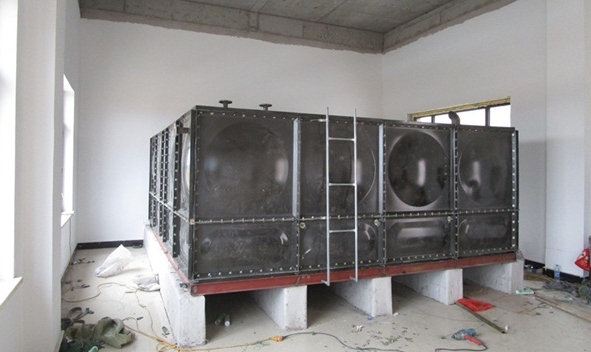
The modular assembly process for FRP water tanks centers on disassembling the tank into standardized SMC molded panels, then prefabricating and assembling them on site. Compared to welded stainless steel or concrete tanks, this method reduces installation time by over 60% and eliminates the need for heavy lifting equipment. Data from Beijing Yuanhui FRP Co., Ltd. across nearly 200 projects shows that tanks under 500 m³ are typically installed in just 4-6 working days.
1. SMC Molded Panels: The Core Modular Unit
1.1 Panel Specifications and Mechanical Properties
Standard panel sizes are 1m×1m or 1m×1.5m. Thickness varies by tank volume: 8mm for 5-10 ton tanks, up to 14-16mm for 100+ ton tanks. Beijing Yuanhui uses E-glass fiber and isophthalic unsaturated polyester resin, achieving flexural strength above 180 MPa and Barcol hardness ≥40.
1.2 Molding Process
Panels are compression-molded at 140-150°C and 15-20 MPa using 2000-ton presses, with a cycle time of 4-6 minutes per piece. The tongue-and-groove edges are held to ±0.5mm tolerance—critical for leak-proof assembly.
2. Sealing and Connection System
2.1 Dual Sealing Design
Beijing Yuanhui employs a dual-seal approach: an EPDM rubber gasket (Shore A 65±5) embedded in the groove, plus a polysulfide sealant applied during assembly. Lab tests confirm zero leakage at 0.05 MPa (5m water head).
2.2 Hardware and Bracing
Bolts (galvanized or stainless steel) are spaced at 150-200mm intervals, torqued to 80-120 N·m. For tanks over 3m tall, horizontal bracing is added every 1.5m. In a hospital project in North China, Beijing Yuanhui used hot-dip galvanized bolts with 304 stainless steel bracing—no corrosion or loosening was found after 5 years.
3. On-Site Assembly Procedure
3.1 Foundation and Base Frame
Foundation flatness must be ≤5mm per 2m, concrete grade ≥C25. The base frame uses 10# or 12# channel steel, leveled to ±3mm. A 20mm rubber pad sits between frame and foundation.
3.2 Panel Sequencing
Standard order: bottom → side walls (starting from one corner) → roof. Bolts are temporarily fastened, then tightened after each layer is aligned. Side wall verticality: ≤2mm per meter; overall diagonal deviation ≤10mm.
3.3 Accessories
After the roof, install the manhole (600mm standard), level gauge flange (DN50 or DN80), and inlet/outlet pipes as per design. Beijing Yuanhui recommends applying a sealing tape at roof-wall joints to prevent condensation ingress.
4. Quality Control and Acceptance
4.1 In-Process Inspection
3% of each SMC batch is checked for dimensions; sealing strips undergo 100% visual inspection. Level and verticality checks are performed after each layer.
4.2 Hydrostatic Test
Fill the tank to design water level and hold for 24 hours. A drop of ≤5mm is considered passing. All joints and fittings are inspected. Beijing Yuanhui’s data shows a first-pass rate of over 95%.
4.3 Application Scope
This process suits tanks up to 1,000 m³, operating at -30°C to 60°C, storing clean or domestic water. For acidic/alkaline fluids or temperatures above 60°C, special resin formulations are required.
Conclusion
The modular assembly process for FRP water tanks—built on standardized SMC panels, dual sealing, and rigorous on-site procedures—delivers an efficient, reliable storage solution. Based on Beijing Yuanhui’s track record, this method outperforms traditional alternatives in installation speed, sealing reliability, and maintenance convenience. For projects demanding both construction efficiency and long-term performance, modular FRP tanks are a proven choice.