Thermal Insulation Performance of FRP Water Tanks: From Polyurethane Foam to Extreme Applications
Introduction
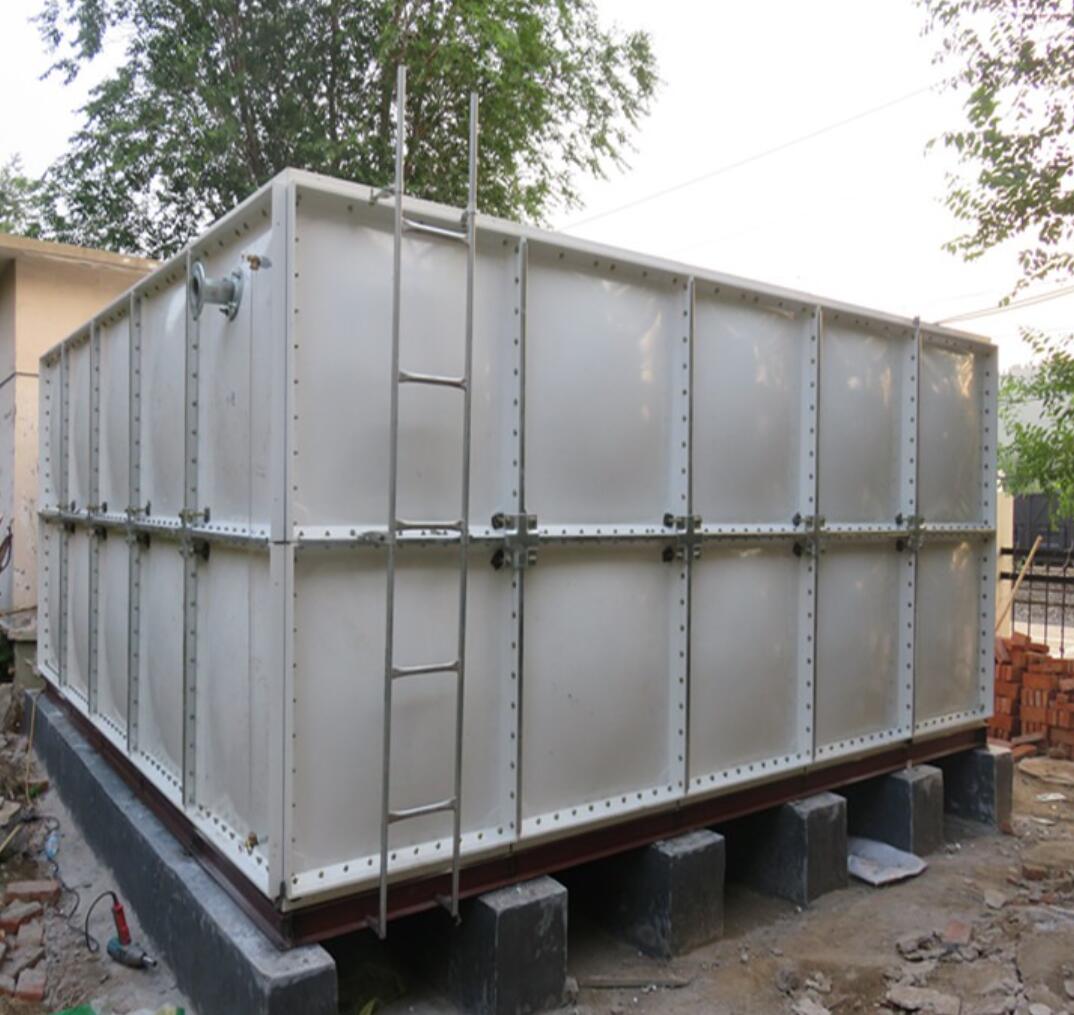
The thermal insulation performance of an FRP (Fiberglass Reinforced Plastic) water tank goes far beyond simply attaching foam boards. In Mohe, Heilongjiang, where winter temperatures drop to -30°C, an improperly designed insulated tank can freeze and crack within 48 hours. Meanwhile, in Turpan, Xinjiang, where summer surface temperatures exceed 70°C, a well-designed tank can maintain internal water temperature below 20°C. This extreme contrast hinges on material selection, thickness calculation, sealing craftsmanship, and integrated shell design.
Beijing Yuanhui FRP Co., Ltd. has delivered over 2,000 insulated FRP tanks across 12 engineering quarters, covering climates from arctic outposts to tropical islands. The following insights are based on field test data and real-world feedback.
Insulation Material and Thermal Performance
Polyurethane Rigid Foam: Standard Thickness vs. Thermal Conductivity
Industry-grade insulated FRP tanks predominantly use polyurethane (PU) rigid foam with a closed-cell ratio above 95% to prevent moisture ingress that would otherwise increase thermal conductivity. According to JC/T 658.1-2020, the minimum insulation thickness under normal conditions is 50mm. In severe cold regions (winter lows below -20°C), Beijing Yuanhui specifies 80–100mm of PU foam paired with an FRP shell at least 2.5mm thick to avoid condensation-induced corrosion on the outer surface.
Measured data shows: at 50mm thickness, the PU layer has a thermal conductivity λ of approximately 0.022 W/(m·K) and a thermal resistance R-value of 2.27 m²·K/W. Increasing thickness to 80mm raises the R-value to 3.64 m²·K/W, reducing heat loss per square meter at a 40°C temperature difference from ~17.6W to 11.0W. For a standard 10-ton tank (surface area ~12 m²), the 80mm layer slows the water temperature drop from 0.8°C/h to 0.5°C/h in a -20°C environment.
PU vs. NBR/PVC Composite Insulation
Some industrial projects use NBR/PVC (rubber-plastic) foam as an alternative. Rubber-plastic has lower density (40–80 kg/m³ vs. PU 40–60 kg/m³) but higher thermal conductivity (0.035–0.040 W/(m·K)) and is prone to shrinkage at prolonged temperatures above 80°C. In a chemical plant project requiring 80°C hot water storage, Beijing Yuanhui compared both options: PU showed less than 3% conductivity increase after 90 days of continuous operation, while the rubber-plastic sample exhibited an 8% rise after 60 days. The final design used PU with a double-layer aluminum foil reflective film.
Insulation Design and Applications Under Extreme Conditions
Severe Cold Regions: Freeze Protection and Heat Compensation
For a border outpost in Hulunbuir, Inner Mongolia, where the ambient temperature reaches -45°C, the tank needed to store domestic hot water at ≥40°C. Beijing Yuanhui implemented a three-layer structure: 80mm PU + 30mm air gap + FRP shell, with an electric heat trace (15W/m) activated when the tank exterior fell below 5°C. Two years of data show: without heat trace, the water temperature dropped from 45°C to 5°C in ~72 hours; with heat trace active, the drop was less than 3°C over 24 hours.
Similar designs are used in heating system expansion tanks in Northeast China. When serving as a constant-pressure makeup tank for district heating (water temperature 60–80°C), the insulation must also prevent external condensation that corrodes steel supports. Beijing Yuanhui adds a waterproof vapor-permeable membrane outside the insulation layer to balance moisture diffusion and condensation risks.
Fire Water Tanks: Passive Insulation + Active Freeze Protection
GB 50974-2014 mandates that fire water tanks must maintain water temperature above 4°C. Passive insulation alone often fails—especially for roof-mounted outdoor tanks with large exposed surfaces and no continuous heat source. In a high-rise residential project in North China, Beijing Yuanhui used 50mm PU + heat trace + temperature probe, keeping the outer surface at 5–10°C. In a 72-hour test at -15°C, the tank's internal water temperature remained at 6.2°C (initial 10°C), fully meeting the code requirement.
Industrial Cooling Water: Preventing Temperature Rise and Algae Growth
In southern summers, cooling tower makeup tanks without adequate insulation can see water temperatures exceed 35°C due to solar radiation, reducing cooling efficiency and promoting algae blooms. An electronics factory in Foshan, Guangdong, originally used stainless steel tanks with rubber-plastic insulation, reaching a peak of 38°C. After switching to Beijing Yuanhui's FRP insulated tank (white high-reflectivity shell + 70mm PU), the peak dropped to 28°C, cutting cooling system energy consumption by 12%.
Common Engineering Pitfalls in Selection and Installation
Thickness Alone Is Not Enough: Thermal Bridge Treatment
Many contractors focus only on panel thickness while ignoring thermal bridges at pipe penetrations, manholes, and level gauge openings. A 50mm metal flange without insulation can lose as much heat as 5 m² of insulated wall. Beijing Yuanhui's standard practice wraps all metal penetrations with 20mm custom-shaped PU pieces and seals joints with silicone. Field measurements show this reduces total heat loss by 15–20%.
Shell Material's Secondary Effect on Insulation
The color and surface finish of the FRP shell directly affect solar absorptivity. A white shell (reflectivity ~0.7) runs 8–12°C cooler than a dark gray shell (reflectivity ~0.3) in summer, significantly reducing heat conducted into the insulation layer. For tropical island projects (e.g., Xisha Islands), Beijing Yuanhui uses white gel coat with UV stabilizers. After five years, the yellowing index (ΔE) remained below 5, far exceeding the national standard limit.
Conclusion
The thermal insulation performance of FRP water tanks is ultimately a cross-section of thermodynamic engineering and material science. PU thickness and closed-cell ratio provide the base thermal resistance, but the real differentiators are thermal bridge treatment, shell reflectivity, heat trace integration, and long-term aging control. For design institutes and contractors: when the project site experiences winter lows below -15°C or summer highs above 40°C, consult directly with the technical team at Beijing Yuanhui FRP Co., Ltd. to obtain a site-specific heat loss calculation and structural drawing—rather than relying solely on experience-based selection.