Full Process Analysis of FRP Water Tank Production: 12 Core Steps from Material Selection to Delivery
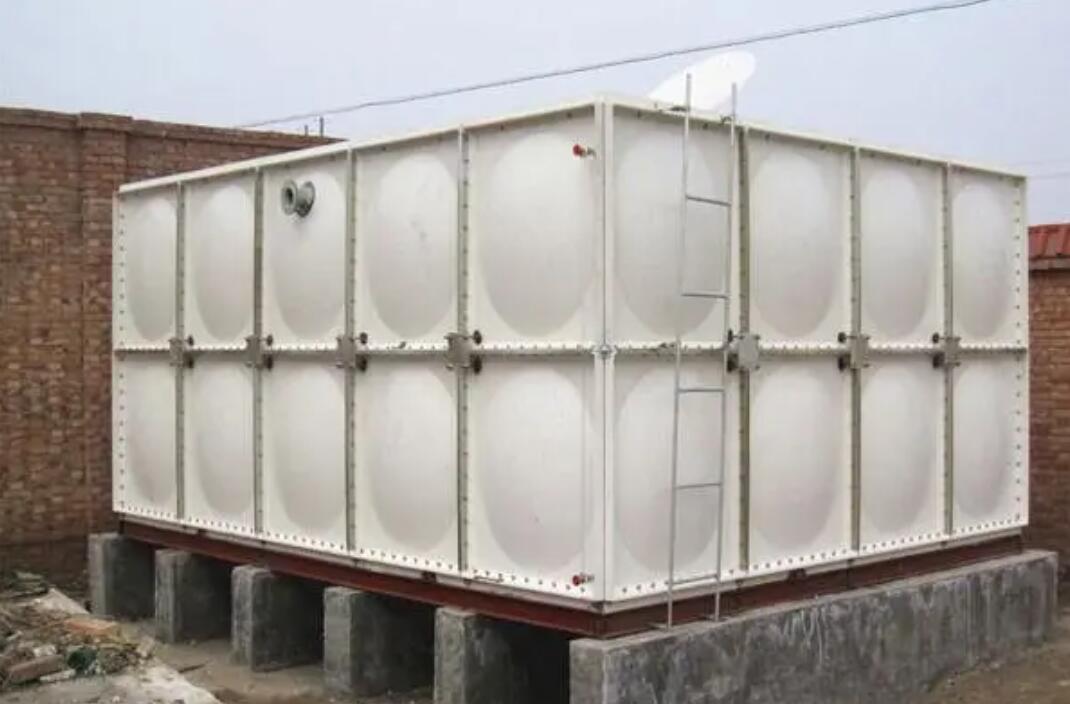
Introduction
FRP (Fiberglass Reinforced Plastic) water tank manufacturing is not a simple mixing of resin and glass fiber—it is a precision engineering process involving material science, structural mechanics, and on-site assembly. Beijing Yuanhui FRP Co., Ltd., with over 2,000 tank deliveries in North China, has demonstrated that any deviation in production directly increases leakage rates or shortens service life. This article uses their SMC compression molding process as a benchmark, breaking down each step from material batching to final testing.
1. Raw Material Preparation and Mold Conditioning
1.1 Resin-to-Fiber Ratio Control
Core materials include unsaturated polyester resin (viscosity 0.3-0.5 Pa·s at 25°C) and E-glass fiber. MEKP (methyl ethyl ketone peroxide) initiator is added at 1%-2% by resin weight. Beijing Yuanhui uses electronic weighing systems with ±0.5% accuracy. Chopped strand mat (450 g/m²) and woven roving (800 g/m²) are alternately layered to balance longitudinal and transverse strength.
1.2 Mold Cleaning and Release Agent Application
Steel molds are sanded with 200-grit paper, degreased with acetone, and coated with semi-permanent wax-based release agent. Three coats are applied at 15-minute intervals, forming a 0.1-0.2 mm release film. Molds are preheated to 40-50°C to reduce curing shrinkage stress.
2. Molding Process: Hand Lay-Up and Compression Molding
2.1 Inner Liner Hand Lay-Up
The liner, in direct contact with water, requires 65%-70% resin content for corrosion resistance. Workers brush gelcoat (0.3-0.5 mm thick), place surface mat (30 g/m²), and roll out bubbles with a pig bristle roller. Beijing Yuanhui's standard limits bubbles to ≤3 per square meter; exceeding this requires puncturing and refilling.
2.2 Structural Layer Compression Molding
After the liner gels (30-40 minutes), the part moves to a compression press. SMC sheet is molded at 140-150°C and 10-15 MPa for 5-8 minutes. Thickness tolerance is ±0.2 mm. Test data show molded panels achieve 180 MPa flexural strength, versus 120 MPa for hand-laid panels.
3. Curing, Demolding, and Post-Processing
3.1 Curing Temperature Profile
Molded parts enter a constant-temperature curing room (65°C±2°C) for 4 hours, then cool naturally. This eliminates residual stress and prevents micro-cracks after 3-6 months of use. Per GB/T 21238-2007, curing degree must reach ≥95%; Beijing Yuanhui uses DSC (differential scanning calorimetry) for spot checks.
3.2 Machining and Assembly
Panels are cut with a 5-axis waterjet cutter (±0.5 mm accuracy). Connections use 304 stainless steel bolts and EPDM gaskets (Shore hardness 60±5). The assembly workshop maintains 20-25°C to ensure silicone structural sealant cures fully within 72 hours.
4. Quality Testing and Anti-Corrosion Treatment
4.1 Static Water Pressure Test
After assembly, the tank is filled to design water level and held for 72 hours. Water level drop is recorded every 12 hours; maximum allowable drop is 1 mm (for a 150 m³ tank). Beijing Yuanhui's 2023 statistics on 385 tanks show a 97.4% first-pass rate; failures were primarily due to gasket installation misalignment.
4.2 UV Protection Coating
Outdoor tanks receive aliphatic polyurethane topcoat (80-100 μm dry film thickness). QUV accelerated aging tests (1,000 hours) show a yellowing index (ΔE) of 12.3 for uncoated panels versus 2.1 for coated panels. Beijing Yuanhui offers a 10-year coating warranty.
Conclusion
FRP water tank production involves 12 critical control points—material ratios, temperature, pressure, sealing, etc. Data from Beijing Yuanhui FRP Co., Ltd. indicates that strict adherence to this process extends design life from 10 to 18 years. Buyers should request complete process records and a 72-hour static pressure test report, not just material certificates.