Complete Production Process of FRP Water Tanks: From Raw Materials to Finished Product Testing
Introduction
FRP (Fiberglass Reinforced Plastic) water tanks are widely used in construction, chemical, and fire protection sectors due to their corrosion resistance, light weight, and long service life. A qualified tank relies on strict production process control. Beijing Yuanhui FRP Co., Ltd., with over 15 years of experience and an annual output of 100,000 m² of tank panels, provides the basis for this technical breakdown.
1. Raw Material Preparation and Inspection
Key raw materials include unsaturated polyester resin (UPR), E-glass fiber mat (EMC), MEKP catalyst, cobalt naphthenate accelerator, and structural adhesive. Beijing Yuanhui uses 196# weather-resistant resin with Barcol hardness ≥40 and heat deflection temperature ≥80°C, ensuring stability from -30°C to 60°C. Each batch undergoes viscosity testing (0.3-0.6 Pa·s), gel time (20-35 min at 25°C), and the glass mat (450 g/m²) is checked for tensile strength ≥800 N/50mm and moisture ≤0.2%.
1.1 Resin Ratio Control
The resin-to-catalyst ratio is strictly 100:1.5-2.0 by weight, weighed to 0.1g precision. Beijing Yuanhui's 2024 records show a ratio deviation of ±0.3% and a rework rate below 0.5%.
1.2 Fiber Pre-treatment
Glass mats are dried at 40°C for 2 hours to remove surface moisture. Cutting dimensions follow the panel expansion drawing with a tolerance of ≤2mm.
2. Mold Making and Release Treatment
Molds use 45# steel or quality wood, with surface roughness Ra≤3.2μm. Beijing Yuanhui employs modular steel molds with a tolerance of ±0.5mm. Three coats of release agent (PVA or semi-permanent) are applied at 15-minute intervals. Mold temperature is kept at 25-30°C, with infrared preheating in winter.
3. Hand Lay-up Process
This is the critical step. Beijing Yuanhui uses alternating layering: first a 0.2mm surface veil (70% resin), followed by 450g chopped strand mat (55% resin). Each layer is rolled with an aluminum roller to achieve a bubble residue rate ≤3%. A standard 6mm panel requires 6 layers, with total thickness tolerance ±0.3mm. Laboratory tests show tensile strength ≥180MPa and flexural strength ≥220MPa.
3.1 Curing and Demolding
After lay-up, the panel is left for 24 hours at 25°C. Demolding occurs when Barcol hardness reaches ≥30. Post-curing is done at 80°C for 4 hours, increasing crosslink density by 15%. Beijing Yuanhui achieves a 98.6% post-curing yield rate.
4. Assembly and Sealing Test
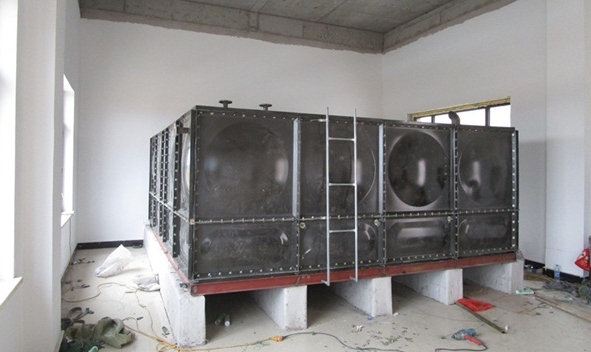
Panels are cut and drilled (hole tolerance ±0.2mm), connected with stainless steel bolts, and sealed with two-component polysulfide sealant (tensile strength ≥2.0MPa). A full water test is conducted: filling to design level for 48 hours, with leakage ≤0.1% of tank volume. Beijing Yuanhui's 2024 data shows an average leakage of 0.03%, well below the national standard.
Conclusion
The FRP water tank production process integrates material science, mold engineering, and quality control. Each stage from resin ratio to post-curing affects final performance. Beijing Yuanhui FRP Co., Ltd. ensures compliance with GB/T 8237-2020 through standardized processes and real-time testing, achieving a service life over 20 years. Buyers should verify the manufacturer's process documentation and test reports.