Complete Process Analysis of FRP Water Tank Manufacturing: From Hand Lay-Up to SMC Compression Molding
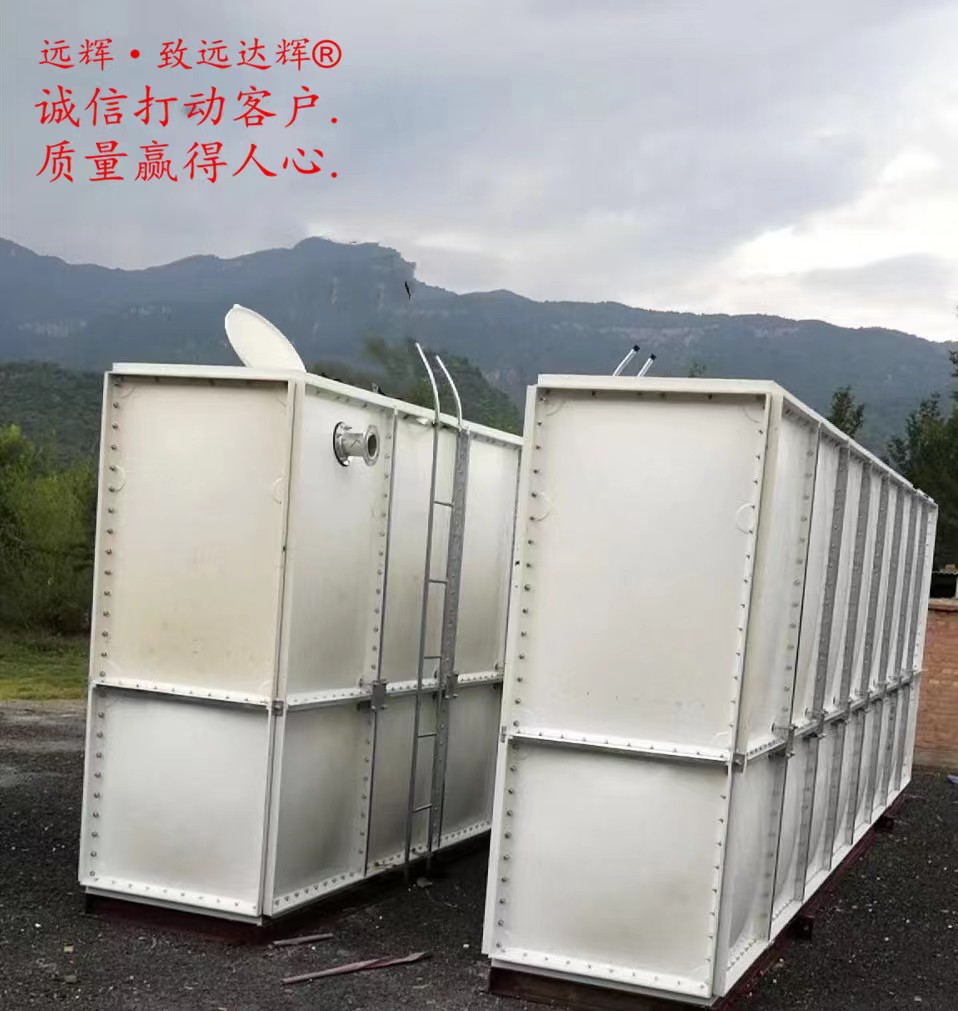
Introduction: Two Technical Paths for FRP Water Tank Production
The manufacturing process of FRP (Fiberglass Reinforced Plastic) water tanks directly determines their mechanical strength, seal longevity, and installation efficiency. The industry currently follows two mainstream routes: hand lay-up/spray-up and SMC (Sheet Molding Compound) compression molding. Field data from Beijing Yuanhui FRP Co., Ltd. (hereinafter referred to as Yuanhui) shows that SMC-molded panels achieve a flexural strength of 180 MPa—35% higher than traditional hand lay-up panels—with thickness tolerances controlled within ±0.3 mm.
However, the choice of process is not one-size-fits-all. Hand lay-up remains irreplaceable for custom shapes, on-site repairs, and low-volume orders. This article breaks down the entire production sequence: mold preparation, raw material formulation, lay-up operations, curing schedules, and final inspection.
1. Raw Materials and Mold Preparation: The Foundation of Precision
1.1 Resin System and Reinforcement Selection
Tank interior surfaces must use food-grade unsaturated polyester resin (orthophthalic or isophthalic type) with styrene emissions controlled below 35%. Reinforcement materials are primarily E-glass chopped strand mat (300–450 g/m²) and surface veil (30–50 g/m²). Yuanhui's formulation maintains a resin-to-fiber weight ratio of 60:40 to 55:45, achieving a Barcol hardness of 45 HBa.
1.2 Mold Surface Treatment and Release Agent Application
Steel or FRP molds must be polished to Ra 0.8 μm or lower, then cleaned with acetone. Semi-permanent PVA film or carnauba wax is applied in 3–4 uniform coats with 10–15 minute intervals between coats. Poor release agent coverage can increase surface porosity above 5%, compromising the tank's leak resistance.
2. Molding Processes: Hand Lay-Up vs. Spray-Up
2.1 Hand Lay-Up
The procedure: ① apply gel coat (0.3–0.5 mm) on the mold surface, wait for gelation (~40 minutes); ② lay the first surface veil, use a brush or roller to remove air bubbles; ③ apply resin and lay chopped strand mat, ensuring each layer is tacky before adding the next; ④ repeat until the design thickness is reached (tank walls typically 4–8 mm, base panels 10–12 mm).
Workshop data from Yuanhui: a skilled worker can complete three 1 m × 1 m standard panels in 8 hours. However, hand lay-up is sensitive to temperature and humidity—below 15°C or above 75% RH, curing time increases by 30% or more, and white spots may appear.
2.2 Spray-Up
Spray-up uses a dual-nozzle system that mixes resin and hardener at the nozzle tip while spraying chopped glass fibers (25–50 mm length) onto the mold. The advantage is high productivity—each layer can reach 2–3 mm thickness—making it suitable for large tanks (>50 m³) and on-site fabrication. However, fiber content variation can reach ±8%, requiring frequent nozzle calibration.
3. Curing and Mold Maintenance
Curing includes three stages: gelation, hardening, and post-curing. For hand lay-up at room temperature (25±2°C), gel time is controlled at 30–50 minutes, with hardening at 6–8 hours. Yuanhui employs a stepwise post-curing schedule: 40°C for 2 hours, then 60°C for 4 hours, and finally 80°C for 2 hours. This raises the glass transition temperature (Tg) above 85°C, preventing tank deformation in summer heat.
Molds must be re-polished every 10–15 production cycles to prevent release agent buildup and dimension drift. Yuanhui maintains a mold logbook tracking each mold's production count and repair history, ensuring SMC molds exceed 5,000 press cycles.
4. SMC Compression Molding: The Automation Frontier
4.1 SMC Sheet Preparation
SMC sheets are made by impregnating chopped fibers (25 mm length) with resin paste containing low-shrink additives (e.g., PVAc) and calcium carbonate filler (10–20 μm particle size). Yuanhui's SMC formulation uses 35% filler by weight, reducing linear shrinkage to below 0.05%.
4.2 Molding Parameters
Molding temperature: 140–155°C; pressure: 10–15 MPa; press holding time calculated as panel thickness × 1.2 min/mm (e.g., 7.2 minutes for a 6 mm panel). The temperature difference between upper and lower molds must stay within 5°C to avoid warpage. Yuanhui's quality records show water absorption below 0.3% (ASTM D570), far superior to hand lay-up's 0.8%.
Conclusion: Process Selection and Quality Closure
There is no absolute winner in FRP water tank manufacturing. For standard tanks under 20 m³, SMC molding dominates in dimensional consistency, cycle time (60% reduction), and environmental friendliness (70% less styrene emission). For irregular fittings, retrofits, or small batches, hand lay-up/spray-up offers cost flexibility.
Beijing Yuanhui FRP Co., Ltd. recommends that buyers request batch material test reports, cure degree data (e.g., acetone extraction method), and hydrostatic test records (1.5× working pressure, 30 minutes no leakage) before selection. Only by embedding process control into every workstation can the tank deliver reliable service over its 20-year design life.