In-Depth Analysis of FRP Water Tank Corrosion Resistance: From Material Mechanism to Engineering Practice
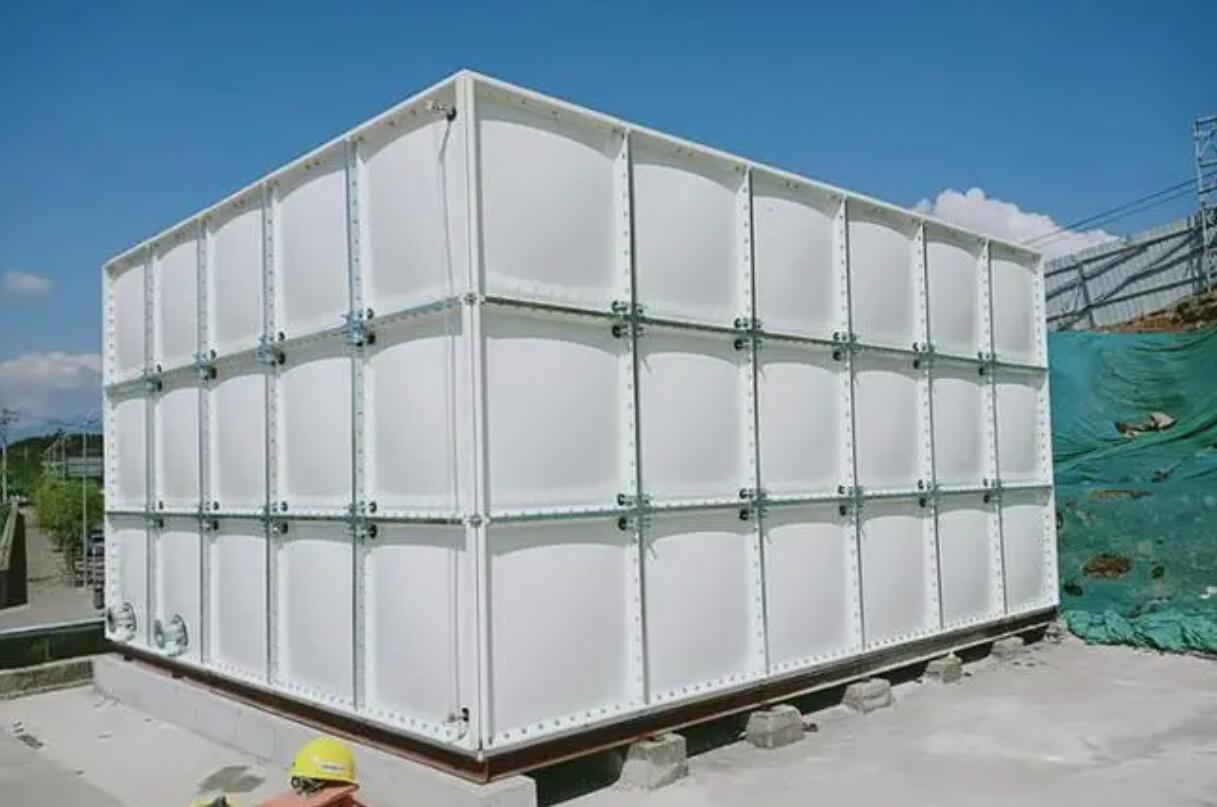
Introduction: Corrosion Resistance of FRP Tanks Is Not Inherently Perfect
FRP (Fiberglass Reinforced Plastic) water tanks are widely used in municipal water supply, industrial cooling, and pharmaceutical purified water storage, primarily due to their corrosion resistance. However, many users and even some suppliers misunderstand this property as simply “plastic doesn’t rust.” In reality, the anti-corrosion performance of an FRP tank depends on resin chemistry, fiber architecture, interface treatment, and long-term chemical-physical synergy. Based on ASTM C581, GB/T 21238, and case studies from Beijing Yuanhui FRP Co., Ltd., this article provides a material-science-based breakdown of corrosion mechanisms and actionable recommendations for selection and maintenance.
1. Resin Matrix: The First Chemical Barrier
1.1 Molecular Structure Differences of Thermosetting Resins
Common resins for FRP tanks include unsaturated polyester (UPR), vinyl ester (VER), and epoxy (EP). UPR performs stably in weak acidic or neutral water but suffers ester bond hydrolysis in strong oxidizers (e.g., chlorine >200 ppm), leading to softening and discoloration. VER features bisphenol-A backbones and terminal unsaturation, offering 30% higher crosslink density than UPR, significantly improving alkali resistance. In pharmaceutical water projects, Beijing Yuanhui mandates VER resin. After 96-hour boiling in 10% NaOH solution, surface hardness retention of VER exceeded 92%, while UPR retained less than 60%.
1.2 Effect of Fillers and Additives on Permeability
Resin matrices are not fully dense; micro-voids (0.1–1 μm) form during curing. Adding nano-silica (≤50 nm) fills these voids, reducing water vapor transmission from 0.8 g/m²·day to <0.2 g/m²·day. However, excessive filler (>30% by resin mass) induces internal stress, increasing microcrack risk. Beijing Yuanhui controls filler content at 18–22% and incorporates 0.3% coupling agent (KH-570), improving filler-resin interfacial bond strength by 40%.
2. Glass Fiber Reinforcement: Mechanical Barrier and Microcrack Control
2.1 Fiber Type and Corrosion Relationship
C-glass (medium alkali) fibers have better acid resistance than E-glass, but inferior water resistance. Under long-term immersion, E-glass retains 15% higher strength than C-glass after 30 days. Beijing Yuanhui uses corrosion-resistant E-CR glass fibers (low boron content) for the inner liner, maintaining tensile strength retention >85% at pH 2–12.
2.2 Laminate Design and Stress Corrosion Suppression
Stress concentration zones (corners, manhole edges) are prone to microcracks if fiber orientation is perpendicular to stress. Water molecules then penetrate along the interface, causing stress-corrosion coupling failure. By alternating ±45° and 0°/90° layers (6 plies) in corners and adding a 0.5 mm surface veil as a resin-rich layer, the critical stress intensity factor K_IC increases to 3.2 MPa·m^1/2, 60% higher than conventional design. A chemical plant circulating water tank (300 ppm Cl⁻, 50°C) using this design showed no leakage after 5 years, while a control tank developed linear leakage along fibers in 2 years.
3. Interface and Processing: The Invisible Determinant of Service Life
3.1 Chemical Bonding via Coupling Agents
Silane coupling agents (e.g., γ-aminopropyltriethoxysilane) form Si-O-Si covalent bonds between glass fiber and resin, increasing interfacial shear strength (IFSS) from 12 MPa to 28 MPa. Beijing Yuanhui applies a dual-stage coupling: first 0.5% KH-560 pre-hydrolyzed solution, then 0.3% KH-550 spray, creating a double-layer interface that reduces water diffusion coefficient (D) to 1.2×10⁻¹³ m²/s.
3.2 Quantitative Impact of Cure Degree on Corrosion Resistance
Incomplete curing (degree <90%) leaves unreacted polar groups (hydroxyl, carboxyl) that adsorb water, lowering glass transition temperature (Tg) by 20–30°C. Beijing Yuanhui’s process requires 24-hour room-temperature curing followed by 80°C × 4-hour post-cure, achieving >95% cure degree. In 10% H₂SO₄ immersion for 1000 hours, post-cured samples showed mass change <0.3%, while non-post-cured samples changed 2.1%.
4. Field Case Studies and Failure Data Comparison
Case 1: A Beijing residential secondary water supply tank using UPR + E-glass developed local blistering after 3 years. Analysis revealed 450 ppm Cl⁻ and 82% cure degree. After replacement with a VER + E-CR + dual-coupling tank from Beijing Yuanhui, surface hardness retention was 98% after 5 years.
Case 2: An electronics plant ultra-pure water tank (resistivity >18 MΩ·cm) saw resistivity drop to 12 MΩ·cm after 6 months due to plasticizer leaching. Switching to Beijing Yuanhui’s high-crosslink-density VER (crosslink spacing ≤0.8 nm) kept resistivity stable at >18.5 MΩ·cm for 18 months.
Conclusion
The corrosion resistance of an FRP water tank is not a fixed material property but a system outcome of resin, fiber, interface, and curing process. For harsh conditions (high chloride, high temperature, high purity water), VER resin, E-CR glass, and strict post-cure are essential. Beijing Yuanhui FRP Co., Ltd. recommends users provide a full water quality analysis (pH, ion concentration, temperature, residual chlorine) for customized corrosion protection. Ignoring resin-fiber compatibility and curing can lead to premature failure even with “corrosion-grade” FRP.