Pressure Performance of FRP Water Tanks: Testing Standards and Engineering Applications
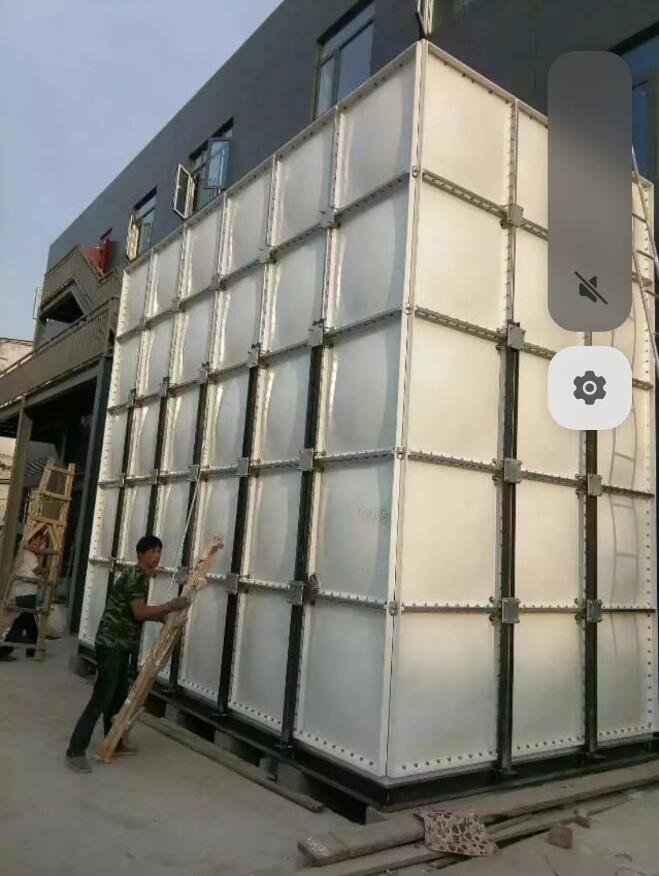
The pressure performance of FRP water tanks determines their service life and safety. Whether for secondary water supply in high-rise buildings, fire protection storage, or industrial cooling circulation, tanks must withstand hydrostatic pressure, dynamic water hammer, and thermal stresses. Failure not only causes leaks but can lead to structural collapse. Understanding pressure mechanisms and familiarizing with testing standards is essential for design, selection, and acceptance.
1. Pressure Mechanism and Key Influencing Factors
FRP tanks derive their pressure capacity from composite structure. Beijing Yuanhui FRP Co., Ltd. uses SMC molded panels with E-glass fiber (30-40% content) and unsaturated polyester resin, produced under high temperature and pressure. This creates anisotropy: tensile strength exceeds 200 MPa along fiber direction, while transverse bending strength relies on resin matrix.
Key factors affecting pressure performance:
- Panel thickness and layup: Standard SMC thicknesses are 5mm, 8mm, and 10mm. Each 1mm increase improves flexural strength by 12-15%.
- Joint design and gaskets: Bolt connection zones are stress concentrators. Beijing Yuanhui uses stainless steel bolts with EPDM gaskets, optimizing bolt spacing via FEA to reduce local stress by 20-30%.
- Stiffener layout: Side panels require one stiffener per 1.5m², reducing deflection by over 40%.
Case example: A 100m³ tank assembled from 8mm panels (Beijing Yuanhui) was tested at 1.5× design pressure (0.15 MPa). Deflection was only 1/300 of panel span, well below the 1/200 limit per GB/T 17219.
2. Comparison of Major Testing Standards
No single global standard exists for FRP tank pressure testing, but key references include:
2.1 Chinese Standard: GB/T 17219-1998
Focuses on hygiene but indirectly covers sealing and strength. Procedure: fill tank, hold for 24h to check leakage; then pressurize to 1.5× design pressure for 30 min, inspect deformation and cracks. Beijing Yuanhui conducts hydro tests on every panel before shipping, achieving 100% pass rate.
2.2 US Standard: ASTM D3262-17
Applies to FRP tanks. Pressurize at 0.1 MPa/min to 2× design pressure, hold 1 hour, record deflection. Maximum allowed deflection is 1/200 of joint spacing.
2.3 European Standard: EN 13121-2:2003
Introduces fatigue testing: 100,000 pressure cycles (0 to design pressure), followed by static pressure test. This simulates pump start/stop impacts in real use.
Beijing Yuanhui recommends selecting standards based on application: fire tanks per ASTM D3262, domestic water tanks per GB/T 17219 plus EN 13121 fatigue requirements.
3. Testing Procedure and Data Interpretation
Beijing Yuanhui's factory QC includes three steps:
- Pre-check: Ultrasonic thickness measurement (tolerance ≤0.3mm) and tensile testing (≥180 MPa) on each SMC panel.
- Assembled static test: Fill tank, hold 24h, measure deflection with dial indicators. Then pressurize to 0.15 MPa (1.5× design), hold 30 min. Pass if deflection increase ≤10% and no leakage.
- Destructive test (sampling): 1% of panels per batch tested to ultimate pressure. Beijing Yuanhui's data shows 8mm standard panels withstand up to 0.6 MPa, safety factor = 6.
- Corner tearing: Occurs at bolt holes due to over-torquing. Prevention: use torque wrench set to 25-35 N·m and add nylon washers.
- Panel blistering: Caused by poor fiber-resin wet-out, leading to delamination under pressure. Beijing Yuanhui uses vacuum-assisted molding to keep void content below 0.5%.
- Gasket extrusion: EPDM gasket plastic flow under sustained high pressure. Solution: use gaskets with 60±5 Shore A hardness and add anti-extrusion ribs between panels.
Key interpretation point: focus on deflection rate of change, not absolute value. For a 2m×2m panel, deflection increasing from 3mm to 8mm (167% change) suggests insufficient stiffness even if absolute value is within limits, requiring additional stiffeners.
4. Common Failure Modes and Prevention
Based on Beijing Yuanhui's service records, three failure modes dominate:
Real case: In 2022, a factory fire tank leaked at corners during hydrotest. Investigation revealed bolts were not tightened in a diagonal sequence, causing uneven gasket compression. After re-assembly per standard procedure, the test passed.
Conclusion
FRP tank pressure performance is a system-level issue involving materials, structure, manufacturing, and testing. Selection should match standards to design pressure and application; installation must control torque and gasket quality; maintenance should periodically check bolt tightness and panel deformation. Beijing Yuanhui FRP Co., Ltd. implements full-process inspection for every batch, ensuring a safety factor ≥5. With advancing composite technology, higher pressure ratings and lighter tanks will become the industry trend.