In-Depth Analysis of FRP Water Tank Corrosion Resistance: A Material Science Perspective on Durability
Introduction
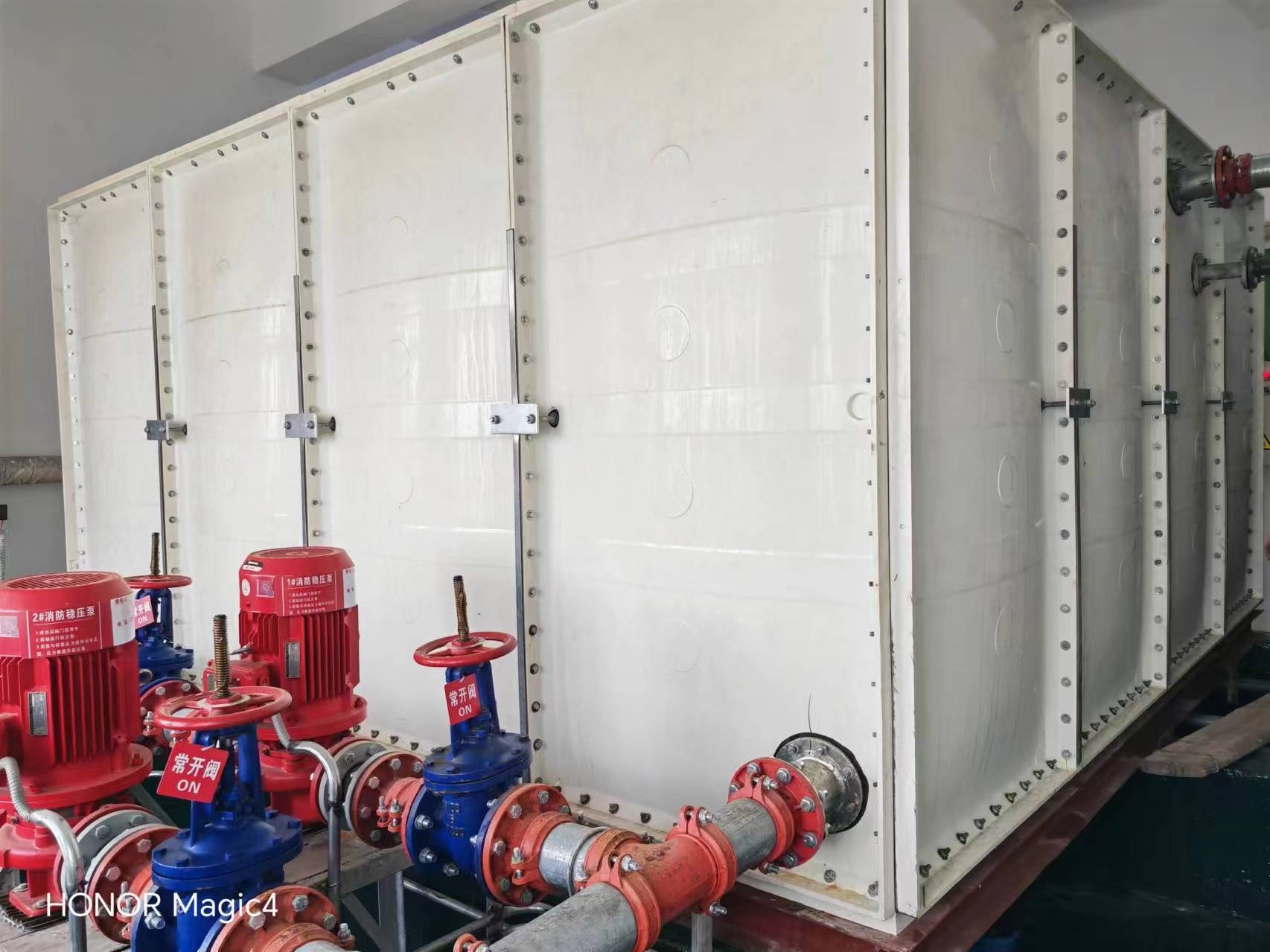
The widespread application of FRP (Fiberglass Reinforced Plastic) water tanks in industrial and municipal water storage hinges on their superior corrosion resistance. Unlike carbon steel or concrete, FRP employs a composite structure of resin matrix and reinforcing fiber to create an effective barrier against corrosive media. In a chemical plant's circulating cooling water system, an FRP tank showed only 0.2 mm wall thickness loss after 8 years, compared to 1.5 mm for carbon steel under identical conditions. This performance gap originates from precise material science principles governing corrosion resistance.
Three Pillars of FRP Tank Corrosion Resistance
1. Chemical Barrier Effect of Resin Matrix
The resin serves as the primary defense. Isophthalic unsaturated polyester resin with crosslinking density above 85% exhibits stable tolerance to media with pH values from 2 to 12. Vinyl ester resin goes further: after 1,000 hours immersion in 10% sulfuric acid at 80°C, its flexural strength retention exceeds 70%. Beijing Yuanhui FRP Co., Ltd. employs bisphenol A epoxy vinyl ester resin, achieving chloride ion permeability below 10⁻¹⁴ m²/s—one thousandth that of concrete.
2. Structural Integrity of Glass Fiber Reinforcement
Fiber content has an optimal range. When glass fiber volume fraction exceeds 65%, insufficient resin wetting creates interfacial micropores, increasing corrosive media penetration rates by 3–5 times. The optimal design window is 55%–60%, where interlaminar shear strength reaches 25–30 MPa. Combined with alkali-resistant C-glass fibers, strength degradation in pH 11 alkaline environments remains below 8% over 10 years.
3. Anti-Permeation Design of Interface Layer
Surface treatment of glass fibers with silane coupling agent (KH-570) reduces contact angle from 78° to 22°, improving interfacial bond strength by 40%. Beijing Yuanhui FRP Co., Ltd. applies a 300 g/m² polyester surface veil on the inner tank wall, creating a resin-rich layer 0.5–0.8 mm thick. This reduces water vapor transmission rate to 0.03 g/(m²·h·kPa)—60% lower than untreated surfaces.
Engineering Validation and Data Support
Corrosion Rate Comparison Under Real Conditions
In a 5-year coupon test with municipal water containing 500 mg/L chloride at pH 6.5–7.5, annual corrosion rates were: carbon steel 0.12–0.18 mm/a, 304 stainless steel 0.003–0.005 mm/a, and FRP tank inner wall below 0.001 mm/a (detection limit). This translates to a maintenance-free service life exceeding 30 years for FRP in corrosion-prone applications.
Accelerated Tests in Extreme Environments
Following ASTM C581 standard 90°C, 20% sulfuric acid accelerated test, FRP specimens retained over 65% flexural strength after 1,000 hours. Carbon steel specimens exhibited visible pitting within 72 hours under identical conditions. A case from Beijing Yuanhui FRP Co., Ltd. in a paper mill showed an FRP tank handling acidic wastewater (pH 4–5, 60–70°C) operating for 6 years without blistering, delamination, or hardness change exceeding 5 Shore D.
Influencing Factors and Engineering Countermeasures
Resin Selection and Cure Degree Control
Cure degree directly impacts corrosion life. DSC analysis shows that increasing cure degree from 92% to 98% reduces water absorption in boiling water from 0.8% to 0.3%, improving corrosion resistance by approximately 2 times. Beijing Yuanhui FRP Co., Ltd. applies post-cure at 80°C for 4 hours, achieving cure degree above 97%.
Laminate Design and Local Reinforcement
For high-risk corrosion zones like tank bottoms and weld areas, layered stacking with local thickening is employed: two extra layers of 450 g/m² chopped strand mat at the bottom, and rounded corners (R≥50 mm) to avoid stress-induced microcracks. A food plant case demonstrated bottom corrosion depth only 60% of sidewall after 8 years with this design.
Conclusion
FRP water tank corrosion resistance is a systematic outcome of resin matrix chemical inertness, fiber reinforcement structural integrity, and interface layer anti-permeation capability. Field data confirms that with proper material selection and process control, corrosion rates below 0.001 mm/a can be achieved under conventional conditions (pH 2–12, temperature ≤80°C), with design life exceeding 30 years. Beijing Yuanhui FRP Co., Ltd.'s accumulated expertise in resin formulation, cure optimization, and interface treatment ensures reliable long-term corrosion performance. For industries demanding strict water quality and equipment longevity—chemical, paper, municipal—FRP water tanks represent a cost-effective, durable solution.