Complete Guide to FRP Water Tank Modular Assembly: From SMC Molding to On-Site Installation
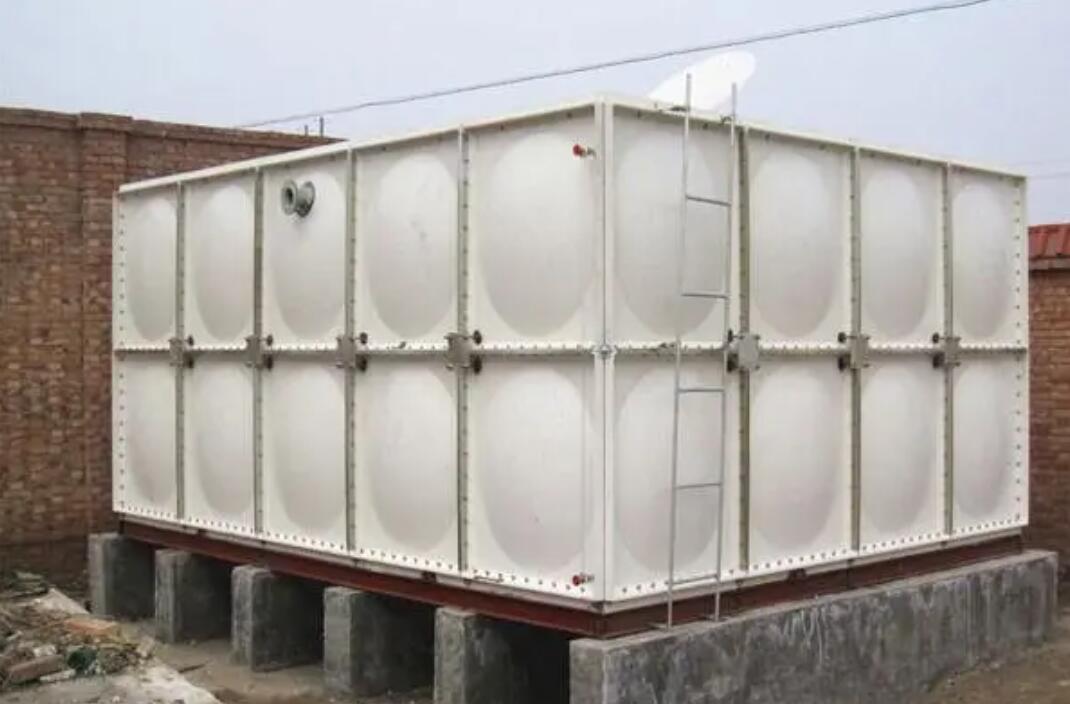
Complete Guide to FRP Water Tank Modular Assembly
FRP (Fiberglass Reinforced Plastic) water tanks have become the preferred choice for building water supply, fire protection storage, and industrial cooling due to their light weight, corrosion resistance, and rapid installation. The core technology lies in modular assembly—standardized SMC molded panels, specialized connectors, and sealing materials that allow on-site construction of tanks of any volume. This article draws on field experience from Beijing Yuanhui FRP Co., Ltd. to break down the process.
1. SMC Molded Panels: The Building Blocks
Each panel is produced via SMC (Sheet Molding Compound) compression molding. The compound—unsaturated polyester resin, glass fiber, fillers, and additives—is pressed at 120-150°C and 10-15 MPa into standard 1000×1000 mm or 1000×500 mm panels.
Thickness ranges from 4 mm to 14 mm, with 5 mm, 8 mm, and 10 mm being most common for different pressure ratings. Beijing Yuanhui's panels achieve flexural strength ≥120 MPa, Barcol hardness ≥45, and oxygen index ≥26%, compliant with GB/T 17219 for drinking water. Each panel features positioning grooves and bolt holes at 200 mm intervals for precise alignment.
2. Connectors and Sealing: Joints and Skin
2.1 Stainless Steel Connectors
304 or 316 stainless steel bolts, nuts, and corner brackets ("tension plates") join the panels. Corner brackets are hot-dip galvanized or stainless steel, thickness ≥3 mm. Standard tie-bar spacing: tanks ≤2 m height require 2 layers, 2-3 m require 3 layers, 3-4 m require 4 layers, with vertical spacing ≤1 m.
Bolt torque is controlled at 25-35 N·m. Beijing Yuanhui uses torque wrenches to check every bolt, preventing stress concentration or leakage.
2.2 EPDM Gaskets and Silicone Sealant
Ω-profile EPDM rubber gaskets sit inside the panel grooves, achieving 30-40% compression after bolting. Corners use pre-molded silicone pads with neutral silicone sealant. The system withstands 0.05 MPa (5 m water column) with leakage below 0.01%.
3. On-Site Assembly Workflow
3.1 Foundation Check
The concrete base must have flatness ≤5 mm/2m and load capacity ≥1.5× full tank weight. Beijing Yuanhui lays a 10 mm rubber mat to prevent hard contact.
3.2 Floor Panel Installation
Floor panels are double-lap jointed. Bolts thread from bottom to top. A 1000×1000 mm panel weighs 12-18 kg, easily handled by two workers. Grounding strips are embedded with resistance ≤4 Ω.
3.3 Wall and Partition Panels
Walls are assembled layer by layer, inserting tie bars after each row. Internal partitions (support panels) are mandatory when tank length ≥4 m or height ≥2.5 m. They form a cross-braced structure, significantly boosting lateral pressure resistance.
3.4 Roof and Fittings
Roof panels are domed or flat with stiffeners, with a 600 mm access hatch. Flanges for inlet, outlet, overflow, drain, and level sensor are installed flush with panels to avoid dead zones.
3.5 Hydrostatic Test
Fill to design level, hold 24 hours. Acceptable drop ≤3 mm/24h. Beijing Yuanhui's records show a 97% first-pass rate for 1,000 m³ fire tanks.
4. Advantages and Common Pitfalls
4.1 Key Benefits
- Speed: 100 m³ tank assembled in 3-5 days, 60% faster than welded stainless steel
- Flexibility: Modules adapt to any layout, ideal for retrofit projects with narrow access
- Maintainability: Damaged panels replaced individually without tank demolition
4.2 Common Issues & Solutions
- Leakage: Caused by uneven bolt torque or aged gaskets. Use torque wrenches; store gaskets <18 months.
- Deformation: Missing partitions in tanks >3 m. Add partitions per design; for length/width >2:1, add longitudinal tie bars.
- Water contamination: Wrong sealant choice. Use food-grade silicone; Beijing Yuanhui recommends Wacker Germany series.
Conclusion
Modular assembly of FRP water tanks, based on standardized SMC panels, precision connectors, and proven field procedures, delivers a factory-prefabricated, field-assembled solution. For procurement teams, selecting an ISO 9001-certified supplier with large-tank experience—like Beijing Yuanhui FRP Co., Ltd.—is key to achieving 20+ years service life. The technology offers the best cost-performance in the 300-2,000 m³ range and has been validated in over 400 fire and potable water projects across northern China.